Request a Demo
Despite not being specified as one of the four core nutrients that must be labeled in GB 28050-2011 General Rules for Nutrition Labeling of Prepackaged Foods, dietary fiber plays an important role in human health due to its functional benefits. Consumers nowadays are more and more concerned with their intakes of dietary fiber from diverse food products. Food enterprises thus are more willing to indicate the content of dietary fiber on food labels. So how to label dietary fiber on food labels while ensuring compliance with Chinese legislations?
Things to know about dietary fiber
As per the definition specified in Fundamental Terminology and Definition of Nutritional Component in Foods, dietary fiber is a polymer of naturally occurred, extracted or synthesized carbohydrates in plants with a degree of polymerization DP≥3, which cannot be digested and absorbed by human's small intestine. Dietary fiber can be divided into soluble and insoluble dietary fiber.
Fructooligosaccharides (FOS) and Galactooligosaccharides (GOS) are two of the most common fibers that can be found at the ingredient list of prepackaged food, both of which belong to soluble fiber and can be used as food nutrition fortifier and common food raw material. Common products containing these two fibers include milk powder, infant formula, cereal-based complementary baby food, etc.
In addition, there are a few other ingredients that can provide dietary fiber, such as Isomaltooligosaccharide (IMO), Inulin, Polyfructose, Polydextrose, Oat β-glucan, Resistant Dextrin.
Compliance takeaways from dietary fiber on nutrition labels
1. General labeling requirements:
It is optional to include dietary fiber on nutrition labels.
If the product itself contains dietary fiber, based on the actual content, terms like dietary fiber, dietary fiber (soluble dietary fiber), or dietary fiber (insoluble dietary fiber) can be indicated on labels.
If additional soluble dietary fiber is added to the product, it can also be indicated in the form of dietary fiber monomer, such as dietary fiber (as Polyfructose) or dietary fiber (as Polyfructose and Inulin). In addition, the content of soluble dietary fiber monomer in the final product, instead of the added amount, should be included in the Nutrition Information.
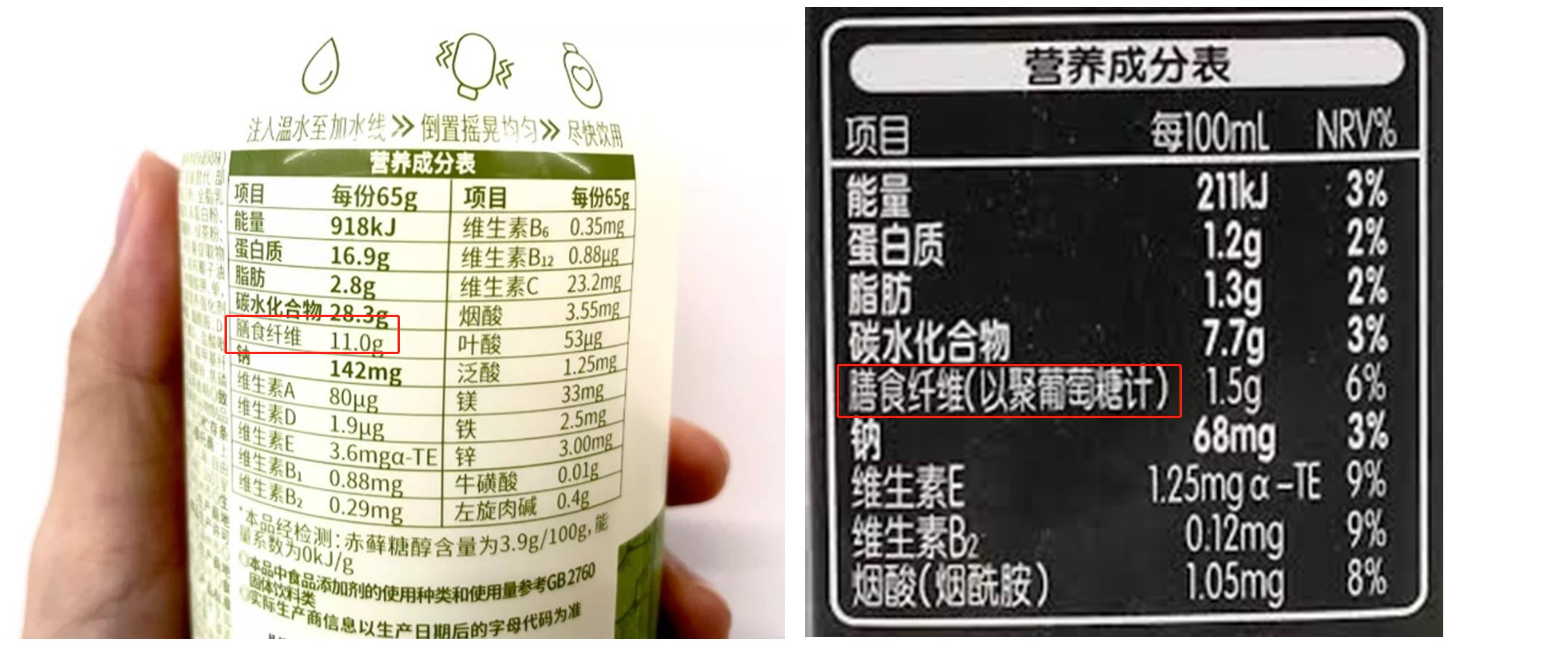
Left: Dietary fiber Right: Dietary fiber(as Polydextrose)
2. Nutritional and functional claims:
Content claim:
Content claim | Requirements | Restrictive conditions |
Source of dietary fiber or containing dietary fiber | ≥3 g/100g (solid) ≥1.5 g/100ml (liquid) or ≥1.5 g/420 kJ | Total content of dietary fiber should comply with the content requirement; or at least one of soluble dietary fiber, insoluble dietary fiber and monomer of fiber complies with the requirement. |
High or rich in dietary fiber or good source of dietary fiber | ≥6 g/100g (solid) ≥3 g/100ml (liquid) or ≥3 g/420 kJ |
Comparative claim:
Comparative claim | Requirements | Conditions |
Dietary fiber increased or reduced | The product contains 25% more or 25% less dietary fiber in comparison with referenced food | Referenced food shall be the same type or kind that consumers are familiar with. |
Function claim:
When the content of dietary fiber meets the requirements for and conditions of the content claim or comparative claim, function claims of dietary fiber can be used with descriptions as "Dietary fiber helps maintain normal function of intestines." or "Dietary fiber is a low energy substance."
3. Dietary fiber and energy
The energy conversion coefficient of dietary fiber is 8 KJ/g, including the dietary fiber contained in the product itself and the monomer components of other dietary fibers. Therefore, if dietary fiber is labeled, the energy provided by dietary fiber shall be calculated. Otherwise, it is not required to include the energy provided by dietary fiber when calculating the total energy.
 We provide full-scale global food market entry services (including product registration, ingredient review, regulatory consultation, customized training, market research, branding strategy). Please contact us to discuss how we can help you by