Request a Demo
As revealed by USDA's report[1] released on July 19, 2019, South Korea’s demand for imported organic foods is increasing. The Korean government also intends to develop a better system for management of organic food[2] before 2022. Part of these plans includes the implementation of a "pesticide-free" certification[3]" from Aug 28, 2020.
1. Terminology and Definitions
1) The term “organic” means a series of activities and processes of producing, manufacturing, processing, or handling organic food or organic processed products not intended for human consumption by using a minimum amount of permitted substances (specified in Point 3) in compliance with the certification standards.
2) The term “organic food” means any organic agro-fisheries food or organic processed food (referring to any food that is manufactured, processed, or circulated using an organic agro-fishery product as the raw material or ingredient) produced through organic methods, from among the foods listed in Framework Act on Agriculture, Rural Community, and Food Industry [4];
3) The term “permitted substance” means any substance allowed to be used throughout the process of producing, manufacturing, processing or handling organic foods, pesticide-free agro-fishery products or organic agro-fishery materials, which is prescribed by Ordinance of Ministry of Agriculture, Food and Rural Affairs[5] (MAFRA) or by Ordinance of Ministry of Oceans and Fisheries[6] (MOF).
2. Authentication of Organic Food Certificate
Competent authority
Organic food certificates are mainly granted by MAFRA (Ministry for Food, Agriculture, Forestry and Fisheries, Republic of Korea) and MOF (Ministry of Oceans and Fisheries).
Authentication standard
A requirement of the raw material, processing method, pest, and pathogenic bacteria control, disinfection, packaging, transportation, and record of processed food, etc. are prescribed. View more requirements at MAFRA[7] and MOF[8].
Application and review of organic food certificate
Enterprises engaged in food manufacturing, processing or handling (including activities like storing up, packaging, transporting, importing or selling organic products) and want to obtain the “Organic Food Certificate” shall submit following application material to institutes designated by MAFRA or MOF:
1. The manufacturing/processing/handling planning of target products
2. Documents related to business operation
3. A map marking the business site scope
4. Drawings of the operation field for manufacturing, processing or handling if the enterprise has one
Besides the document review, institutes will also conduct an onsite inspection of all organic manufacturers applying for certification. The organic food certificate is valid for a year.
Symbol of organic food certificate
The organic certification mark can be used on labels of all packages, products, advertising, etc.
Released by MAFRA | 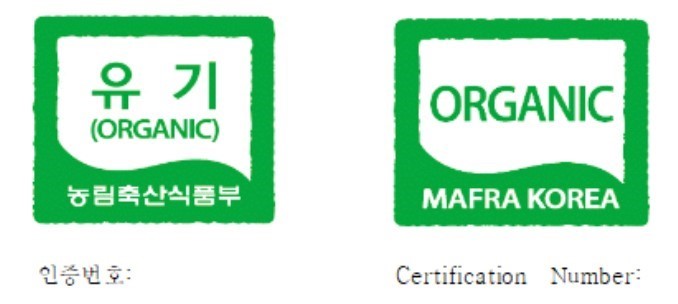 |
Released by MOF | 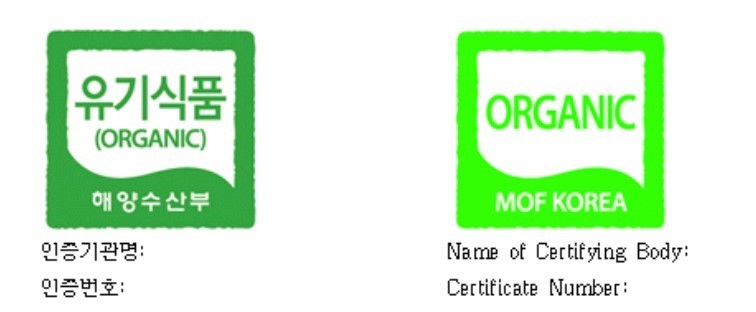 |
3. Declaration of Imported Organic Food
Korean enterprises that want to import organic food shall declare the importation of food categories, quantities, etc. to MAFRA or MOF before the finish of customs clearance formalities. Then officials from MAFRA or MOF will assess if products comply with certification standards and adhere to regulatory compliance obligations.
The following exemptions are offered where there is:
Mutual recognition of organic standards between South Korea and its trade partners
Organic certification has been granted by a 3rd party institution officially recognized by South Korean authorities
Other situations regulated by MAFRA or MOF
4. Equivalency Recognition
South Korea has a mechanism in place that allows market entry for organic products that comply with the organic certification standards stipulated by foreign governments. Governments that which to avail of this market access pathway must apply for mutual recognition (equivalency) of organic food standards to NAQS (National Agricultural Products Quality Management Service) or NFQS (National Fishery Products Quality Management Service).
The rationale for this mechanism is based on the assertion by foreign governments that the organic certification standards adopted in their own regulatory frameworks are equivalent to or higher than South Korean standards. Until now, South Korea has signed mutual recognition agreements with the EU and the USA.
According to the Equivalency Certificate and Management Requirement of Organic Food[9], the equivalence standard in foreign countries shall meet the standards of CAC’s Guidelines for the Production, Processing, Labelling and Mar keting of Organically Produced Foods (CAC/GL 32)[10] or the general standards put forward by IFOAM (International Federation of Organic Agriculture Movements).
 We provide full-scale global food market entry services (including product registration, ingredient review, regulatory consultation, customized training, market research, branding strategy). Please contact us to discuss how we can help you by