Request a Demo
According to “2020 Consumption Trend Report (Dairy)” 1 jointly published by Economic Daily and Yili Group, although the outbreak of COVID-19 affected the sales of dairy products in early 2020, it gradually improved with the well control of the pandemic and the sales value of liquid milk represented 5% YoY growth as of November 2020. Will such upward trend continue in 2021? This article will analyze its future development based on the market performance in 2020.
Dairy sector in 2020
1. The consumption demand boasted the rapidest growth during the recent decade
The consumption demand for dairy products amounted to 54.3 million tons in 2020, which increased by 8% compared with 2019 and it also marked the highest growth rate starting from 2006 2. As revealed by data sourced from National Bureau of Statistics, the annual liquid milk consumption amount reached to 27.1 million tons in 2020, representing 2.9% YoY growth (the growth rate is 0.8% higher than that in 2019); the domestic output and import volume of dried dairy products totaled to 4.02 million tons, representing 4% YoY growth (the growth rate is 0.8% higher than that in 2019).
Notes: the consumption amount is valued by the domestic output and import volume
2. Domestic raw milk price remained high
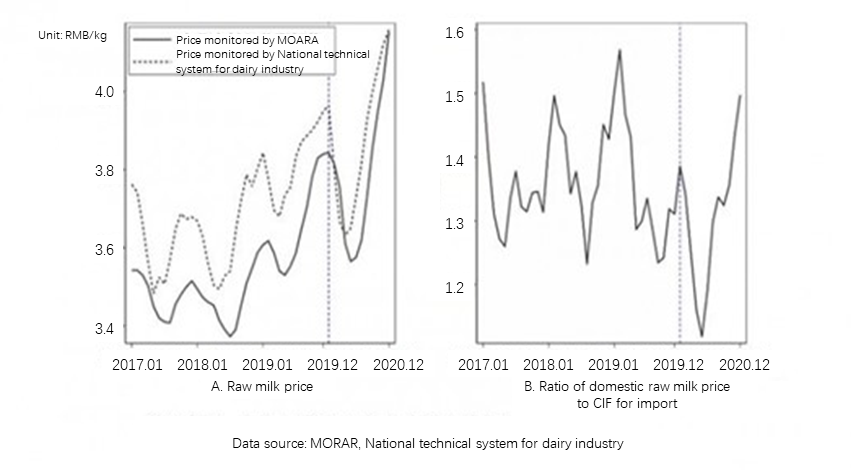
According to data monitored by MOARA, domestic raw milk price climbed to 4.15 RMB/kg in December 2020, which was 8.1% higher compared with the same time in 2019. Generally speaking, it is subject to a periodic decline, that is, it will decrease in the first half year but increase in the second half year.
In 2020, the average price of domestic raw milk was 3.79 RMB/kg, which is 30.2% higher than that of imported raw milk (2.91 RMB/kg, C.I.F. price). It is noteworthy that the price gap between domestic and imported raw milk was narrowed down in the first half of 2020, but domestic price sharply increased in second half year, which enlarged the gap and highlighted the price advantage of imported raw milk.
Chart 1 Domestic Raw Milk Price and the Comparison with CIF
3. The import growth rate of dairy products decline
As revealed by GAC data, the import volume of dairy products hit 3.3 million tons in 2020. It represented 10.4% YoY increase but the growth rate decreased by 2.5% compared to 2019. The import performance of specific dairy products are summarized as below:
The import of whey and cream sharply increased, whose import volume reached 626 thousand tons and 116 thousand tons, representing 38.2% and 35.2% growth respectively.
The import volume of fresh milk hit 1.04 million tons, which increased by 16.8% compared with 2019. 129 thousand tons of cheese were imported in 2020, which rose by 12.5%.
The import volume of yogurt, raw milk powder, and infant formula milk powder were 32 thousand, 979 thousand and 335 thousand tons, which dropped by 4.9%, 3.5% and 3%, respectively. It is the first time that the import of milk powder and infant formula declined during the recent years.
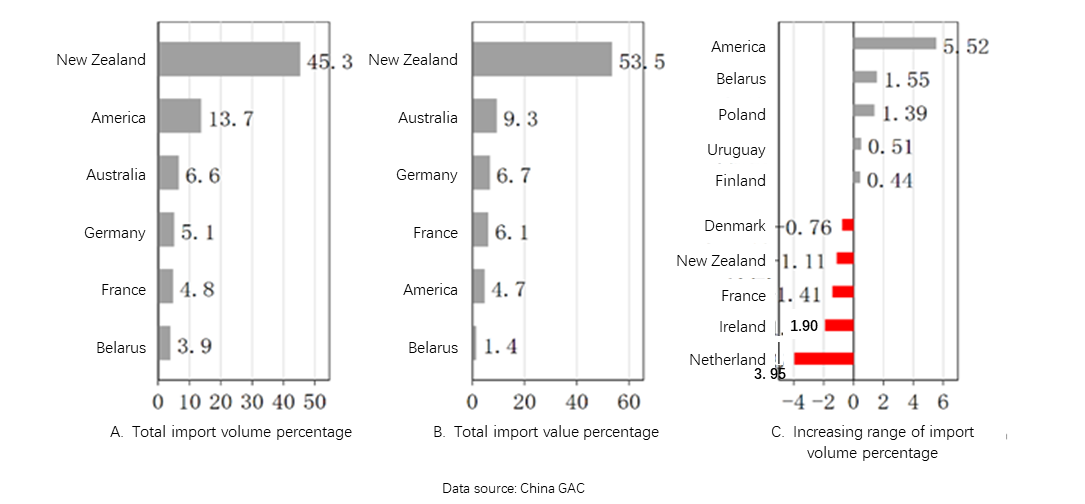
When it comes to the import origin, New Zealand accounted for the majority of the overall dairy import volume (45.3%), followed by America (13.7%) and Australia (6.6%). As significant dairy exporters to China, Netherlands and France occupied less proportion of China’s import supply in 2020, whose import volume percentage dropped by 4% and 1.4%. The import source adjustment also indicates the impact that Sino-US Trade Agreement brought to China dairy’s import origin structure.
Chart 2 The Percentage of Major Import Origin of Dairy Products
Outlook for 2021
1. The growth of dairy consumption demand is likely to decelerate
Considering the effects of COVID-19 epidemic and uncertain international trade relationship, it is hard to say if Chinese economic will maintain the rapid growth in 2021. In addition, the pork production capacity is expected to recover in the first half of the year, leading to the decrease of pork price and higher pork demand. As dairy could be considered as protein substitute for pork 3, the demand of dairy products is likely to be affected.
2. Domestic raw milk price may decline
In the past year China increased the investment on cow breeding so as to relieve the shortage of raw milk. It started to gain profits in 2021, and raw milk price may drop with the increasing supply. Additionally, the consumption demand for dairy products may be subject to lower growth rate and it would also affect the price. However, considering the high feeding cost, it is anticipated that domestic raw milk price will have modest increase in the second half of 2021 and the annual raw milk price will be lower than 2020.
3. The import of dairy products will have slight growth
At present raw milk is oversupplied in the global market, which may lead to the decrease of raw milk price in overseas countries. Undoubtedly it will facilitate their dairy exportation to China. However, the growth of consumer demand may be decelerated and domestic dairy manufacturers are likely to occupy more market shares with the improved product competitiveness and consumer confidence. In this case, the import volume will keep rising but the growth rate may decline.
Suggestions for overseas stakeholders
At the end of 2020, SAMR released the “Promotion Action Plan of Dairy Quality and Safety” 4, which showcased China’s determination to further improve the product quality and foster consumers’ confidence towards domestic dairy products. In addition, Chinese government also greatly support the revitalization of domestic dairy industry and aims to realize raw milk self-sufficiency level of 70%. Under such circumstance, overseas dairy manufacturers should place more emphasis on the product quality and consider localization strategy so as to better understand the demand of Chinese consumers. Besides, overseas enterprises could invest more on products they boast competitiveness and also have growth opportunities in China, such as cheese and whey powder.
 We provide full-scale global food market entry services (including product registration, ingredient review, regulatory consultation, customized training, market research, branding strategy). Please contact us to discuss how we can help you by