Request a Demo
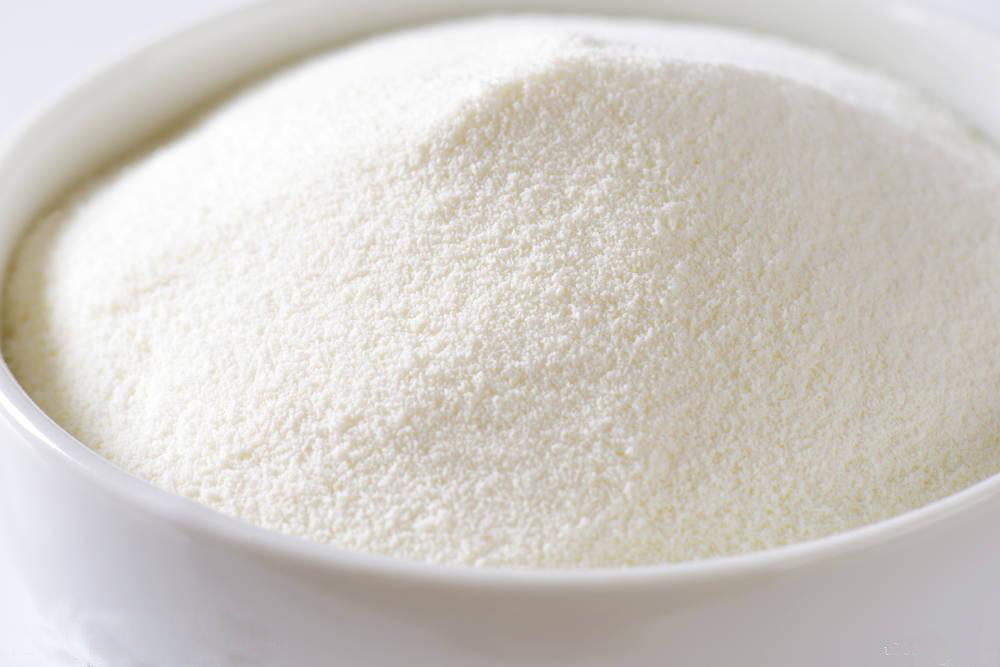
Titanium is the 9th most abundant element in Earth’s Crust and titanium dioxide (TiO2 or E171) is the oxide of this metal, which occurs naturally in several kinds of rock and mineral sands.
Extracted from five different crystal forms, the appealing white TiO2 has been widely used as a dye for over 90 years throughout the world in a vast range of industrial applications and consumer goods such as paints, printing inks, plastics, paper and board, textiles, ceramics, construction materials, and last but not least pharmaceuticals, cosmetics and food.The food products most often containing titanium dioxide (especially in its nano form) are candy, chewing gums, some dairy and other sweets, all showing the characteristic white color. Many Food Contact Materials also contain TiO2. This substance is chosen by producers mainly for its color and apart from this it doesn’t add much to food products containing it. For this reason, and following new scientific studies highlighting possible health risks, in recent times the nonchalant utilization of this coloring agent has been criticized.
Legal Status in the EU and recent scientific findings
In the EU the substance is currently listed under Regulation 1333/2008, which in its Annex II lists the maximum limits of E171 in various food categories. It is therefore permitted to use it in food, as its toxicity has not yet been fully proven. In fact, on 14 September 2016, EFSA Panel on Food Additives and Nutrient Sources added to Food (ANS) published a scientific opinion stating that the absorption rate for orally administered titanium dioxide is extremely low and doesn’t raise up any genotoxicity concerns.
However, many reasonable doubts surround TiO2, as (among others) back in 2010 the International Agency for Research on Cancer (IARC) already considered it as a Group 2B “possible carcinogen” and European Chemicals Agency (ECHA) recently agreed on this.
This research assessed the health risks of the substance only when inhaled and so bear little relevance to when it is added to food, but a recent (20 January) French Institute for Agronomic Research study testing oral exposure to the substance on mice sparked new concerns.
Researchers fed rats a dose of TiO2 similar to the exposure humans may experience through food consumption, showing for the first time that titanium dioxide is absorbed by the intestine and passes into the blood. The study showed an association between Titanium dioxide particles and the rise and advancement of early stages of colorectal cancer. Traces of the substance were also found in the animals’ livers.
Titanium Dioxide Manufacturers Association didn’t wait long to publish a statement declaring that INRA researches “found no consistent pattern and were conducted using a protocol which cannot be extrapolated to conclude that it could cause cancer in humans”, citing last years’ EFSA study as a source of evidence of the safety of the substance.
Acknowledging these results and noticing that EFSA 2016 study didn’t provide an Acceptable Daily Intake (ADI) for this substance, the European Commission informed member states of its intention to launch a public request to acquire technical data on titanium dioxide to send to EFSA for further review. There will also be a carcinogenesis study carried out under OECD guidelines to continue observations at later stages of cancer.
Following this and other scientific evidence, it is probable that the current legal environment for this substance in food products will be subject to change, especially in Europe, highly affecting the way E171 is regulated worldwide. In case Titanium Dioxide will be classified as a Class 1 Carcinogen, it will surely be classified as a Carcinogenic, Mutagenic, or Toxic for reproduction (CMR) substance under EU registration, affecting also its REACH status.
Legal status in China
Titanium Dioxide is classified as a food additive in Chinese food regulations. So the regulations we should mention are National Food Safety Standard for Food Additive Use GB2760 -2014 as well as GB 25577-2010 regulating specifically Titanium Dioxide.
You can find both the regulation in our database:
- GB 2760-2014 National Food Safety Standard Standard for Uses of Food Additives
- GB 25577-2010 National Food Safety Standard for Food Additive Titanium Dioxide
GB2760 -2014 lists Titanium Dioxide in Appendix A, naming it a coloring agent and sets the limits for its utilization in various food categories, including gum based candies, decoration and toppings and jelly.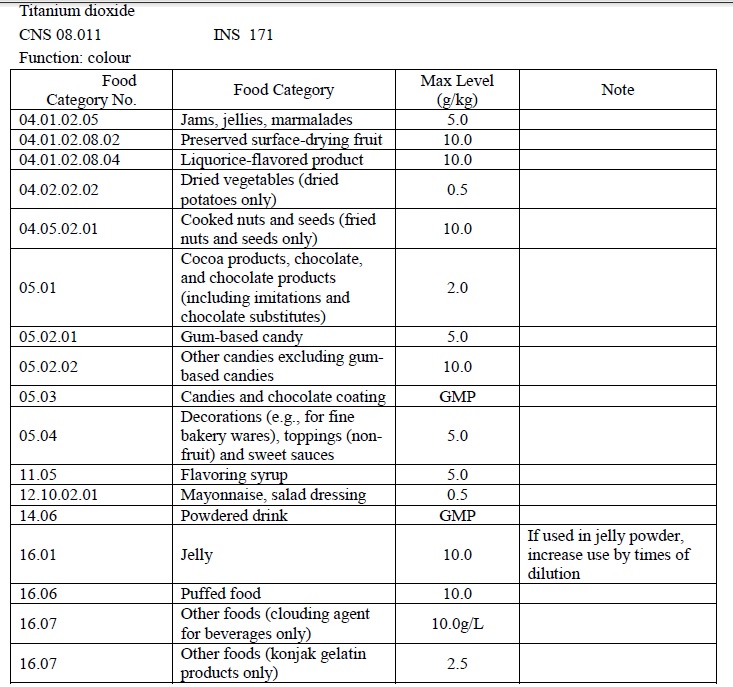
GB 25577-2010 sets minimum quality requirements for the substance in terms of purity and physical characteristics as well as describing testing methods.
It is probable that changes in the legal status of the substance in Europe will lead to changes of similar nature in China, as happened many times in the past. Even though food is just one of many uses for Titanium Dioxide, these changes might have a high impact on its market, valued at 17.7 billion USD in 2015. Will the top players of this highly concentrated market (first four producers account for 50% of the total net production volume) be able to adapt to them?
 We provide full-scale global food market entry services (including product registration, ingredient review, regulatory consultation, customized training, market research, branding strategy). Please contact us to discuss how we can help you by