Request a Demo
Part 1: Importation Performance of Beer, from 2017 to 2019
1.1 General importation performance
The importation of beer products declined in 2019 both in terms of import amount and value. The decrease in imported beer may be due to the saturated market in China, the high industrial concentration ratio, etc. View more at China Beer Sector Analysis.
Table 1: Import value & volume of beer products, from 2017 to 2019 (Source: GAC)
Year | Import amount (million liters) | YOY Growth rate | Import Value (million dollars) | YOY Growth rate |
2017 | 716.8 | — | 751 | — |
2018 | 822.5 | +14.7% | 906 | +20.6% |
2019 | 733.6 | -10.8% | 822 | -9% |
1.2 Performance of categories
Among the beer products, the performance of non-alcohol beer (<0.5% ABV; ≥3.0°P) is still optimistic. After the sudden increase in 2018, the growth rate of its import value and amount fell to around 20% in 2019. However, it only took up 0.2% of the total volume of beer products.
Table 2: Import value & volume of non-alcohol beer, from 2017 to 2019
Year | Import amount (thousand liters) | YOY Growth rate | Import Value (thousand dollars) | YOY Growth rate |
2017 | 591.5 | — | 731.8 | — |
2018 | 1329 | +125% | 1779.5 | +143% |
2019 | 1656.6 | +25% | 2068.4 | +16% |
1.3 Top trading countries of beer products, by import volume
Germany still played the leading role in beer exportation to China while the import amount of Mexico decreased by 44% compared to 2018. South Korea remained the third spot and had a similar performance to 2018.
Table 3: Top trading countries of beer products, 2018 vs. 2019
2018 | 2019 | |||
Country | Volume (Unit: million liters) | The proportion of the total import amount | Volume (Unit: million liters) | The proportion of the total import amount |
Germany | 240 | 29% | 209.7 | 28.6% |
Mexico | 196 | 24% | 109 | 14.9% |
South Korea | 104 | 13% | 105.9 | 14.4% |
Belgium | 39 | 5% | 52.4 | 7% |
Britain | (not listed in the top 5) | (not listed in the top 5) | 46.6 | 6% |
Part 2: Importation Performance of Wine, from 2017 to 2019
2.1 General import performance
The import volume of wine products kept downward for two years, and its import value is 14.7% less than that of 2018. The whole wine industry is facing a challenge.
Table 4: Import value & volume of wine products, from 2017 to 2019 (Source: GAC)
Year | Import amount (million liters) | YOY Growth rate | Import Value (million dollars) | YOY Growth rate |
2017 | 750.6 | — | 2800.8 | — |
2018 | 689 | -61.6% | 2862.8 | +2% |
2019 | 615.5 | -10.7% | 2442 | -14.7% |
2.2 Performance of categories
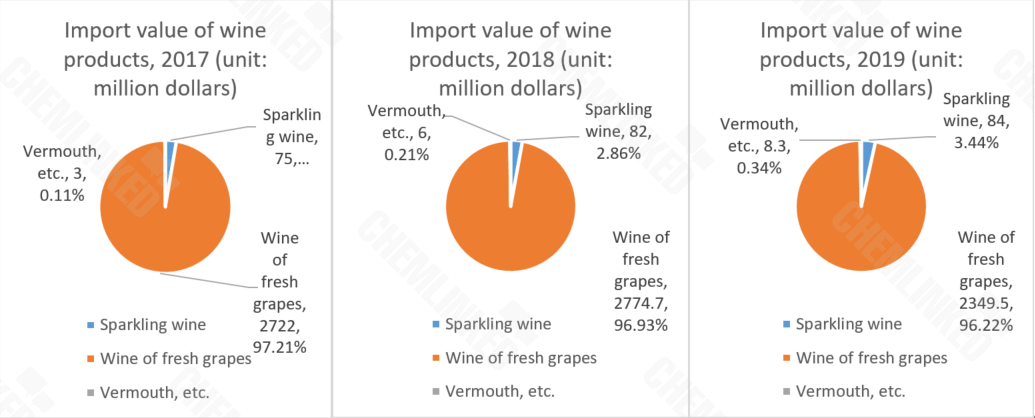
Both the import value of sparkling wine and Vermouth increased. While the import value of grape wine was 15% less than that of 2018.
The proportion of wine categories, from 2017 to 2019, by value
2.3 Top trading countries of wine products, by import value
The wine import volume from France decreased by 21% in 2019, which greatly influenced its import value, 35% lower than that of 2018. Growth of Australian imports remained stable, ranking number 1 in terms of import value.
Table 5: Top exporters of wine to China, 2018 vs. 2019
2018 | 2019 | |||
Country | Value (Unit: million dollars) | The proportion of the total import amount | Value (Unit: million dollars) | The proportion of the total import amount |
Australia | 782 | 27% | 865 | 35.4% |
France | 1069.7 | 37.4% | 695 | 28% |
Chile | 376 | 13% | 346 | 14% |
Italy | 170.6 | 5.96% | 159 | 6.5% |
Spain | 170 | 5.94% | 146.5 | 6% |
Part 3: Importation Performance of Spirits, from 2017 to 2019
3.1 General import performance
Unlike the performance of beer and wine products, the importation of spirits has continued to grow from 2017 to 2019 with a stable and fast growth rate.
Table 6: Import value & volume of spirit products, from 2017 to 2019 (Source: GAC)
Year | Import amount (million liters) | YOY Growth rate | Import Value (million dollars) | YOY Growth rate |
2017 | 73 | — | 1139 | — |
2018 | 82 | +12% | 1410 | +23.8% |
2019 | 110 | +34% | 1604 | +13.8% |
3.2 Performance of categories
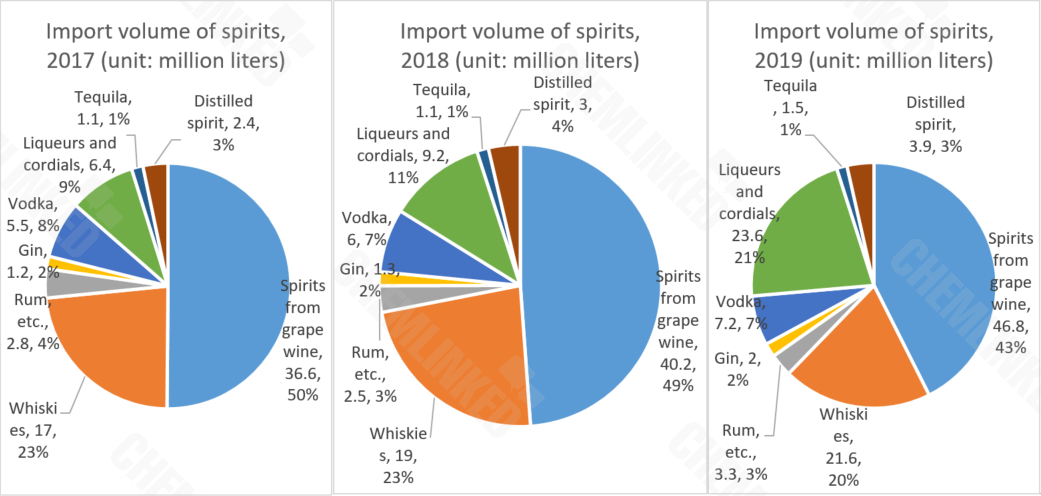
The import volume of each category increased, especially one of liqueurs and cordials (2.6 times of that of 2018) and the spirits distilled from grape wine, with a YOY growth rate of 9.8% in 2019.
The proportion of spirit categories, from 2017 to 2019, by volume
3.3 Top trading countries/areas of spirits, by import value
The import value of spirits from France remained similar to 2018, but the import value of Germany is four times higher than that of 2018.
Table 7: Top exporters of spirits to China, 2018 vs. 2019
2018 | 2019 | |||
Country | Value (Unit: million dollars) | The proportion of the total import amount | Value (Unit: million dollars) | The proportion of the total import amount |
France | 1056 | 74.9% | 1087.8 | 67.8% |
Britain | 156 | 11% | 184 | 11.5% |
Germany | 13.4 | 0.9% | 67 | 4% |
Taiwan | 33 | 2.3% | 50.8 | 3.2% |
USA | 16 | 1.1% | 18.5 | 1.2% |
*Statistic methods of the importation data of beer, wine, and spirits in this article:
Beer products include the HS Code of 22030000 and 22029100.
Wine products here include sparkling wine (HS Code of 22041000), wine of fresh grapes (22042100, 22042200 and 22042900), Vermouth, etc. (22051000 and 22059000).
Spirit products here include 22082000 (spirits obtained by distilling grape wine), 22083000 (whiskeys), 22084000 (Rum and other spirits obtained by distilling fermented sugarcane products), 22085000 (Gin), 22086000 (Vodka), 22087000 (Liqueurs and cordials), 22089010 (tequila) and 22089020 (distilled spirits).
All the data above are from China’s GAC website.
 We provide full-scale global food market entry services (including product registration, ingredient review, regulatory consultation, customized training, market research, branding strategy). Please contact us to discuss how we can help you by