Request a Demo
Editor's note: This article was originally published on July 13, 2024, and was updated on September 13, 2024, as per the latest developments. The updated contents are marked in red below.
On June 13, 2024, Food Standards Australia New Zealand (FSANZ) announced the approval of P1028 – Infant Formula, making significant amendments to the Australia New Zealand Food Standards Code (the Code). This approval mainly introduces new product category, composition, and labelling of infant formula products. Food ministers were notified of the approval. If no review is requested within 60 days, the Code will be amended accordingly. The changes will take effect upon gazettal, with a five-year transition period granted by FSANZ. On September 13, 2024, FSANZ released Amendment No. 231. The revised regulation for infant formula products applies in Australia only. New Zealand has opted out of this standard.
Major revisions
Change of regulatory structure
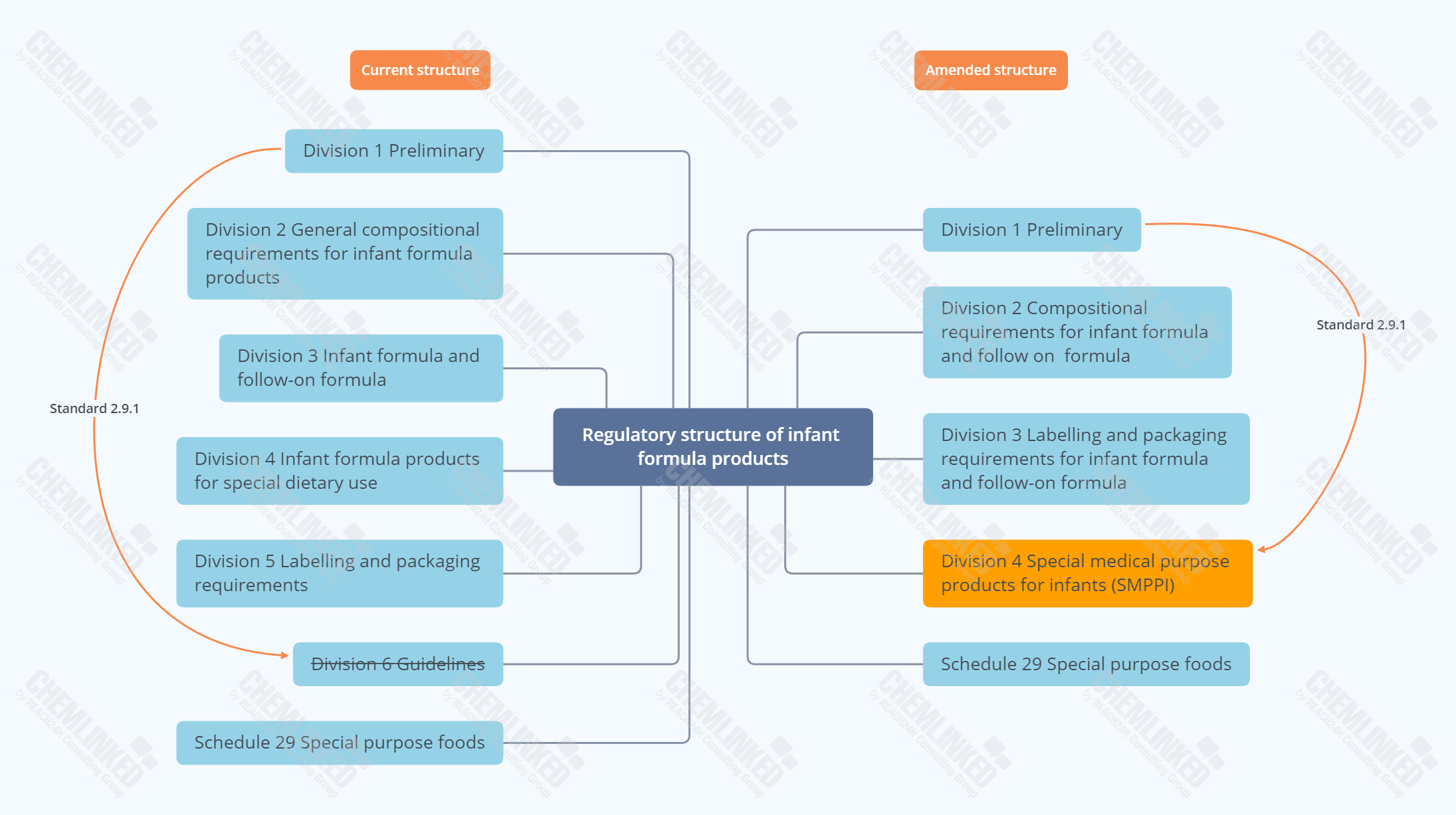 The amendment introduces distinguishing requirements that separate formula for healthy infants from specialised formula for infants with disease, disorder or condition. These requirements are detailed as follows:
Division 2 and Division 3 of Standard 2.9.1: Prescribes requirements for formulas for healthy infants (infant formula and follow-on formula).
Division 4 of Standard 2.9.1: Sets requirements for specialised formulas for infants with specific health conditions (SMPPi).
Additionally, the new regulations replace the current Division 6 Guidelines with Guidance Upper Limits (GULs) described in Schedule 29 and Standard 2.9.1. GULs offer recommended upper levels for nutrients based on current scientific knowledge but are not mandatory.
Establishment of SMPPi as a new product category
The amendment renames the Infant Formula Products for Special Dietary Use (IFPSDU) category to Special Medical Purpose Product for infants (SMPPi), along with the following changes. The amendment mainly:
Introduces compositional requirements for SMPPi that mirror the composition of infant formula. In addition, SMPPi can deviate from the composition requirements when required to achieve the product’s intended medical purpose.
Adds a restriction on sale that limits the sale of SMPPi to medical practitioner, dietitian, medical practice, pharmacy, the responsible institution or majority seller of that product.
Introduces a new labelling framework for SMPPi: a). new labelling requirements for ingredients, date marking, nutrition information, inner packages, transportation outers and the differentiation of SMPPi from other products; b). a specific prohibition on claims made about SMPPi, unless expressly permitted; c). permission of a lactose free claim on SMPPi;
Revision of infant formula and follow-on formula
Compositional requirements
General compositional requirements: For instances, FSANZ introduces permissions relating to energy, macronutrients, minerals, vitamins, electrolytes and nutritive substances.
Protein source: A requirement is added that the protein source for infant formula and follow-on formula must only be derived from one or more of the following proteins—cow milk, goat milk, sheep milk, soy protein isolate or a partially hydrolysed protein. Any protein sources outside of those specified above will be required to undergo a premarket assessment through FSANZ.
New requirements for added fructose and/or added sucrose: Infant formula and follow-on formula must not contain added fructose and/or added sucrose, with two exceptions. First, formula manufactured from partially hydrolysed protein is permitted to contain added fructose and/or added sucrose, provided that it is added to provide carbohydrate and the sum does not exceed 20% of available carbohydrates in the formula. Second, the presence of added fructose and/or added sucrose is the result of the presence of inulin-type fructans and/or processing aids in accordance with the Code.
Specific nutrient adjustments: Follow-on formula and infant formula have the same compositional requirements except for the protein minimum, vitamin D maximum, calcium maximum, iron minimum, choline minimum, inositol minimum and L-carnitine maximum. For instance, FSANZ decides to increase the vitamin D maximum from 0.63 µg/100 kJ to 0.72 µg/100 kJ in follow-on formula.
Labelling and packaging requirements
Product differentiation: Requirements are introduced to require infant formula and follow-on formula to be differentiated from each other and from other foods by the use of text, pictures and/or colour.
Voluntary stage numbers: The amendment introduces the voluntary use of stage numbers. For instance, if used, the number must appear on the front of the package of the product and be located immediately adjacent to the relevant age statement.
Statement of protein source: The specific animal or plant source of protein should be included in the name of the food, on the front of the package.
Prohibited information: Further prohibitions are added on information relating to other foods and ingredients, protein source and the words “partially hydrolysed”. For example, the word “milk” will be prohibited as the sole descriptor of the protein source in the protein source statement.
Declaration of vitamins and minerals: The amendment permits an optional format for declaring added vitamins and minerals in the statement of ingredients.
Warning statements: FSANZ simplifies the separate “follow instructions exactly” warning statements for powdered, concentrated and ready-to-drink formulas to a single warning statement applicable to all product types.
Nutrition information statement: Requirements are amended for the nutrition information statement including what must be provided in the statement.
Lactose free claims: FSANZ removes labelling permissions for making low lactose and lactose free representations on infant formula and follow-on formula labels.
 We provide full-scale global food market entry services (including product registration, ingredient review, regulatory consultation, customized training, market research, branding strategy). Please contact us to discuss how we can help you by