Request a Demo
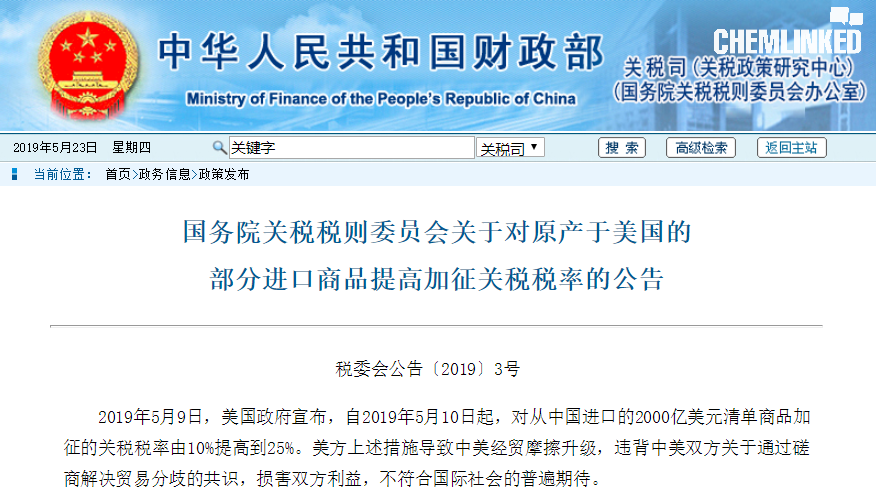
On May 13, 2019, Ministry of Finance of the People’s Republic of China (MoF) announced tariff hikes on US goods[1] in retaliation for increased levies (up from 10% to 25%) on $200bn worth of Chinese goods. Four lists of goods containing 5140 items are subject to 25%, 20%, 10% and 5% tariff increase respectively. The announcement will take effect on June 1.
 Baby Foods are Involved
US food industry involved in infant formula, food for special medical purposes, cod-liver oil, malt beer, plant oil and etc. will all be affected.
| Tariff increase | HS code | Items | MFN/provisional duty rate |
| 25% | 15041000 | Cod-liver oil and its fraction | 12% |
| 19011010 | Prepackaged infant milk powder | 15%/5% | |
| 19019000 | Other foods (include food for special medical purposes) | 10%/5% *FSMP 0% | |
| 22030000 | Malt beer | 0 | |
| 20% | 22086000 | Vodka | 10% |
| 19041000 | Cereal based puffed or frying food | 10% | |
| 10% | 19011090 | Other baby food (complementary infant food) | 15%/2% |
| 21061000 | Concentrated protein and artificial protein | 10% | |
| 5% | / | chemical products and etc. | |
Calculation of Tariff
| customs duty= duty-paid value´ (currently applicable duty rate+ tariff increase) |
According to another MoF announcement[2], the final tariff rate is calculated using the formula above. A 25% tariff increase, for example, does not mean a 25% tariff but is actually just the multiplier used to calculate the overall increase. To calculate the currently applicable duty rate on US goods refer to most favored nation treatment (MFN) or provisional tax rate. Food for special medical purposes was subject to zero provisional tariff rate this year, but is subject to the 25% tariff increase under the new conditions. (For more 2019 tariff information: read article here[3])
Applying for Exemption from Tariff Hike
Another document titled Measures of Excluding Items from Tariff Increase (for trial) [4]was released concurrently. It allows stakeholders in China to file an application for exemption if they are prohibitively affected by the increased tariffs.
Applicants for exemptions
They should be stakeholders, including enterprises or industry organizations/chambers in China that deal with import, manufacturing and use of goods affected by the tariffs.
Applicable scope
The measures apply to all items subject to tariff increase.
Application time
Exemption application is submitted online (https://gszx.mof.gov.cn/). The online system will be open to public submission twice:
June 3, 2019~July 5, 2019
September 2, 2019~October 18, 2019
Recap of China’s Tariff Moves on US Goods
| Date | Event |
| April 2, 2018 | 15% and 25% tariff increase on 128 US goods[5]
|
| April 4, 2018 | 25% tariff increase on 14 categories and 106 items of US goods[6]
|
| June 15, 2018 | 25% tariff increase on $34bn US goods[7] (effective on July 6)
|
| August 3, 2018 | 25%, 20%, 10%, 5% tariff increase on $60bn US goods |
| December 14, 2018 | Suspension of 5% tariff increase that was effective on September 24 Suspension of 25% tariff increase that was effective on July 6 Effective from January 1, 2019 to March 31, 2019[9] |
| March 31, 2019 | Continue to suspend tariff increase on vehicles and their parts[10] |
| May 13, 2019 | 25%, 20%, 10% tariff increase on part of the $60bn US goods list previously released on August 3, 2018 (effective on June 1) Measures of Excluding Items from Tariff Increase (for trial) |
Read impact of China-US tariff war on bilateral food trade here[11].
 We provide full-scale global food market entry services (including product registration, ingredient review, regulatory consultation, customized training, market research, branding strategy). Please contact us to discuss how we can help you by