Request a Demo
On June 6, 2023, Indonesia BPOM unveiled Regulation Number 13 of 2023 concerning Food Categories, which came into force immediately after its promulgation and supersedes previous regulation. For processed foods already obtained circulation permits, they shall comply with this new regulation no later than 30 months after its implementation.
1. Food categories
All locally-produced or imported foods for retail sales shall meet the requirements stated in the corresponding food categories. The new regulation divides all foods into 16 general categories, from dairy products to RTE processed foods. Each general category is refined to subcategories level by level, to ensure the clear description and related requirements of specific product categories. Take whole milk for an example, it is under 01.1.1 Liquid Milk under 01.1 Liquid Milk and Dairy Products under 01.0 Dairy Products and specified with definition & basic features. Only whole milk fully comply with this definition and basic features can be circulated in the Indonesian market.
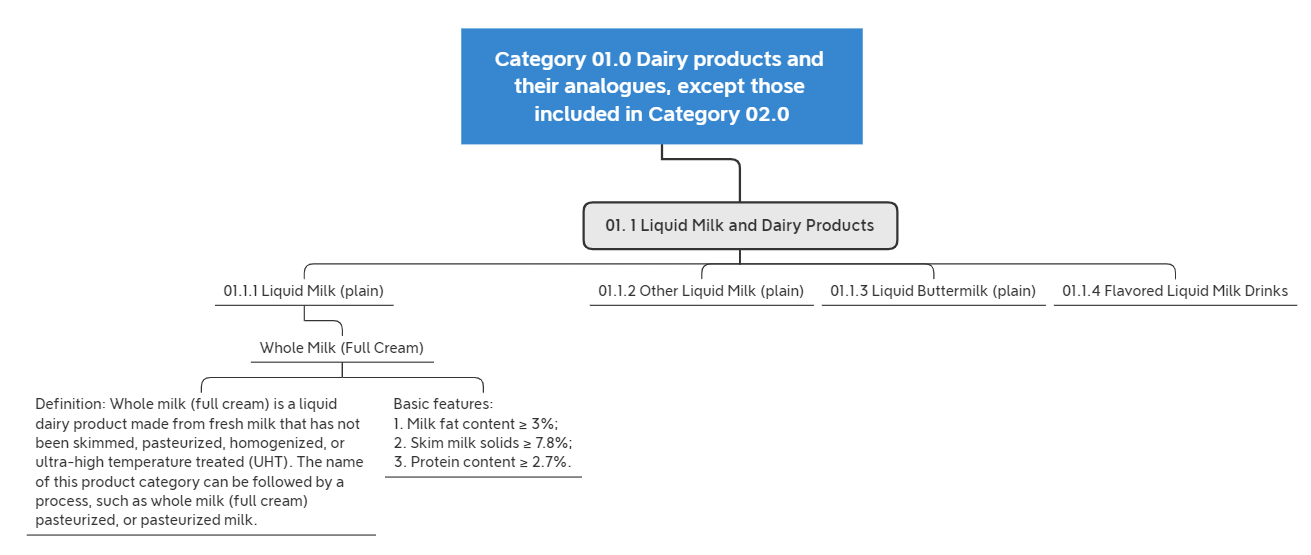 Definition & basic features of whole milk (full cream)2. Raw Materials of Processed Food
According to this new regulation, raw materials that can be used in processed food include:
a) Raw materials listed in Appendix 1 Food Categories, and/or
b) Raw materials listed in Appendix 2 Raw Materials Derived from Plants or Animals.
Notably, in Appendix 2, raw materials derived from plants/animals can be categorized as either unrestricted or restricted in terms of their usage.
A. Raw materials without use restrictions (323 items)
Example:
Common name | Species name | Other names/Synonyms | Usable parts |
Acai | Euterpe oleracea | Catis martiana O.F.Cook ; Euterpe badiocarpa Barb.Rodr.; Euterpe beardii L.H.Bailey ; Euterpe brasiliana Oken; Euterpe cuatrecasana Dugand | Fruit |
B. Raw materials with use restrictions (9 items)
Example:
Common name | Species name | Other names/ Synonyms | Part | Form | Food category | Maximum limit |
Ginseng | Panax ginseng C.A. Meyer, Panax quinquefolius L. | / | Root | Roots, aqueous extracts or aqueous and ethanol extracts | All food categories, excluding those included in 13.0 | 1. The maximum dose is 0.5-1.7g of dry root per day. The ratio of ginseng root to ginseng extract is 3-7: 1. Ginsenoside Rb1 and Ginsenoside Rf are identified. 2. Warning on the label: Ginseng should not be consumed in excess of the recommended dose; Attention must be paid to its use in pregnant and lactating women as well as children. It is not recommended to be used in people with hypertension and diabetes. |
To use food categories or raw materials outside of Appendix 1 and 2, a written approval letter from the Director of Processed Food Standardization shall be obtained. Such applications must be submitted via BPOM's online website, and attached with following materials:
a) Materials of the applicant;
b) Materials of the raw material;
c) Safety data of the raw material;
d) Regulatory overview and/or distribution of the raw material in other countries/regions (for imported raw materials only);
e) Data on using the raw material in processed foods.
If you need the full English version of this regulation, please feel free to reach out to us via [email protected].
 We provide full-scale global food market entry services (including product registration, ingredient review, regulatory consultation, customized training, market research, branding strategy). Please contact us to discuss how we can help you by