Request a Demo
1. The nutrition facts labeling is mandatory for processed food.
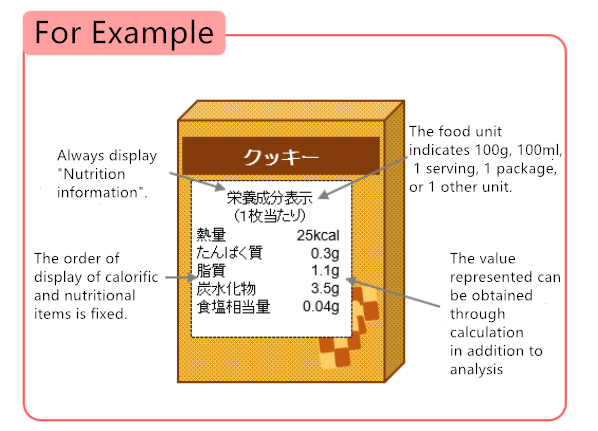
Here are some questions frequently raised by food enterprises:
Q1: Is testing the only method to determine nutritional value?
A: No.
You can use the data in the "Standard Tables of Food Composition in Japan" and the data obtained from the raw material factory to determine the value on the label.
However, when nutrient content label claims (such as low-calorie, low-salt, etc.) or functional foods are labeled, the value must be obtained in accordance with the methods specified in the "Food Labeling Standards."
Q2: Is it necessary to indicate the wording of "Estimated value" or "This displayed value is for reference only " when the data is calculated from the database, etc.?
A: Not necessarily required.
"Estimated value" is not required to be indicated if the data calculation follows the "food labeling standard," and it is within the error range. However, if the value may exceed the allowable deviation range, the "Estimated value " must be indicated. In this case, it is necessary to keep the basic data of the set value, and either the word "Estimated value " or " This displayed value is for reference only " must be displayed in a place close to the nutrition label.
In addition, in case the "highest value" and "lowest value" are marked, it is not allowed to indicate the "estimated value."
For more details, you can find this on the CAA website.
︒ Leaflet: The First Time to Make Nutrition Labeling
︒ Nutrition Labeling Guideline for Businesses
2. In principle, allergen labeling is required for individual raw materials and additives
Specific raw materials
Ground rules | Food | Reason | Obligation |
Food Labeling Standards (specified raw material) | Shrimp, crab, wheat, buckwheat, eggs, milk, groundnut (peanut) | According to the number and severity of the disease, it is necessary to mark allergen labeling. | mandatory |
Notice by CAA (conform to specified raw material) | Almond, abalone, squid, ikra, orange, cashew, kiwi, beef, walnut, sesame, salmon, mackerel, soybean, chicken, banana, pork, matsutake, peach, yam, apple, animal gum | it's not as serious as specific raw materials.
However, whether it is to be listed as a specific raw material needs to be investigated in the future. |
The rules of allergen labeling
If the alias of the specific raw materials are labeled, and it refers to the same substance, it is not required to indicate the allergen substance.
E.g. “卵”(egg) belongs to specific raw materials. If "玉子" or "たまご" (both mean egg) are indicated on the package, it is not required to label "the product contains eggs."
The product shall indicate allergen substance warning if its production line is shared by food products made from specific raw materials.
E.g., "the manufacturer also produces food products containing xxx (the name of specific raw materials)"
It is not allowed to use vague expressions.
E.g., it cannot say "it is likely to contain xxx (the name of specific raw materials)."
There are two forms for allergen substance labeling.
individual labeling

batch display

Please read The Transition Period to Japan's New Food Labeling Standards is Coming to the End for more detailed analysis.
 We provide full-scale global food market entry services (including product registration, ingredient review, regulatory consultation, customized training, market research, branding strategy). Please contact us to discuss how we can help you by