Request a Demo
[Updated on July 4] According to the notice released by State Administration for Market Regulation (SAMR) on July 3, 2022, a preliminary investigation showed the detection of propylene glycol in Maiquer's pure milk is due to the excessive usage scope of food flavoring. Moreover, SAMR inspected 23 batches of pure milk products, which were from 14 major market players. Only the pure milk products from Maiquer (6 batches) were detected with propylene glycol (detection result: 0.264 g/kg to 0.363 g/kg). SAMR demands that the market regulation department in Xinjiang investigate the event as soon as possible and impose the penalty according to the law. [Updated on August 23] As per the official notice released by the market regulation department in Xinjiang, the local competent authority issued a fine of 73 million yuan to Maiquer. The illegal gains of over 360 thousand yuan were confiscated. Moreover, the authority imposed a fine of 718 thousand yuan on the legal representative of Maiquer; a fine of 203 thousand yuan on the the director of the dairy factory; a fine of 328 thousand yuan on the directly responsible person of the production workshop and a fine of 276 thousand yuan on the person who is responsible for mixing ingredients. |
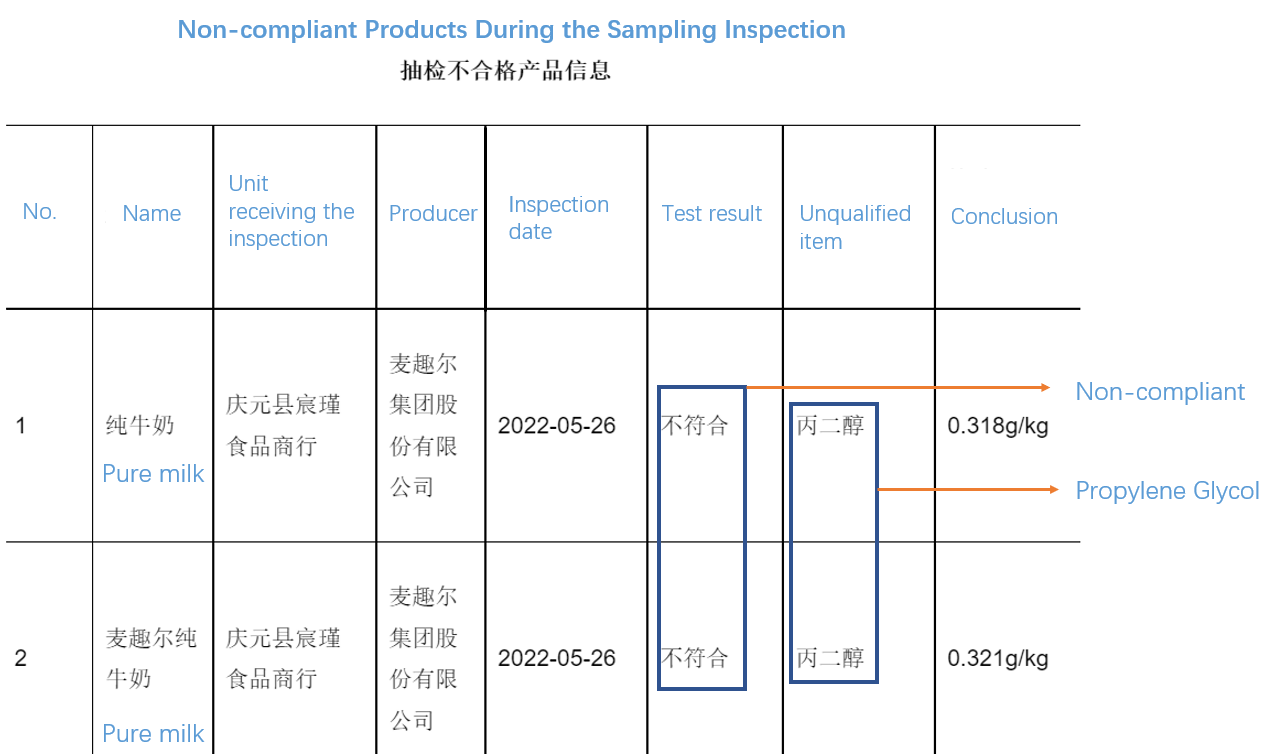
On June 30, 2022, the Chinese social media was flooded with consumers’ astonishment, angry and concerns. As revealed by a notice by a county-level market regulation department* in Zhejiang province three days ago, propylene glycol was detected in two batches of pure milk products from a Xinjiang brand called “Maiquer”. According to the laws, this substance shall not be used in dairy products.
[Notes: The notice was deleted from the official website. ChemLinked called the local department yesterday and got the response that the authority would release a new notice later. Once it is released, the new notice shall prevail.]
As the spreading of this news on the Internet, some media began to discuss the toxicity of propylene glycol with expressions like “The milk you drink may be poisonous as propylene glycol is a food additive with low-toxicity. Overconsumption of propylene glycol in a long term may result in kidney diseases.”, which soon ignites the worries of consumers and made this news become the hottest topic. There are several reasons behind such high attention. First, currently food safety is still a thorn in the side of Chinese consumers. Many are afraid if their health will be impacted when any food safety incident happens. Second, along with government’s and industry’s efforts in the past years, consumers have greatly raised their consumption confidence toward domestic dairy brands. Some comments have expressed their worries: “Can’t believe it. It reminds me of the melamine event in 2008”. Such news brings a big grudge in people’s mind and may exacerbate the trust issue. Last but not the least, due to the popularity of Xinjiang dairy among consumers, Maiquer, Tianrun, Huayuan and Xiyuchun are now typical and well-known brands to consumers. Especially Maiquer, it is the top 1 pure milk with the most affections on Tmall, an E-commerce platform under Alibaba Group. Why would Maiquer be so popular? The biggest attractive point to consumers is Maiquer’s product has a thick milky flavor while the products of its competitors have lighter taste. Thick milky flavor is also recognized as the advantage of milk from Xinjiang Uygur Autonomous Region.
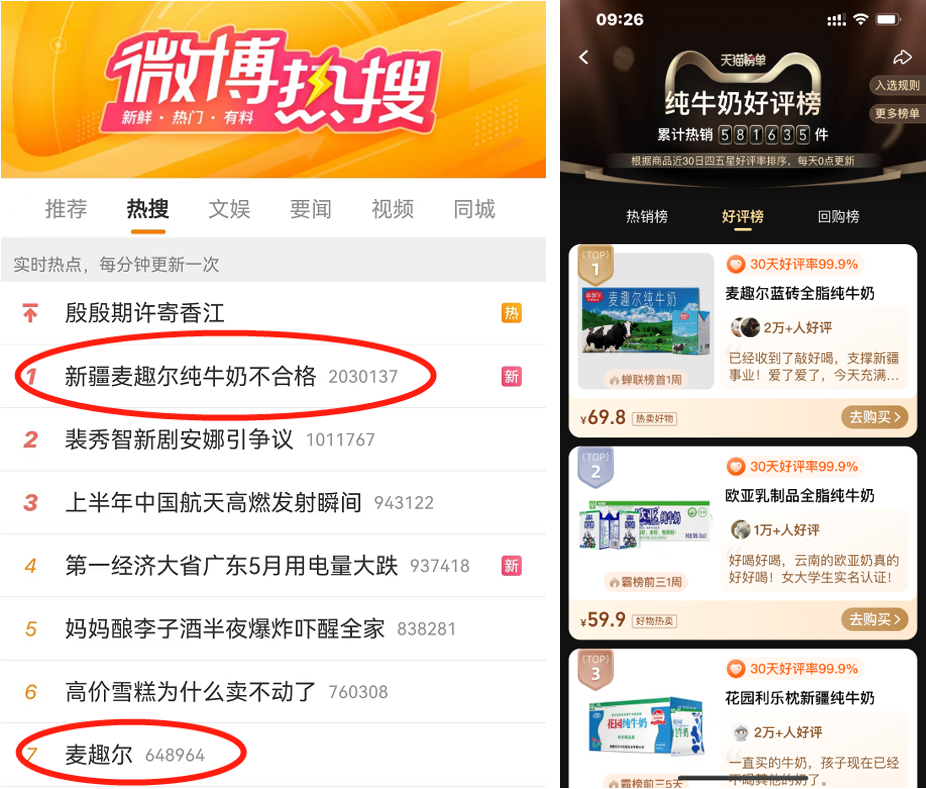
Left: The disqualification of Maiquer’s pure milk became the hottest topic on Chinese social media Weibo, while Maiquer itself becoming the 7th hottest topic. Right: Maiquer is the top 1 pure milk with the most affections on Tmall.
What is propylene glycol and its hazard
Propylene glycol is approved to be used as food additive, food flavoring and processing aid in China. When it is used as a food additive, it can play functions as stabilizer, coagulator, anticaking agent, defoaming agent, emulsifier, water retention agent and thickener. As for its application scope, it can only be used in uncooked wet flour products (maximum limit 1.5 g/kg) and pastries (maximum limit 3.0 g/kg). When using it as processing aid, it can only be used in the processing and extraction technique for beer products.
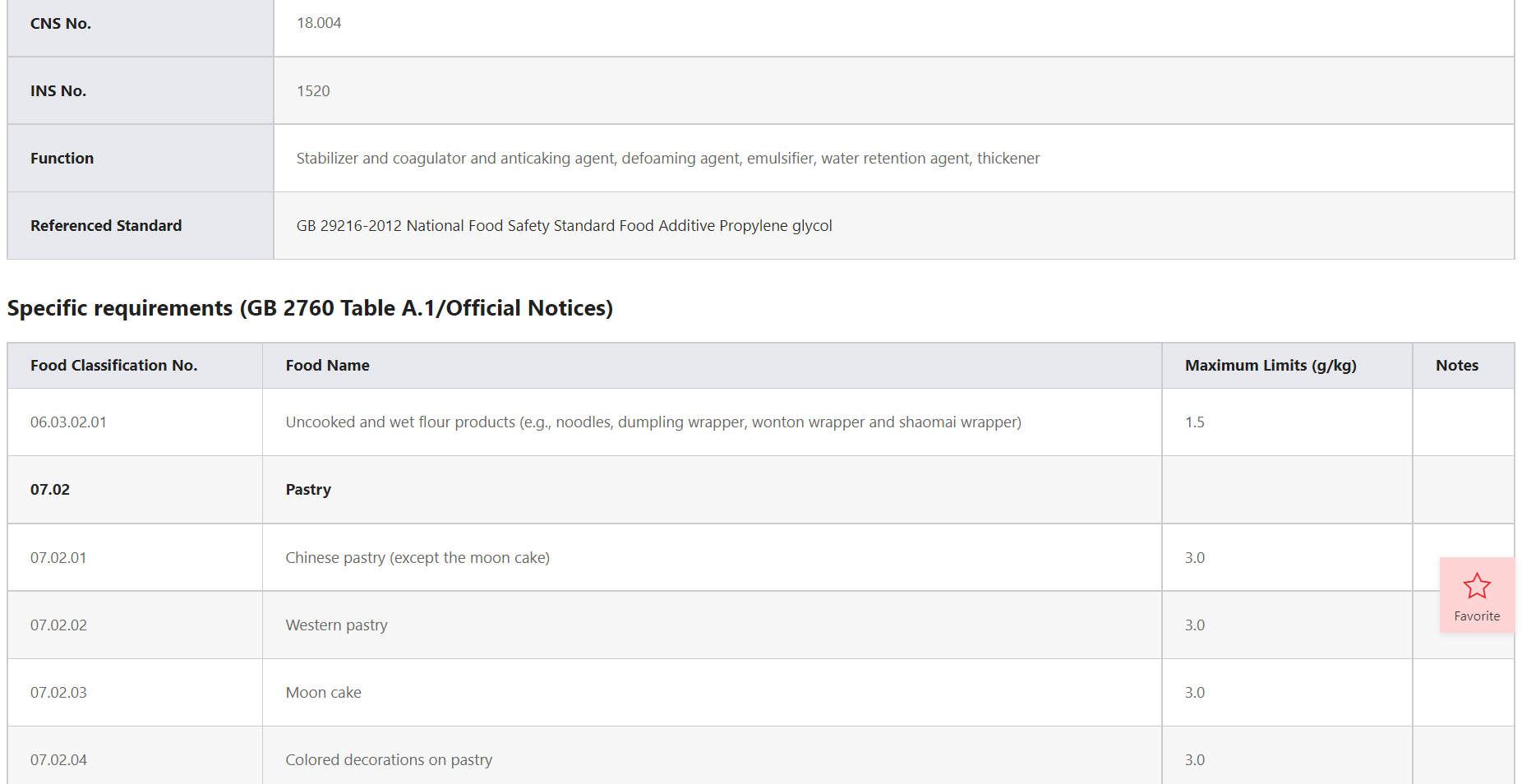
Source: ChemLinked Food Additive Database
Whereas propylene glycol has been approved as a food additive, it won’t damage people’s health even after a long-term consumption as long as it has been used legally. Moreover, according to the evaluation of propylene glycol by the Joint FAO/WHO Expert Committee on Food Additives (JECFA), the acceptable daily intake (ADI) is 0-25 mg/kg body weight. Since the detected amount of propylene glycol is 0.32 g/kg, a person of 60 kg will exceed the ADI if he/she dinks 4.7 kg of the involved milk per day. In another word, it is lucky that the detected non-compliant item and content level will not impact consumer’s health.
Corresponding compliance issues
Although the product won’t impact consumer’s health, it is still a non-compliant product. As explained above, propylene glycol can only be used as food additive in uncooked wet flour products and pastries. Hence, it is illegal to add it into pure milk. In addition, propylene glycol can be used as food flavoring in many food categories and it is also an extensively used flavor solvent. But since involved products are sold as pure milk, it is also not permitted to add flavoring into “pure” milk based on the national standard.
So where did the detected propylene glycol come from? At present, there are several assumptions.
Migration from feed
Some believe it could be due to the migration from feed as propylene glycol can be used as a feed additive. Science writer Yun Wuxin responded that only a small amount of propylene glycol will enter into cow’s milk, if it is used as a feed additive. However, the detected amount is 0.32 g/kg, which is recognized as a quite high content. It’s hard to imagine how large the added amount of propylene glycol in feed if this assumption is correct. To verify this assumption, it’s necessary to detect the content of propylene glycol in the feed and cow’s milk.
Contamination from co-line production
Some assume it may be the residues in pipeline after the production of other products. Yun Wuxin believes that if the production pipeline was not cleaned thoroughly, only part of that batch of products would be contaminated, while others won’t be detected with such a high content. Even if the residue is from the pipeline, the milk is still non-compliant and will face penalties.
Illegal addition of food flavoring
Another assumption is this so-called “pure” milk is added with food flavoring. Based on the feedback from netizens, Yun Wuxin speculated this could be the most possible reason. To verify this assumption, the testing for different batches of product should be conducted.
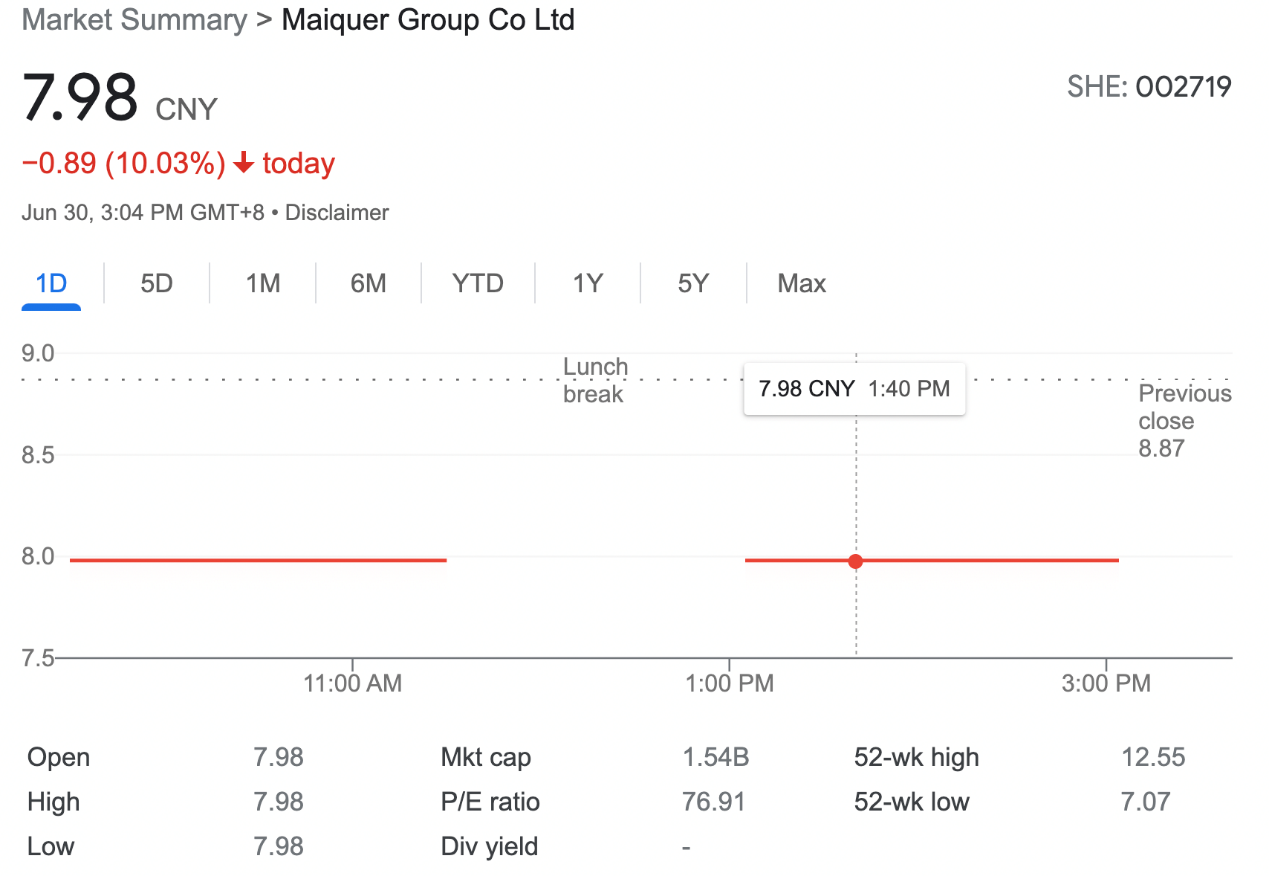
All in all, the above is still the public’s assumption. Affected by this news, Maiquer’s stock hit a limit down on June 30, 2022. Disclosed by Maiquer’s notice on July 1, 2022, the local market regulation department is now in Maiquer and investigating the event. Up until now, the result has not been concluded.
Reminder for stakeholders
At the end of this article, there is a reminder for other dairy companies. For some stakeholders, you may have the question “How would it be detected? Propylene glycol is not a specified sampling item in the ‘Implementation Rules for National Food Safety Supervision Sampling Inspection’”. It is not a specified testing item in SAMR’s regular inspection. However, during the actual implementation, market regulation departments at all levels will still conduct the inspection for some unspecified items to monitor the risk. According to an industry insider, it is innovative for the authority to test the content of food additives like propylene glycol in pure milk. After the spreading of this news on the Internet, it could be possible that local authorities in other regions may strengthen their inspection plan. For stakeholders, it is essential to make sure products are compliant by conducting self-inspection regularly to guarantee the food safety and quality.
 We provide full-scale global food market entry services (including product registration, ingredient review, regulatory consultation, customized training, market research, branding strategy). Please contact us to discuss how we can help you by