Request a Demo
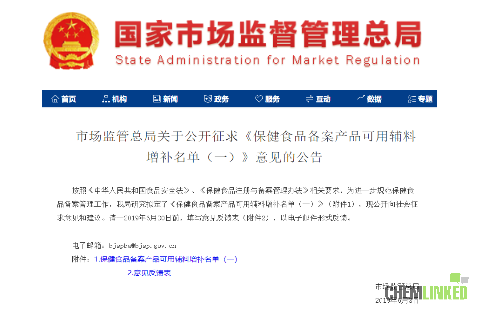
On June 3, 2019, China State Administration for Market Regulation (SAMR) released a consultation draft of List of Additional Auxiliary Materials Approved For Use in Filing-Type Health Food (1st Batch)[1].
 In China’s health food management system, health foods certification requires a product to be either registered or filed depending on the labeling claims made on the product and the specific characteristics of the product.[2] For health foods whose ingredients are not in the Directory of Health Food Raw Materials [3]and List of Auxiliary Materials for Health Food Filing and Terms of Use (Trial)[4] published in 2017, they are subject registration and require systematic evaluation (clinical, toxicological etc.) to substantiate the functional claims used on these products. Products which use ingredients listed in the health food raw materials directory and select appropriate nutrient supplementation claims can be filed.
The List of Auxiliary Materials for Health Food Filing and Terms of Use (Trial) specifies the list of auxiliary materials (non-active ingredients) allowed in health food and also details regulations, permitted application range and terms of use. The newly drafted List of Additional Auxiliary Materials Approved to be used in Filing-Type Health Food would be a supplement document to the above list published in 2017. Major changes are:
Adding 17 new ingredients to the list
The currently effective list contains 179 ingredients, in the announcement the SAMR proposed to add 17 ingredients:
| S/N | Name | Relevant Standards | Maximum Usage |
| 1 | Menthol | GB 1886.199 | As appropriate |
| Chinese Pharmacopoeia Menthol | |||
| 2 | Galactooligosaccharide (GOS) | Former MoH announcement No.20-2008 | As appropriate |
| Former NHFPC announcement No.08-2016 | |||
| Former NHFPC announcement No.08-2017 | |||
| 3 | Fructo-oligose (FOS) | GB/T 23528 | As appropriate |
| 4 | Isomaltooligosaccharide | GB/T 20881 | As appropriate |
| 5 | Edible sweet potato starch | GB/T 34321 | As appropriate |
| 6 | Magnesium carbonate | GB 25587 | Products claiming supplementing magnesium and products whose target user is people aged 1~3 shall not use magnesium carbonate. Maximum limit for other products is 0.8g per day. |
| Chinese Pharmacopoeia Heavy magnesium carbonate | |||
| 7 | Citric acid | Chinese Pharmacopoeia Citric acid | As appropriate |
| 8 | Anhydrous citric acid | Chinese Pharmacopoeia Anhydrous citric acid | As appropriate |
| 9 | Phospholipid | GB 28401 | As appropriate |
| 10 | Concentrated soybean phospholipids | LS/T 3219 | As appropriate |
| 11 | Powdered soybean phospholipids | LS/T 3219 | As appropriate |
| 12 | Fractionated soybean phospholipids | LS/T 3219 | As appropriate |
| 13 | Transparent soybean phospholipids | LS/T 3219 | As appropriate |
| 14 | Soybean phospholipids | Chinese Pharmacopoeia Soybean phospholipids | As appropriate |
| LS/T 3219 | |||
| 15 | Octyl and decyl giycerate | GB 28302 | As appropriate |
| 16 | Curcumin | GB 1886.76 | As appropriate and maximum amount is 0.7g/kg |
| 17 | Fruits and vegetables powders | NY/T 1884 | As appropriate |
Adding standards of 29 ingredients
Some health food ingredients have corresponding standards in the food sector and the pharmaceutical sector respectively. Manufacturers could adopt either food standards or Chinese Pharmacopoeia standards as long as they are in the list. Standards of 25 ingredients are added, including:
| S/N | Name | Current applicable standards | Standards to be added |
| 1 | D-mannitol | GB 1886.177 | ChP D-mannitol |
| 2 | Potato starch | GB/T 8884 | ChP Potato starch |
| GB 31637 | |||
| 3 | Tapioca | GB/T 29343 | ChP Tapioca |
| GB 31637 | |||
| 4 | Edible wheat starch | GB/T 8883 | ChP Edible wheat starch |
| GB 31637 | |||
| 5 | Edible corn starch | GB/T 8885 | ChP Edible corn starch |
| GB 31637 | |||
| For more, please email to ChemLinked for translation service. | |||
Any comments should be submitted by email prior to June 30. (Email address: [email protected] )
Health Food Administration and Future Trend
| Registration | Filing | |
| Procedure | Systematic evaluation, technical review… | Submitting materials for verification, archiving, publicity and referencing |
| Ingredients positive list? | No specific list, but according to a REACH24H Consulting Group specialist, manufacturers have more flexible choices apart from ingredients allowed in certain food type. |
|
| Scope (current) | Products whose ingredients are not in the list | Products whose ingredients are in the lists |
| Fundamental differences | Need to undergo systematic evaluation to substantiate the function claims | No requirement for systematic evaluation to prove the function claims, because there are substantial supporting studies. |
| Scope (future) | For those whose ingredients are not in the list | To expand the list (China SAMR to Append Health Food Positive List with 5 New Functional Ingredients[5] ) |
| Function claim | Should undergo clinical trials etc. to prove the function | No need clinical trials etc. |
| Note | Currently only nutrient supplements do not need registration, and they cannot bear those function claims, but that does not necessarily mean filing-type health foods cannot bear function claims. The government is consulting on expanding the ingredient lists in order to let more health foods can undergo filing instead of registration. | |
| Health food administration trend | Make less products undergo registration | Let more products undergo filing |
 We provide full-scale global food market entry services (including product registration, ingredient review, regulatory consultation, customized training, market research, branding strategy). Please contact us to discuss how we can help you by