Request a Demo
On February 6, 2023, Shanghai Consumer Council (SCC) published an article to cast doubts on the market chaos of foods added with hyaluronic acid (HA, also called sodium hyaluronate), and urge more stringent supervision from regulators, after conducting a special investigation since September of 2022.
Since 2021, food & beverage products added with HA have sprung up in the Chinese market. As the nascent market continues to grow, chaos and disputes began to emerge that hard to ignore. It is known that HA can help improving the skin condition when it is used in mesotherapy and skin boosters. Does it have the similar effect when used in food? A lot of merchants claimed so and used it as a selling point, in despite of the common confusion from consumers.
Four Questions Raised by Shanghai Consumer Council
Q1: Do foods added with HA have the similar effect as skin boosters?
A1: HA has a strong water absorption feature, which enables it to replenish water and improve skin condition through medical cosmetic injection, e.g., skin boosters. From the perspective of food raw material, HA is a long chain polysaccharide. After entering the gastrointestinal tract, it will be decomposed into monosaccharide and disaccharide before absorption. At present, there is no authoritative evidence that oral consumption of HA can promote its synthesis in the body. Therefore, claims regarding foods containing HA can boost skin conditions are untenable.
Q2: Who's touting such effect for HA foods?
A2: As investigation revealed, even though HA food enterprises seldom claim the similar effect as skin boosters for their HA food products in ads and sales page, they do use many suggestive sales pitches. Take a bottled water added with HA for example, the merchant used "drinkable HA", "dual thirst-quenching" to imply the effect of skin hydrating. For these sales pitches, SCC expects related merchants can provide consumers with authoritative evidence.
Besides, SCC found out that such misleading information was more popular on social media platforms. Those authors and users, in the name of "scientific research" or "first-hand experience", claim that HA food really works just like skin boosters. SCC questioned the commercial interests behind the promotion from these authors.
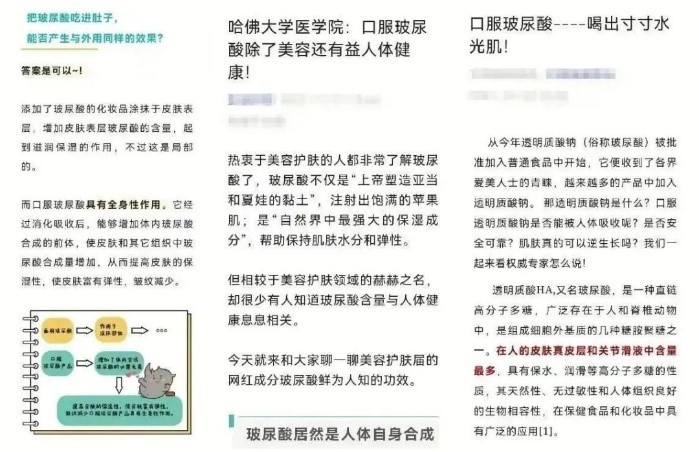 Article titled Oral consumption of HA can improve your skin condition.Image comes from SCC.
Q3: What methods do merchants use to reinforce the indoctrination?
A3: SCC assumes the main method is “personalized push notification mechanism” that is commonly adopted by social media to reach targeted consumers. On Chinese popular social media Xiaohongshu (Little Red Book), the number of posts regarding "HA food" and "oral HA" reach over 7,800 and 20,000 respectively. It is difficult for consumers to tell if the information and user experience is true or not, especially the content elaborately "sugared up" by the marketers. This kind of marketing routine is highly covert, not well regulated, and has a better effect on indoctrination.
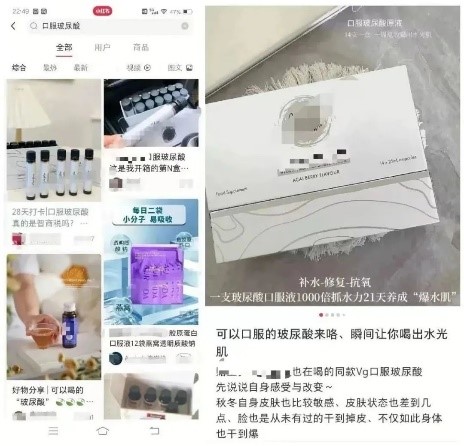 Search result of
Q4: Why does HA become a raw material of ordinary food?
A4: Back in 2008, HA (sodium hyaluronate) was allowed to be used in health food in China. Later in January 7, 2021, HA was allowed to be used as a raw material of ordinary food, such as dairy, beverage, alcohol, chocolate, candy and frozen drink. (Click ChemLinked news for details.) SCC advocates that related regulators shall strictly manage the use of HA in food, and regulate the market behaviors, so as to protect the rights of consumers.
Views and suggestions from ChemLinked
Apparently, SCC's doubts reflect consumers' confusion and concern about HA food. Those market chaos has indeed disrupted the market order and harmed the consumers' right to know. From the perspective of regulatory compliance, China indeed allows the proper use of HA in some food products. Hence, the real issue isn't about market access; instead, it is about claiming and advertising. Many merchants hit "edge ball" to promote their products.
According to Chinese laws and regulations, HA is not one of the nutrients specified in GB 28050 General Rules for Nutrition Labeling of Prepackaged Foods, so claims revolving HA are not legitimate in China, let alone the cosmetic-like claims. China's Advertising Law also explicitly prohibits false, misleading and unscientific information. Stakeholders should strictly comply with existing Chinese laws and regulations, and carry out product sales and promotion in a standardized manner. Moreover, voices urging the further development of relevant regulations and standards for HA food are growing louder in the industry. Only through this way can this promising market develop towards a more orderly and healthy direction.
 We provide full-scale global food market entry services (including product registration, ingredient review, regulatory consultation, customized training, market research, branding strategy). Please contact us to discuss how we can help you by