Request a Demo
On December 14, 2022, the Ministry of Food and Drug Safety (MFDS) published the amendments to Food Labeling Standard1. The regulation is implemented along with its issuance. Nevertheless, the modifications for reference daily intake will be effective on January 1, 2024.
The detailed amendments are specified below:
1. Liquor's Calories Information
In South Korea, liquor is not subject to the mandatory nutrition label. Enterprises can voluntarily label liquor products with nutrition information. In this case, all nine nutrients, including calories, sodium, carbohydrate, sugar, fat, trans fat, saturated fat, cholesterol, and protein, shall be indicated on the package. After the implementation of the new Standard, enterprises can only label calories without other eight items. In addition, calories should be indicated along with the net contents as shown below:
Example: 330ml (000 kcal) |
2. Labeling Standard of "No Salt Added"
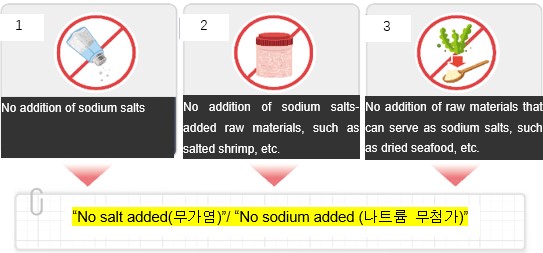
The labeling standard of “no salt added(무가염)” and “no sodium added (나트륨 무첨가)" are modified. Previously, when the sodium content in food was less than 5mg/100g, the products can declare as "salt-free (무염)”, “no salt added”, or “no sodium added”.
In accordance with the revised provisions, the labeling standards of “no salt added” and “no sodium added” are changed as follows:
(1) No addition of sodium salts; (2) No addition of sodium salts-added raw materials; (3) No addition of raw materials that can serve as sodium salts. Only when it satisfies all three criteria, the product can declare as “no salt added(무가염)” or “no sodium added (나트륨 무첨가)”. |
3. Permissible Tolerances for Nutrients
Background Information
As stipulated in the Food Labeling Standard, the actual measured value of calories, sodium, sugars, fats, trans fats, saturated fats, and cholesterol should be less than 120% of that indicated on the food label.
However, for fermented food whose substances may be verified due to fermentation, the standard is hard to be complied with. Additionally, regarding the nutrients in small amounts, it's easy to extend the tolerance range even if there is just small difference. For example, when the indicated value of sodium is 10 mg, the permissible tolerance is 12 mg (120%*10mg). In this case, if the product contains 12.6mg, although it only exceeds 0.6 mg than the permissible tolerance level, the label will be deemed improper.
Therefore, the authority optimizes the permissible tolerances for Kimchi and foods containing small amounts of nutrients. |
(1) The tolerance range between the indicated value of the nutritional component and the actual measured value of Kimchi is modified from 120% to 130%.
(2) For nutritional components in small amounts, the tolerance ranges are modified:
Nutrients | Indication Amount | Tolerance |
Sodium | Less than 25mg/ 100g(ml) | + 5 mg |
Sugar | Less than 2.5g/ 100g(ml) | +0.5 g |
Saturated fat | Less than 4g/ 100g(ml) | +0.8 g |
Cholesterol | Less than 25mg/ 100g(ml) | + 5 mg |
4. Reference Daily Intake
The reference daily intake values of foods are optimized to keep aligned with the modifications in superordinate regulations.
 We provide full-scale global food market entry services (including product registration, ingredient review, regulatory consultation, customized training, market research, branding strategy). Please contact us to discuss how we can help you by