Request a Demo
Background
In March 2013, China realized largescale institutional reform, forming China’s first centralized and Ministerial level Food Safety Authority the CFDA. Just 5 years after on March 2018, China disbanded the CFDA and replaced it with a new regulatory authority named SAMR, which will have increased responsibilities and enforcement powers in addition to taking over responsibilities previously designated to the CFDA (read CL news here). As one of their first major policy plans, SAMR outlined their “3 stipulation scheme” which serves as their organizational blueprint outlining their function and responsibilities, organizational structure, departments and respective division of labor and general staffing breakdown.
A Chronology of Food Safety Administrative Reform
To date China’s expanded food safety institutional and administrative framework has gone through 8 major restructuring iterations since the implementation of the reform and opening up policy of the late 70s and early 80s. The last institutional reform took place in 2013, with the aim of streamlining administration and delegating power to market. In addition, the elevation of China’s Food and Drug Administration (CFDA) to a ministerial level authority afforded greater legal enforcement power, clarification on division of labor between the different ministries involved in regulating China’s food supply chain and offered greater transparency for consumers. A key change was the development of self-regulation mechanisms which would also place a greater onus on industry in terms of their accountability and their responsibilities to ensure food safety.
Although (as evidenced by the food safety data) there was marked progress made between 2013 and 2018, China’s State Council has deemed it necessary to undertake another massive reform of its food safety regulatory system to realign the system with current economic goals, account for the rapid developments in the food industry, the increasing significance of inward trade pressures and to fill in the loopholes remaining after the last ministerial reshuffle.
Although other ministries involved with administrating food safety in China, namely the NHC (formerly NHFPC) and China Customs (GAC) have also undergone reformation, from our analysis it is clear that the most significant and important changes affecting administration of food safety are associated with the formation of the SAMR. We found that SAMR has undergone changes with the greatest potential to impact market access and compliance requirements if only for the reason that it not only encompasses most of the functions previously designated to CFDA but also takes over functions previously handled by the now disbanded AQSIQ and SAIC. In contrast, there are just minor adjustments to the responsibilities of NHC and GAC (in food sector).
Although the significance of the following fact is difficult to interpret, it is worth noting that SAMR’s 3 stipulation scheme was not released until mid-August, deviating from the official schedule (Jun. 20—approval of new “3 stipulations scheme”; by the end of September—new scheme implementation). Based on this delay, it is very hard to say whether the following plans will be unfurled as scheduled.
3 Stipulation Scheme of SAMR
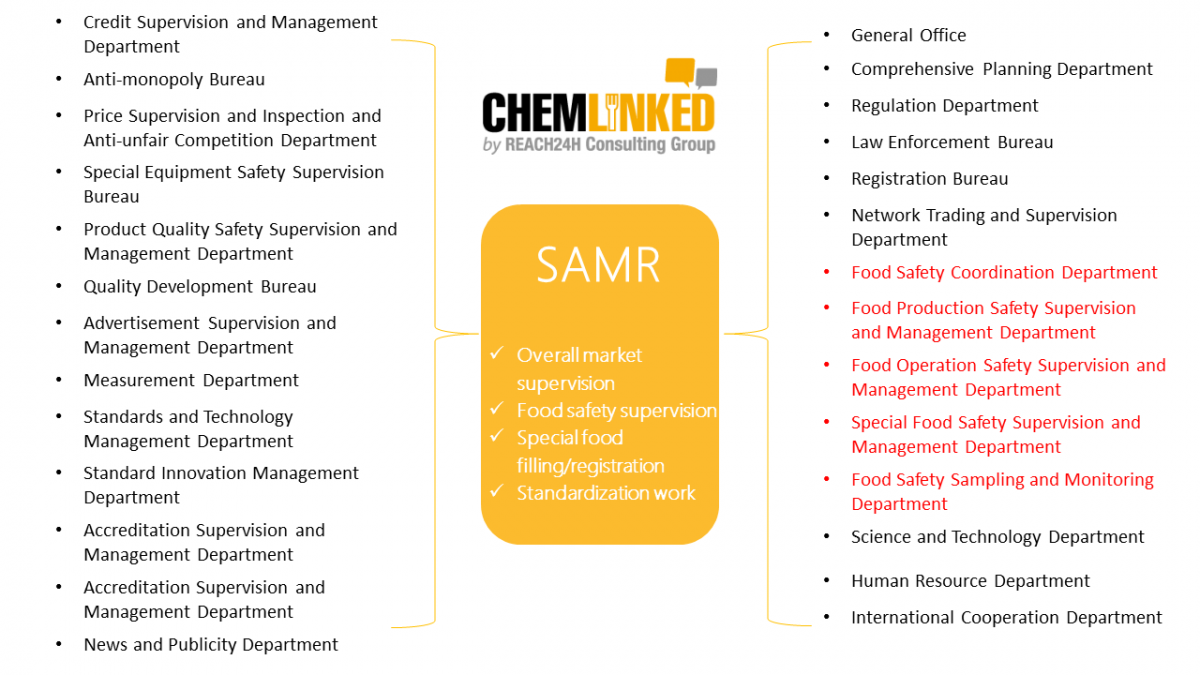
In general, SAMR takes overall charge of market supervision (food, cosmetics, pharmaceuticals, medical devices, Chinese medicine), and now it is responsible for all work previously undertaken by CFDA, including policy drafting and supervision of special food (read CL news here).
Food safety supervision will be strengthened
SAMR will streamline and integrate departments belonging to the 3 disbanded authorities, but it does not mean that features and responsibilities of the former CFDA, AQSIQ and SAIC have been overlooked. SAMR consists of 27 subordinate departments, 5 of which are majorly tasked with food administration. The "Food Safety Inspection and Monitoring Department" is newly established, highlighting the significance of sampling inspection as a key metric in assessing food safety supervision progress and highlighting areas of weakness.
Special food policy remains unchanged temporarily
The establishment of a “special food safety supervision department” (health foods, infant formula, foods for special medical purposes) suggests that registration/filing of special food may in the future be subject to more stringent supervision. This department will exclusively take charge of administrating the entire special food supply chain including all registration/filing work. At present the details of these changes and the practical impact on market access requirements have not been specified, so for all intents and purposes stakeholders will follow the requirements of the former CFDA.
CNCA registration & infant formula registration
There is significant change to the status of CNCA after the departmental restructuring. Previously CNCA was an independent institution under the oversight of AQSIQ, and took charge of overseas manufacturer registration (dairy, meats, aquatic foods, birds’ nests). Under the new system CNCA has become a subordinate department of SAMR (named “Accreditation Supervision Department”), which means that it is less independent now and under the jurisdiction of SAMR. However, its name “CNCA” will still be used.
SAMR is now the authority tasked with administrating both infant formula registration and overseas manufacturer registration. Undoubtedly, the inspection procedures will be further optimized to align with the requirements of infant formula registration. One thing we are sure of is that CNCA registration of overseas manufacturers will not be removed and indeed it is our expectation that the promise made by CFDA to expand overseas manufacturer registration to other high risk food categories (covering both high volume imports and inherent high risk categories of food) will likely be made good on by SAMR.
3 Stipulation Scheme of NHC
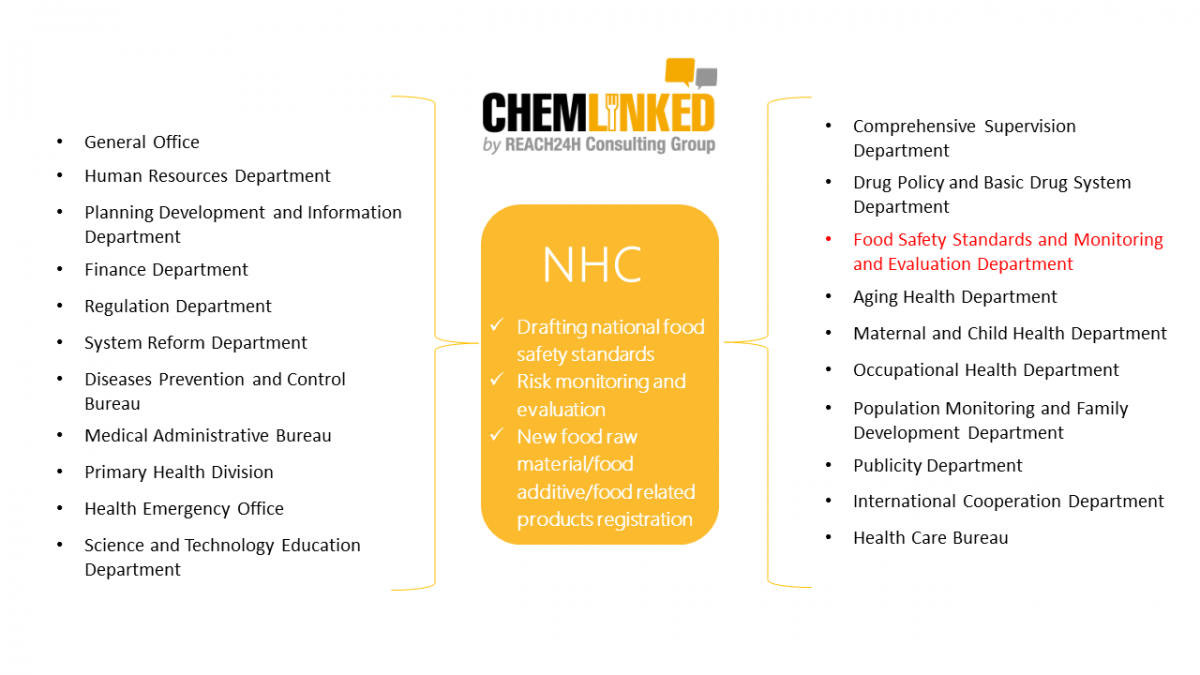 Generally speaking, NHC (National Health Commission) now takes charge of all food-related work previously undertaken by NHFPC, including:
standard drafting
risk monitoring
application of new food raw material/new food additives/new food related products
NHC will harness a big data approach through the use of its large database of national food safety and hygiene data to develop and promulgate more effective national food safety standards. We can expect are more stringent hygiene indexes, such as the maximum residue level of contaminants, pesticides and veterinary medicines in food (read CL news here).
3 Stipulation Scheme of GAC
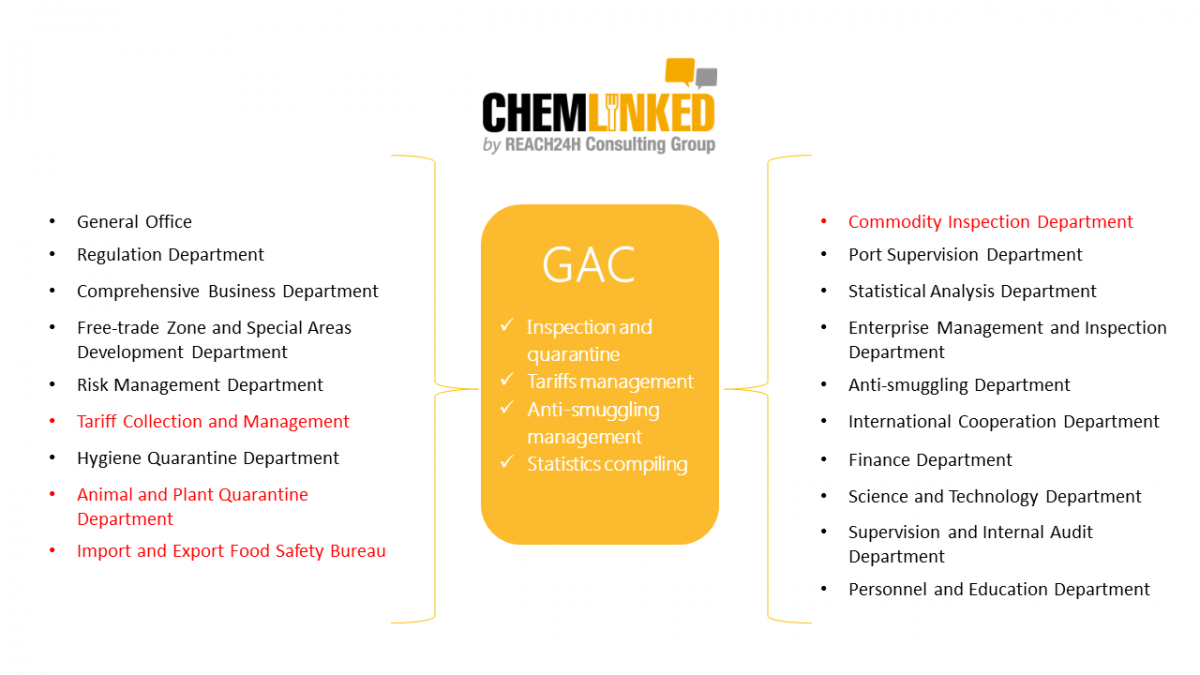
GAC’s new role will see it integrate responsibilities previously designated to AQSIQ and its subordinate provincial CIQ departments (read CL news here). A major bonus for international stakeholders can be seen in the integration of customs declaration and inspection which should in theory accelerate customs clearance times.
Although on first glance there seems to be significant benefits to the recent reform, on closer inspection the lack of WTO notification work (SPS and TBT notification) and regulation study might be cause for some consideration. Previously, AQSIQ and its subordinate provincial CIQ departments were heavily involved in studying the regulations used in foreign countries and also took charge of China’s WTO notification work. To date there have been no obvious indications on whether or not GAC will continue following these principles or continue working on previous projects.
Impact on Overseas Manufacturers
China is currently in the midst of a vast economic and social metamorphosis in which it is attempting to prioritize domestic consumption as a key driver for economic growth while transitioning away from its traditional reliance on primary and secondary industries. It appears that China’s latest iteration of intuitional reform is likely aimed at facilitating this transition and we get a greater appreciation for the key changes involved in this intuitional reform by contextualizing it in the light of this overarching goal. A key aim is the development of mechanisms that allow greater self-regulation by industry and allow market forces to guide regulation, the use of smarter metrics to gauge the efficacy of regulation and further consolidation and centralization of food supply chain administration . Devolution of centralized power to provincial authorities has been retained which will free up the central authority’s manpower to focus on important policy issues and allow more time to work towards realizing key food safety goals.
A key takeaway for international stakeholders is that the increased demand for imported foods may occasion development of new regulations and trade channels to facilitate importation with a concomitant increase in the stringency of supervision and the stringency of quality standards.
With all this said it is necessary to reiterate that the “3 stipulation scheme” is just a very broad outline of new ministries and departments. While we can infer a great deal from this blueprint, it provides us no information on future food policy or requirements which will ultimately be unveiled in the coming years. Therefore, we suggest overseas manufacturers to continue following all previous compliance and market access requirements and keep close tabs on China’s food regulation updates.
 We provide full-scale global food market entry services (including product registration, ingredient review, regulatory consultation, customized training, market research, branding strategy). Please contact us to discuss how we can help you by