Request a Demo
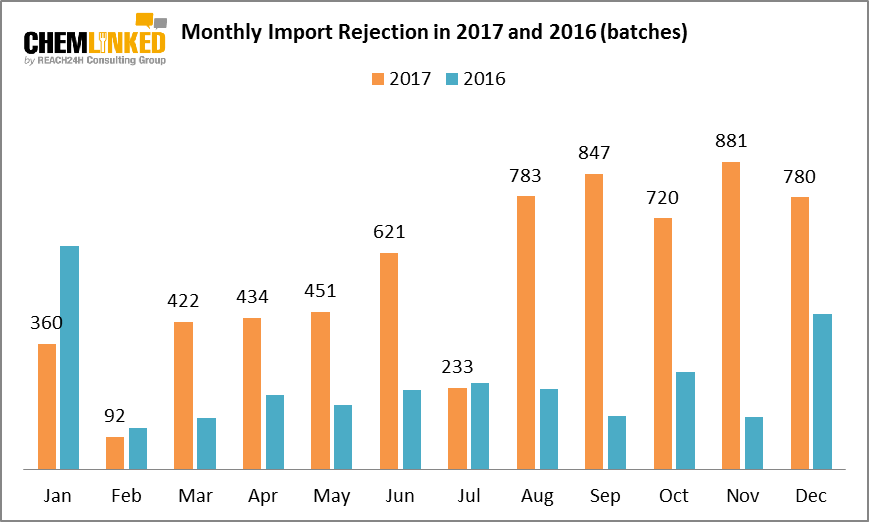
In recent years demand for imported food has grown significantly in China. According to data released by China AQSIQ, there were 6624 batches of food rejected during 2017, more than double the amount seen in 2016 (3031 batches). Altogether over 52 thousand tons of food were returned or destroyed. Non-compliance mainly involved beverage, pastry & biscuit, candy products, grain & grain products, and wine. Major rejection reasons were unqualified certificates and non-compliant labels.
The following chart offers a comparison between 2016 and 2017 data.
Non-compliant imported food data by countries/regions of origin
In 2017, 94 countries/regions had food rejected by Chinese authorities. With 909 batches of food rejected, Japan was the country with the highest number of rejections, followed by Taiwan, America, Korea, and Australia.
Countries/regions of origin | Batches | Proportion |
Japan | 909 | 14% |
Taiwan | 698 | 10% |
America | 525 | 8% |
Korea | 399 | 6% |
Australia | 306 | 5% |
France | 303 | 5% |
British | 293 | 4% |
Italy | 279 | 4% |
Germany | 262 | 4% |
Hong Kong | 235 | 4% |
Others | 2415 | 36% |
Japan
In 2016, Japan just accounted for 6% of the total food non-compliance, while in 2017 it ranked No.1 on the list, representing 14%. Food belonging to “HS code 19” (pastry food) accounted for the majority. 550 batches of this food category were rejected, due to lack of compliant documents or supporting materials.
Taiwan
698 batches of food were found non-compliant in 2017, which is similar to 2016 data (approximately 727 batches). Non-compliant label and lack of supporting materials are two major reasons that caused import rejection.
America
The number of non-compliant food batches increased from 182 in 2016 to 525 last year. Unlike Japan and Taiwan, illegal use of food additives and shelf life issue accounted for the majority of non-compliance.
Korea
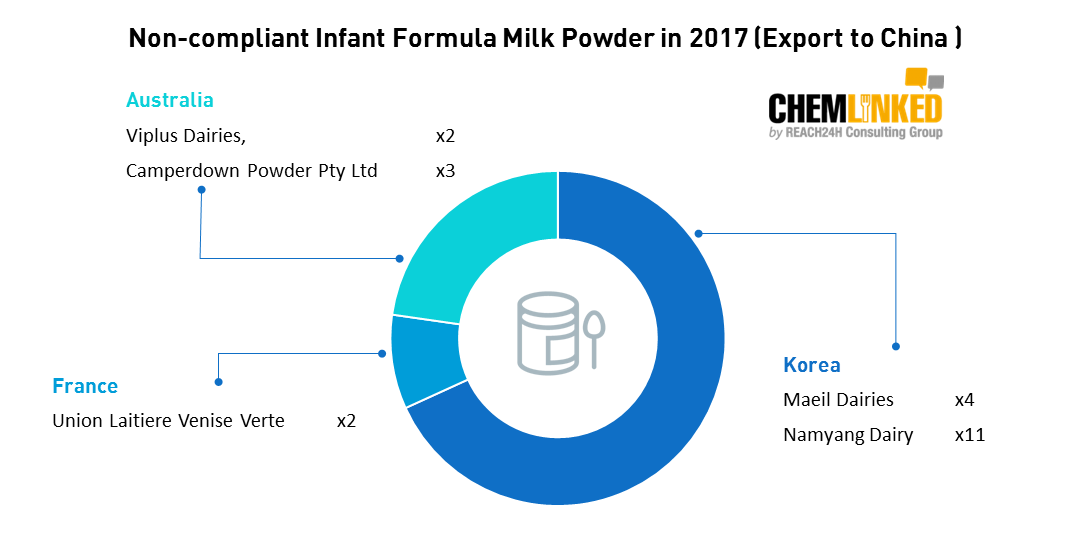
Korea is the country with the most rejected infant formula powder. 15 batches of infant formula milk powder manufactured by Maeil Dairies and Namyang Dairy are rejected in 2017 due to exceeding shelf life.
Australia
Label and shelf life issues are two major reasons for Australia's food import rejection, accounting for 38% of the total. Altogether 306 batched of food were rejected, and 47 batches of wine and 5 batch of infant formula milk powder from Australia were inspected non-compliant in 2017.
Non-compliant imported food by food categories
Food non-compliance in 2017 covers 450 types of food from following 22 HS code.
HS code | Food categories | Non-compliance of 2017 | Non-compliance of 2016 | ||
Batches | Proportion | Batches | Proportion | ||
19 | Preparations of cereals, flour, starch or milk; pastry products | 1758 | 26.5% | 833 | 27.5% |
22 | Beverages, spirits, wine and vinegar | 1267 | 19.1% | 511 | 16.9% |
21 | Miscellaneous edible preparations | 926 | 14.0% | 452 | 14.9% |
20 | Preparations of vegetables, fruit, nuts or other parts of plants | 575 | 8.7% | 271 | 8.9% |
17 | Sugars and sugar confectionery | 348 | 5.3% | 134 | 4.4% |
02 | Meat and edible meat offal | 344 | 5.2% | 111 | 3.7% |
04 | Dairy product; birds’ eggs; natural honey; edible products of animal origin, not elsewhere specified or included | 332 | 5.0% | 229 | 7.6% |
18 | Cocoa and cocoa preparations | 279 | 4.2% | 105 | 3.5% |
09 | Coffee, tea and food flavoring | 229 | 3.5% | 136 | 4.5% |
16 | Preparations of meat, of fish or of crustaceans, molluscs or other aquatic invertebrates | 172 | 2.6% | 26 | 0.9% |
03 | Fish and crustaceans, molluscs and other aquatic invertebrates | 139 | 2.1% | 72 | 2.4% |
08 | Edible fruit and nuts; peel of citrus or melons | 77 | 1.2% | 23 | 0.8% |
15 | Animal or vegetable fats and oils and their cleavage products; prepared edible fats; animal or vegetable waxes | 55 | 0.8% | 46 | 1.5% |
11 | Products of the milling industry; malt; starches; inulin; wheat gluten | 27 | 0.4% | 36 | 1.2% |
12 | Oil seeds and oleaginous fruits; miscellaneous grains, seeds and fruit; industrial or medicinal plants; straw and fodder | 27 | 0.4% | 25 | 0.8% |
10 | Cereals | 23 | 0.3% | 14 | 0.5% |
25 | Salt, Sulphur, etc. | 13 | 0.2% |
| 0.0% |
07 | Edible vegetables and certain roots and tubers | 9 | 0.1% | 4 | 0.1% |
28 | Inorganic Chemicals, precious metal, rare earth metals, radioactive element | 8 | 0.1% | / | 0.0% |
05 | Products of animal origin, not elsewhere specified or included | 8 | 0.1% | 10 | 0.3% |
13 | Shellac, gum, resin, and other organic infusions | 4 | 0.1% | / | 0.0% |
35 | Protein substances | 4 | 0.1% | / | 0.0% |
*if the non-compliance proportion is higher than that of 2016, the figures are highlighted in red; otherwise, they are highlighted in green.
Generally speaking, the number of non-compliant batches for each food category all increased compared to last year and some even doubled or tripled. Food belonging to “HS code 19, 22, and 21” still remains the top 3 of food non-compliance, while the proportion of food HS code 19 and 21 dropped slightly to 26.5% and 14.0%. HS code 22 (Beverages, spirits, wine and vinegar) presents the most remarkable increase by 2.2% among those 22 food categories.
Dairy products
199 batches of dairy products were rejected in 2017, amounting to nearly 500 tons. Cheese products were most frequently blacklisted as 84 batches were inspected non-compliant majorly due to exceeding shelf life. Dairy products are mainly imported from European countries. With 37 batches rejected, Italy is the country with the most dairy product non-compliance, followed by Australia (32), and France (26). In addition, some famous brands were also blacklisted, such as A2 and Devondale.
Infant formula
Though infant formula accounted for a small percentage of imported food non-compliance, 22 batches of infant formula milk powder from Korea, Australia and France were rejected in 2017. The major reason for non-compliance is exceeding shelf life. Manufacturers blacklisted are Viplus, Maeil Dairies, Namyang Dairy, Camperdown Powder Pty Ltd, and Union Laitiere Venise Verte.
Wine
China imported 746 million liters of wine worth about US$2.789 billion in 2017. The number of rejections was also high, especially for grape wine. 500 batches of wine were rejected and more than half was grape wine. The import volume to rejection ratio was however similar to previous years. French wine ranked top in 2017 in both import volume and value terms. France also ranked number 1 in terms of wine non-compliance. 87 batches of wine from France were rejected, followed by Australia (47) and Germany (45). The non-compliance majorly resulted from non-compliant label and lack of qualified certificate.
Please click here for data analysis of China’s wine import of 2017.
Reasons for food non-compliance
Health and safety violations | |
exceeding shelf life | 17.2% |
illegal use of food additives | 13.0% |
microbial contamination | 6.3% |
illegal use of food fortification substances | 2.9% |
violating national food safety standards | 1.6% |
Non-health and safety violations | |
lack of compliant documents | 19.2% |
non-compliant use of label | 16.1% |
non-compliant package | 6.3% |
lack of inspection and quarantine permit | 4.9% |
discrepancy between cargo and certificates | 4.6% |
Others | |
| 7.8% |
Unqualified documents, shelf life and label issues are 3 leading factors that caused food rejection. Lack of compliant documents most frequently occurred among the three, representing 19.2%. In terms of health and safety violations, nearly 1140 batches of food were associated with shelf life issues. Long duration of transportation may be one of the factors, but it also suggests that some foods exported to China may not be fresh enough. As for illegal use of food additives, it mainly concerns exceeding application scope/limit of colorants, preservatives and vitamins.
Comments and suggestion
Make full preparation prior to food export
Shelf life is one of the major factors that caused non-compliance. Generally speaking it may take approximately 1 or 2 months for consignments of food to reach China by ship from far away countries/regions. After arriving at China’s ports, CIQ will conduct a series of inspection and quarantine. If enterprises lack some essential documents or the label is not compliant, they have to spend time supplementing materials or revising the label. In this way, the product may have already passed or be nearing its expiry date before it is cleared. Therefore, it is important to make full preparation prior to exporting food to China, including arranging a reasonable transportation schedule, checking whether documents are well-prepared, if the label is compliant, etc..
Be acquainted with China’s food import regulations
Based on data mentioned above, non-health and safety violations accounted for the majority of food non-compliance during 2017. It means that many overseas manufacturers are not so familiar with detailed requirements when exporting food to China.
The Chinese government has released a series of administrative measures related to food import, such as Administrative Measures for Inspection and Supervision of Imported Foods at Ports (Draft), Administrative Measures on Inspection, Quarantine and Supervision of Import and Export Dairy Products. Besides, in recent years China has been optimizing national food safety standards and related industry regulations, including updates, deletions and refinements of China’s directory of national food safety system (click here for detailed information), finalizing "Technical Guidance for Labeling of Infant Formula Recipe Registration" (read CL article here).
Due to the complexities inherent in crossborder regulatory compliance we find that document, label, package and other compliance issues are frequent occurrences. Therefore, it is highly suggested that staff tasked with ensuring the compliance of goods exported to China should study related import documents. They can also seek help from professional compliance consulting companies, like REACH24H. Enterprises shall also monitor some official websites like CFDA, AQSIQ, or just pay attention to some professional food information platforms, such as ChemLinked Food Portal, to obtain the latest regulatory updates.
 We provide full-scale global food market entry services (including product registration, ingredient review, regulatory consultation, customized training, market research, branding strategy). Please contact us to discuss how we can help you by