Request a Demo
In July 2017, NHFPC released an official letter detailing the updates, deletions and refinements of China’s directory of national food safety system marking a milestone in the construction of China’s food safety regulatory framework. These changes beg the following questions: Why is the government updating its food safety standards? What is the current state of China’s national food safety standard system? How will the standard system develop in the future?
In this article we will overview China’s food safety standard system and detail recent changes in addition to offering some insight and answers to these difficult questions.
Reasons why Chinese government updates and optimizes its national food safety standards
Repetition, redundancy and conflict in China’s national food safety standards
Before 2009, China had 3 separate national food safety standard systems administrated by 3 competent authorities. There was the Food Hygiene Standard enacted by the Ministry of Health, the Food Quality Standard enacted by AQSIQ and the Agriculture Products Quality and Safety Standards enacted by the Ministry of Health. One of the biggest problems in this three pronged system was that regulatory content was duplicated in many standards making designation of regulatory responsibility and clarification of industry obligations particularly difficult. Take inorganic arsenic limits in foods for example, the FooHygiene Standard (GB2762-2005) stipulated its limit in poultry meat was 0.05 mg/kg, however, according to the Food Quality Standard (GB-16869-2005), it was 0.5mg/kg for fresh and frozen products. Under these circumstances, enterprises were unclear about which standards to reference when circulating products on the market.
Loopholes in food safety regulation
At one stage there were over 5000 food safety standards in China, but despite this high number there were still obvious loopholes, glaring omissions in content and lack of regulatory coverage in important sectors of the food industry. A prime example of this was highlighted after the 2008 melamine scandal in which 30,000 infants were diagnosed with kidney stones caused by consumption of melamine adulterated formula. Interestingly at the time there was no specific standard regulating melamine use in foods.
Outdated food safety standards hinder the development of food industry
With the development of society and scientific technology, the food industry is experiencing rapid changes. Food raw materials are becoming more diversified, testing methods are becoming more advanced, and the public is also asking for higher standards. In 2011 food safety standards used for over 10 years accounted for 25% of all Chinese food safety standards, and some standard hadn’t been revised in 20 years. The problem was twofold, both negatively affecting the development of China’s domestic industry and also hindering exports to other countries.
Analysis of current framework of national food safety standards
According to the Directory of National Food Safety Standards issued in 2017, China’s food safety standards can be classified into 6 categories, including general standard, product standard, additive specification and related standard, food related products, production and operation standard and testing method standard.
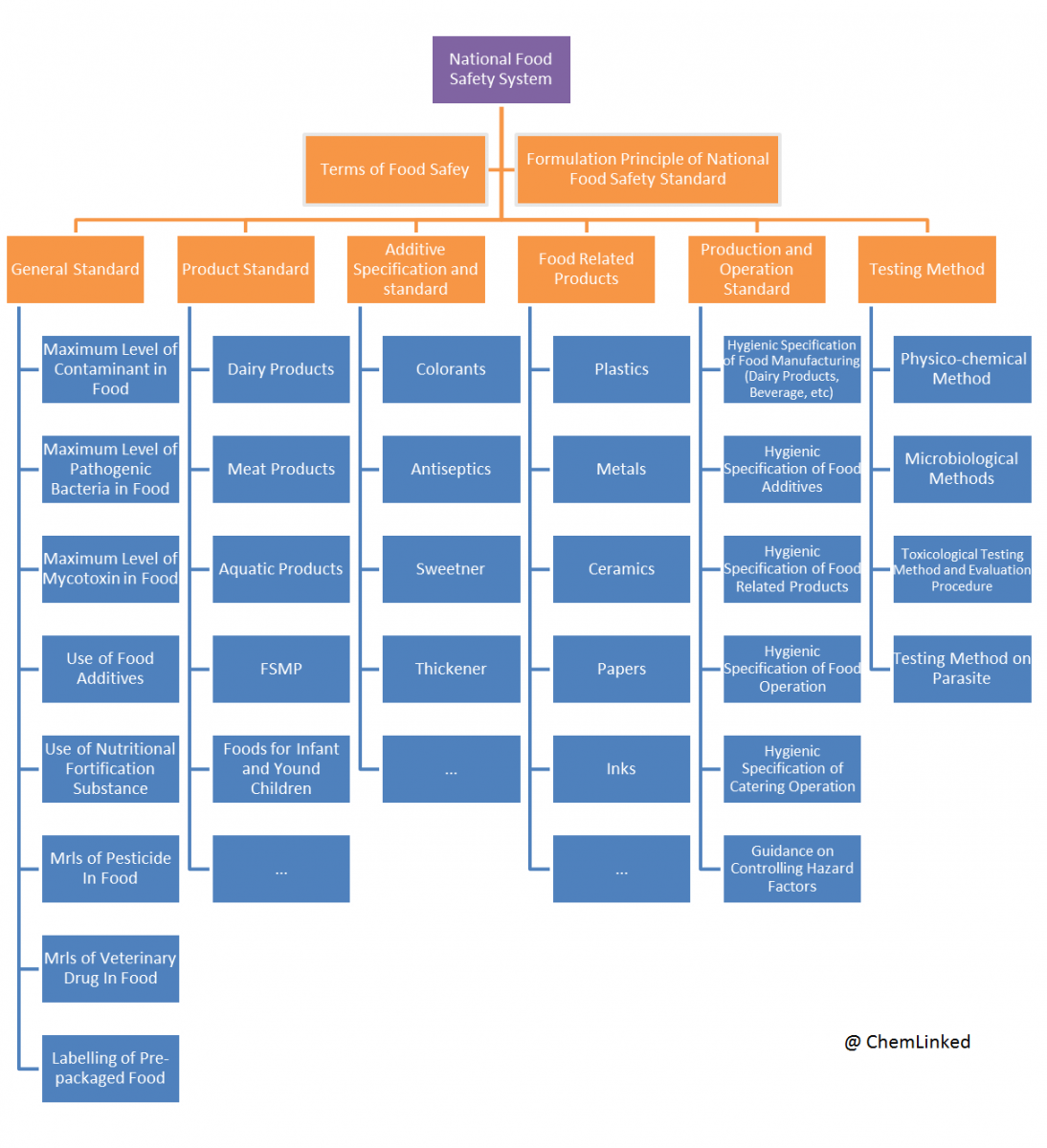
As of April 2017, 1,224 national (GB) standards have been issued by China NHFPC, including 11 general standards, 73 product standards, 615 standards for food additives, 15 for food related products, 25 for food production and operation, 418 testing method (Check all the standards in our F-lists).
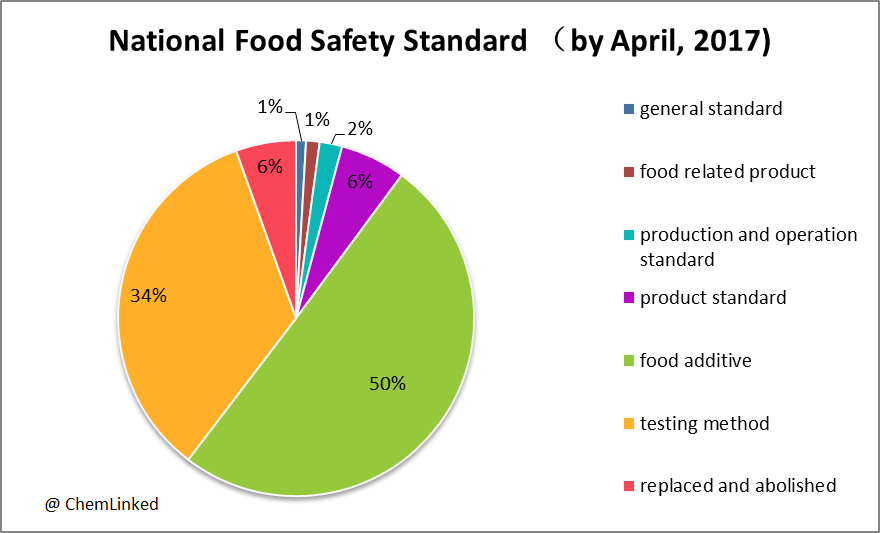
Food additive and testing methods account for the majority of standards, while general standard and standard for food related products only account for 1%. Generally speaking China operates using horizontal standards which cover all food products and vertical standards which stipulate detailed requirements for specific products.
● General standard: Horizontal standards
General standard focuses on broad, all-encompassing food requirements, such as contaminant, pesticide residue, labeling, etc. The application scope of general standards is much wider than other food safety standards. For example, GB 7718-2011 General Standard for the Labeling of Prepackaged Foods specifies the common requirements of labeling for all prepackaged food. Moreover, general standards also set several essential indexes in food industry, such as maximum level of contaminant in different types of food regulated in GB 2762-2017, maximum mycotoxin level in GB 2761-2017, maximum residue limit of pesticides in GB 2763-2016. GB 2760-2014 also stipulates the use of food additive in various foods. These requirements apply to all kinds of food and food products.
● Product standard: Vertical standards
Compared with general standards, product standards set specific requirements for food categories and specific products, such as milk powder, health food, beverage, etc. A product standard details product specific requirements including maximum level of microorganism, contaminant, pesticide and use of food additives which supersede the general requirements for foods laid out in horizontal standards. In instances where a specific index is omitted from a product standard manufacturers can reference general standards.
● Food additives
China uses a positive list system to manage the use of food additives. Only additives reviewed and approved by government can be used in food. GB 2760 stipulates permitted additives, application scope, maximum usage and some other requirements. For some food additives, authorities also set standards to regulate sensory requirements, physicochemical indexes, and testing method.
● Food related products
Food related products mainly include food contact materials, detergent, sanitizer. China also adopts a positive list system to regulate the additives used in food contact materials. Approved additives, their application scope, usage amount and other requirements are all listed in GB 9685-2016. There are also standards for specific food related products, like ceramic articles, plastic materials, and glass articles. These standards mainly specify their physical and chemical Indexes and specific conditions of migration tests.
● Production and operation standard
These standards focus on the management of the early links in the supply chain including primary agricultural products, manufacture of food, circulation and operation, etc.
● Testing method standards
Testing method standard consists of physical and chemical analysis, microorganism examination, toxicology examination, determination of residual veterinary drug and pesticide etc. At present, testing method standards are all mandatory in China. Testing methods are also specified in some product standards which is a source of confusion for industry in regards to regulatory compliance and selection of the appropriate testing methods.
Standard optimization, refinement, update and consolidation
According to the announcement released by NHFPC in July, 2017, 1082 pesticide and veterinary drug standards will be updated by MOA, and a further 3310 standards will be treated as follows:
Some standards will be integrated, revised or transferred (integrated into 412 items of standards)
Some are suggested to be abolished (57 items)
Some are excluded from national food safety standard system (1913 items)
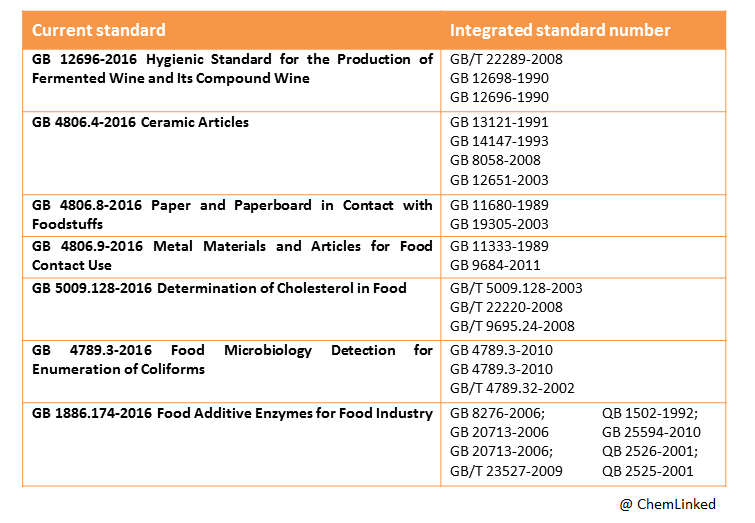
Due to content repetition in many instances several standards are integrated into one national standard. Take the determination of protein for example, previously, apart from national standard for determination of protein in food, there was also protein determination in oil, edible fungi, cereal and bean; nitrogen content determination in meat and meat products, plant oilseeds residues. After clearance, all those standards are integrated as GB 5009.5-2016 Determination of Protein in Food. Here are some other examples.
The future trend of China food safety system
General standards will cover more food and food products and will increasingly supersede product standards
Industry experts predict that general standards will be further updated and cover specific food and food products. As a general rule industry is advised to primarily reference general standards rather than product standards during NPD or market entry feasibility assessment.
Application of HACCP system
HACCP is a systematic preventive approach to food safety to prevent or minimize insults of a biological, chemical, or physical nature encountered during production processes that can cause the finished product to be unsafe. At the beginning, manufacturers need to have hazard analysis, then they should determine critical control points and set crucial limits. HACCP system prioritizes premarket safeguarding of food safety rather than inspection of finished products. This system has been widely adopted in developed countries, like America, Canada, and Australia, and is mandatory in production of multiple food categories. However, China still relies on examination of finished products to foster food safety, which is not an efficient way to identify problems. Although there are production and operation standards (like GMP) effective in China, there is still no HACCP system or similar.
 We provide full-scale global food market entry services (including product registration, ingredient review, regulatory consultation, customized training, market research, branding strategy). Please contact us to discuss how we can help you by