Request a Demo
The halal food industry in the Philippines is rapidly expanding, fueled by both a growing domestic Muslim population and increasing consumer interest in ethical, safe, and high‐quality products. As the nation positions itself as a major processing hub for halal food in the Asia Pacific region, it has become an attractive gateway for global halal food suppliers targeting key Muslim markets such as Indonesia, Malaysia, and the Gulf Cooperation Council (GCC) countries. In this article, ChemLinked delves into the market landscape, regulatory mechanisms, ongoing industry initiatives, as well as the challenges and opportunities that lie ahead.
Thriving Halal Food Market
Thanks to supportive government policies, surging consumer demand, a strategic geographic location, and a robust agricultural base, the Philippines is set to emerge as a key player in the global halal market. This development opens up significant opportunities for both local enterprises and international investors.
1. Market overview
With the increasing Muslim population, the food sector in the Philippines is witnessing a dynamic transformation, as halal-certified products gain prominence. Notably, the country boasts the third largest Muslim population in Southeast Asia. According to the National Council of Muslim Filipinos (NCMF), Muslims constitute approximately 10% of the population—around 12 million people—primarily concentrated in Mindanao and increasingly in urban centers such as Metro Manila and Cebu.
Beyond satisfying domestic demand, the Philippine Department of Trade and Industry (DTI), in collaboration with local industry players, is actively promoting the Philippines as a halal food processing hub. Here, both local and imported raw materials are processed, branded, and then exported to predominantly Muslim regions.
Driven by these factors, industry projections suggest that the market could expand from an annual value between PHP 40–100 billion (USD 777 million–USD 1.94 billion) to around PHP 230 billion (USD 4.46 billion) in the coming years.
2. Halal import
The Philippine halal market is valued at billions of pesos annually. Data from the Philippine Bureau of Customs (PBOC) indicate that the country imported approximately US$120 million worth of halal products in 2022, covering dairy, meat, and various processed food items. For example:
Dairy Products: The United States (51%) and New Zealand (47%) are the primary suppliers. Major dairy imports include skimmed milk powder (44%), milk fat (29%), lactose powder (10%), buttermilk powder (9%), whey powder (7%), and cream cheese (1%).
Beef: Halal beef imports are sourced mainly from India (63%), Brazil (30%), Australia (5%), and Ireland (1%).
Poultry Meat and Products: The United States dominates the supply of chicken leg quarters (96%), while Brazil (4%) provides a range of other chicken cuts such as wings, half breast, and leg quarters, as well as skin and mechanically deboned meat.
Glucose Syrup: Primarily imported from South Korea.
Animal Fats: Tallow is mostly supplied by Australia (93%) and, to a lesser extent, by Ireland (1%), while chicken fat comes from France (6%).
Other Products: Various processed food items, including cocoa products and chicken powder, also contribute to the market.
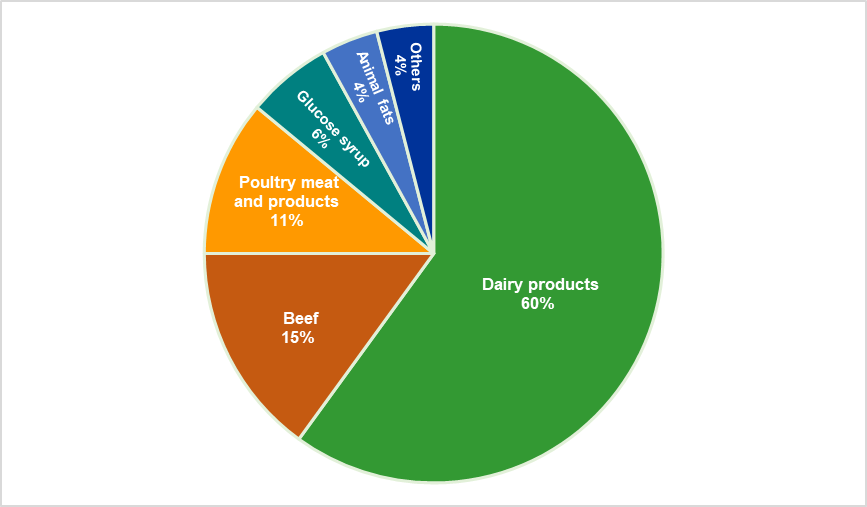 Imported Halal Products in the Philippines in 2022
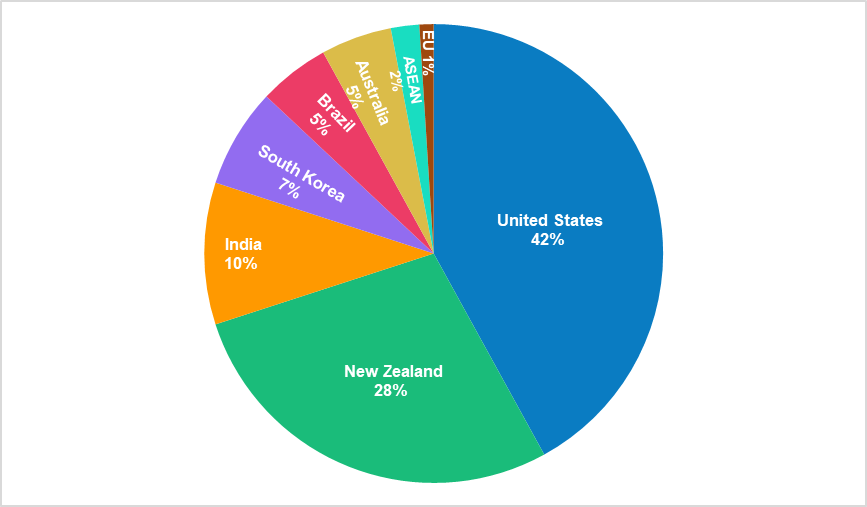 Sources of Imported Halal Products in 2022
3. Challenges and dilemmas
Despite being home to Southeast Asia's third-largest Muslim population, the Philippines lags behind non-Islamic countries such as Singapore and Thailand in halal production. The relatively low number of halal-certified goods, services, and companies further hampers industry growth. Key challenges include:
Certification & Standardization: A primary hurdle is the absence of a unified and transparent certification system. With only a limited number of restaurants holding halal certification, inconsistencies may foster consumer mistrust. Ongoing efforts aim to streamline the certification process by aligning local standards with international guidelines.
Infrastructure & Supply Chain: Establishing robust supply chains—including cold storage and logistics that strictly adhere to halal requirements—remains critical. Investments in dedicated halal industrial zones and production facilities are essential to ensure the seamless operation of the supply chain from farm to table.
Consumer Awareness & Education: Both producers and consumers exhibit varied levels of understanding regarding true halal compliance. Educational campaigns and training programs are needed to dispel misconceptions and assist small and medium-sized enterprises (SMEs) in meeting certification requirements.
Halal Regulatory Landscape
Although the Philippines does not enforce mandatory halal certification policies, the rapid growth of the halal industry has prompted continuous improvements in its regulatory framework and certification requirements.
1. Main regulators
In 2012, the National Commission on Muslim Filipinos (NCMF) was mandated by Republic Act No. 9997 to develop the Philippine Halal industry and accredit halal-certifying bodies. This act transferred the responsibility of halal certification to the private sector while assigning the government, through NCMF, to accredit halal certifiers. To date, NCMF has recognized 12 Accredited Halal Certifying Bodies (HCBs) across the nation to conduct halal certification activities. Moreover, NCMF is tasked with:
Assisting Philippine HCBs in gaining recognition abroad;
Helping manufacturers and producers promote and market halal foods and products;
Harmonizing domestic halal standards and formulating a National Halal Standard in line with international guidelines;
Establishing a database of halal companies, manufacturers, and products for ready reference.
Later in 2016, Republic Act No. 10817 established the Philippine Halal Export Development and Promotion Board (hereafter as "Halal Board"), chaired by the Department of Trade and Industry (DTI), with the NCMF Secretary designated as vice chairperson. This act reassigned the task of halal accreditation to DTI's Philippine Accreditation Bureau (PAB). The Halal Board's primary functions include:
Formulating, advocating, coordinating, overseeing, and assessing the implementation of the Philippine Halal Export Development and Promotion Program;
Recognizing accredited halal certification bodies abroad to open new markets and expand existing ones for halal products, processes, and services;
Issuing the Philippine Halal Logo along with guidelines for its proper use.
It is important to note that while both the NCMF and the Halal Board are authorized to accredit HCBs, the NCMF's jurisdiction covers halal-certified products for local consumption, whereas the Halal Board focuses on products intended for export.
At the end of 2024, the Philippines launched the National Halal Industry Development Office (NHIDO) under the DTI. This initiative supports the government's halal strategy by coordinating all development efforts, engaging stakeholders, and establishing a unified and robust halal industry. NHIDO's key responsibilities include:
Simplifying halal certification and standards for micro, small, and medium enterprises (MSMEs) through capacity-building programs and specialized training;
Promoting public awareness via various media platforms and community outreach initiatives;
Developing a comprehensive halal industry database and establishing monitoring and evaluation systems for data-driven planning.
2. Key legislations
The Philippine halal regulatory framework is anchored primarily in Republic Act No. 9997 and Republic Act No. 10817. In addition, several voluntary halal standards for agricultural products have been released, offering guidelines on the production, preparation, handling, and storage of halal food. The main legislative instruments include:
Legislation | Effective Date | Main Contents |
Republic Act No. 9997 National Commission on Muslim Filipinos Act of 2009 | March 5, 2010 | Establishes the NCMF to safeguard and promote the cultural, educational, economic, and religious rights of Muslim Filipino communities. The Commission is responsible for coordinating policies, promoting Islamic education, and setting halal industry standards. |
December 11, 2014 | Supplements RA No. 9997 with detailed rules and regulations. | |
Republic Act No. 10817 Philippine Halal Export Development and Promotion Act of 2016 | May 31, 2016 | Establishes the Philippine Halal Export Development and Promotion Program, outlining targets, objectives, and strategies to boost the export of halal products. It also creates the Philippine Halal Export Development and Promotion Board. |
August 10, 2017 | Provides detailed rules and regulations supplementing RA No. 10817. | |
March 13, 2008 | Outlines general guidelines for the preparation and handling of halal food in the Philippine food industry, serving as a basic requirement for food products and trade. | |
2015 | Specifies requirements for halal feeds regarding the use of by-products, upgrading of ingredients, and productivity enhancements. | |
PNS-BAFS 101-2016 – Halal Agriculture and Fisheries Products — Product Standard | Originally released in 2011 and revised in 2016 | Defines halal and non-halal food sources, sets minimum requirements for halal certification of animal, plant, and genetically engineered products, and outlines standards for slaughtering, hygiene, packaging, and labeling. |
PNS-BAFS 102-2016 – Halal Ruminants — Code of Practice — Slaughtering | Originally released in 2011 and revised in 2016 | Covers facility requirements, animal handling, slaughter procedures, and post-slaughter processing, ensuring the safety and compliance of halal ruminant meat. |
PNS-BAFS 103-2016 – Halal Poultry — Code of Practice — Slaughtering | Originally released in 2011 and revised in 2016 | Sets requirements for the halal slaughter of poultry for human consumption, addressing all stages from production to distribution. |
2018 | Establishes the principles of halal goat production in accordance with Islamic law. | |
2021 | Details the minimum requirements for the handling of raw milk from cattle, carabao, water buffalo, or goats to ensure compliance with halal standards. |
3. Halal certification
Halal certification verifies that products, processes, services, and systems adhere to halal standards through independent and ethically sound audits. Before a product can feature a halal label, it must undergo inspection by recognized organizations—typically non-profit Philippine Muslim People's Organizations (MFPO) or Muslim Non-Governmental Organizations (MFNGO)—which serve as Halal Certification Bodies (HCBs).
The Philippines currently employs a voluntary halal certification system. Interested parties may secure certification from accredited local bodies; however, a unified national standard or regulation for halal certification is still lacking, as various HCBs operate based on their own guidelines.
Generally, the halal certification process in the Philippines involves submitting a letter of intent, completing an application form, undergoing an evaluation and facility audit to ensure compliance with halal standards, and, upon satisfactory review, receiving the certification.
Common documents required for halal certification include:
Letter of Intent: A formal request from the company or manufacturer specifying the products for which halal certification is sought.
Application Form: Detailed company and product information, including contact details and product sheets.
FDA Certificate/Permits: Such as the License to Operate (LTO) and Certificate of Product Registration (CPR).
Product Information: Detailed composition and ingredient list.
Laboratory Analysis: Test reports from accredited laboratories.
Brief Description of Manufacturing Process
Establishment Layout
For imported food products, the Philippine FDA requires importers to register all prepackaged food items. Any labeling claim—such as halal—must be supported by proper documentation. In such cases, a halal certificate from an internationally recognized certifying body may be submitted alongside the Certificate of Product Registration (CPR). Imported products may also seek halal certification from local HCBs. For further details, please refer to Understanding the Philippines' Certificate of Product Registration (CPR) Requirements for Imported Foods.
4. Halal logo
After obtaining Halal Certificates from accredited HCBs, certified products can carry a halal logo on the packaging. Same as the halal certification requirements, the halal logo vary among the HCBs.
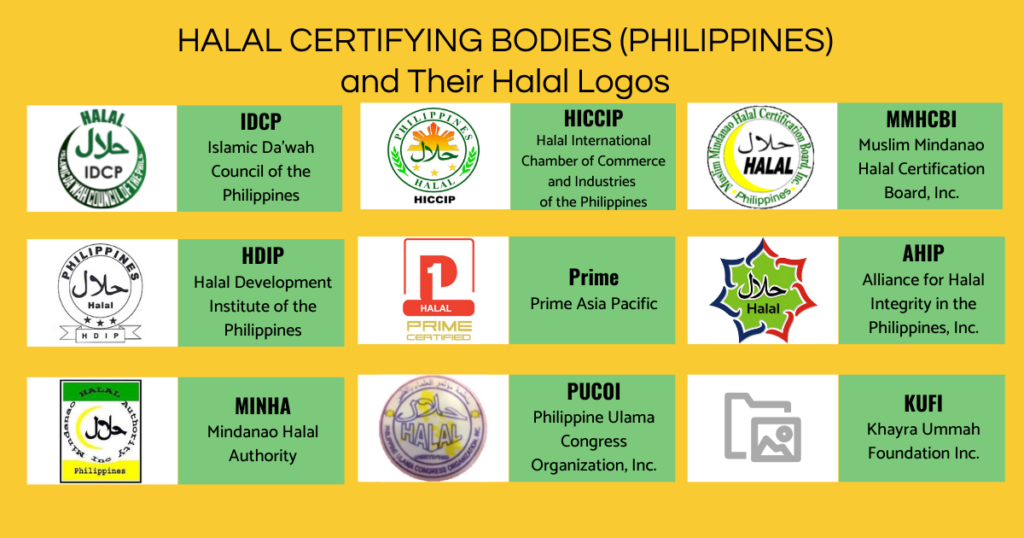 Part of Halal Logos from HCBs in the Philippines
To identify halal-certified products, the Philippine government introduced a national halal logo in July 2019, available in both monochrome and full-color versions. Monochrome version is for labeling purposes as a means to reduce printing costs and another in full color is for other printing materials. Importantly, despite the launch of the National Halal Logo, existing logos of HCBs remain authorized for use.
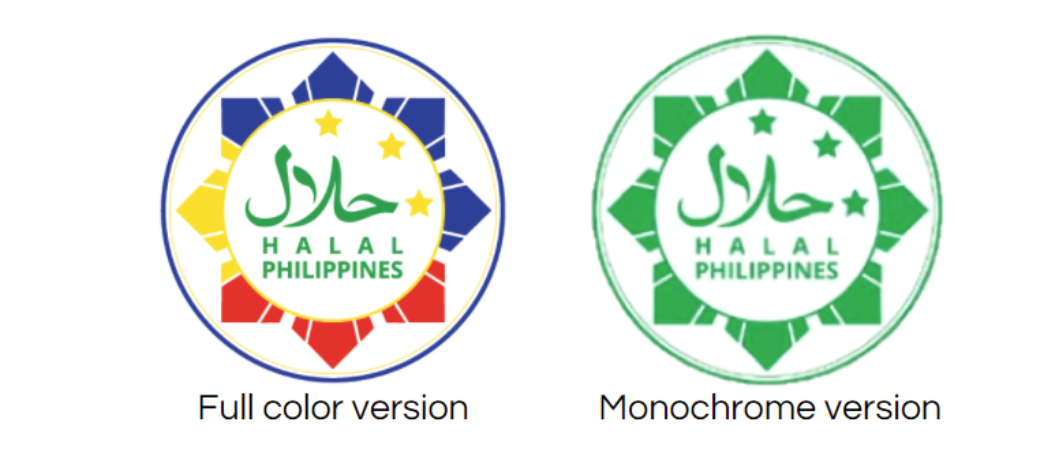 Philippine National Halal Logo
Conclusion
Although the halal food market in the Philippines is developing rapidly and has significant potential, and the government has ambitions to position the country as a leading halal processing hub in the Asia-Pacific region, the market still faces some major challenges.
A major limitation is the relatively small number of halal-certified products available. More critically, government oversight of halal food and certification remains weak. This is primarily reflected in the lack of clear authority distribution among different agencies, inadequate enforcement of responsibilities, and the absence of mandatory and unified halal regulations. As a result, the halal industry in the Philippines is often perceived as loosely structured, with significant gaps and inconsistencies. These gaps compromise the integrity of halal-certified products and services. Additionally, there is a lack of dedicated infrastructure for halal storage, slaughterhouses, and transportation, making halal products more susceptible to contamination.
Nonetheless, the future of the Philippine halal food industry appears promising. With more robust government support, growing consumer demand, a strategic location, and a solid agricultural base, the Philippines is well-positioned to become a pivotal player in the global halal food market, offering significant opportunities for both local businesses and international investors.
 We provide full-scale global food market entry services (including product registration, ingredient review, regulatory consultation, customized training, market research, branding strategy). Please contact us to discuss how we can help you by