Request a Demo
Before exporting halal foods to Malaysia, it is crucial to comply with both the relevant food category regulations and halal requirements. While many people are familiar with the Department of Islamic Development Malaysia (JAKIM) as the primary authority overseeing halal certification, it is important to recognize that other authorities also impose halal requirements across various aspects. Understanding these regulations is essential for ensuring compliance. In this context, this article summarizes the halal requirements established by the above authorities and highlights key content affecting halal food regulations.
Notably, although halal certification is generally voluntary, it is mandatory for all animal products (excluding pork) and their derivatives prior to export. For other product categories, while not legally required, obtaining halal certification is strongly recommended. Read more at ChemLinked’s article:
1. Regulations under the Ministry of Domestic Trade and Cost of Living (KPND)
The Ministry of Domestic Trade and Cost of Living Affairs (KPDN) aims to foster a viable and competitive domestic economy. A key regulation under KPDN is the Trade Descriptions Act 2011, which prohibits false trade descriptions and misrepresentations. This Act is critical for understanding halal food regulations, as it establishes the foundation for its subordinate regulations related to halal management.
Key Regulatory Provisions
1. Trade Descriptions (Definition of Halal) Order 2011: This order defines that food / products are considered halal if:
They do not contain parts from forbidden animals for Muslims or are not slaughtered;
They do not contain impurities (najis);
They are not intoxicating;
They do not contain parts or products from humans;
They are not toxic or harmful to humans;
Equipment is not contaminated with impurities; and
They are not in contact with, mixed with, or close to forbidden animals or impurities during processing.
2. Trade Descriptions (Certification and Marking of Halal) Order 2011: This regulation specifies the conditions under which foods can be labeled as halal and includes provisions for the halal logo and recognition of foreign halal certification bodies. Notably:
All imported food and goods marketed in Malaysia shall not be described as halal unless the imported food and goods comply with the requirements or certified as halal by the foreign halal certification body recognized by JAKIM.
The importer or manufacturer of the food and goods which have been certified as halal by the foreign halal certification body recognized by JAKIM shall mark on the said food and goods, the name of the said certification body.
Table 1: Summary of Regulations Under KPDN
No. | Regulation name | Major content |
1 | Prohibition of false trade descriptions and misstatements | |
2 | Trade Descriptions (Definition of Halal) Order 2011 & Its Amendment |
|
3 | Trade Descriptions (Certification and Marking of Halal) Order 2011 and its amendment |
|
4 | Trade Descriptions (Certification and Marking of Halal Fees) Regulations 2011 and its amendment | Fees for certification |
2. Regulations Under the Royal Malaysian Customs Department (RMCD) and Malaysia Quarantine and Inspection Service (MAQIS)
To understand halal requirements for imported foods, it is imperative to consider the regulations imposed by Royal Malaysian Customs Department (RMCD) and Malaysia Quarantine and Inspection Service (MAQIS). These bodies oversee the importation of goods and ensure compliance with health and safety standards.
Key regulations include:
Customs (Prohibition of Imports) Order 2023 and their amendments specify the goods which are prohibited to be imported into Malaysia except they are imported in the manner provided. For instance, it is specified that products such as meat and milk must obtain an import permit issued by or on behalf of the Director General of the Department of Malaysian Quarantine and Inspection Services (MAQIS) under the Malaysian Quarantine and Inspection Services Act 2011 [Act 728].
Animal Act of 1953 and Animal (Importation) Order 1962 also impose similar requirements regarding import permit for animal and animal products.
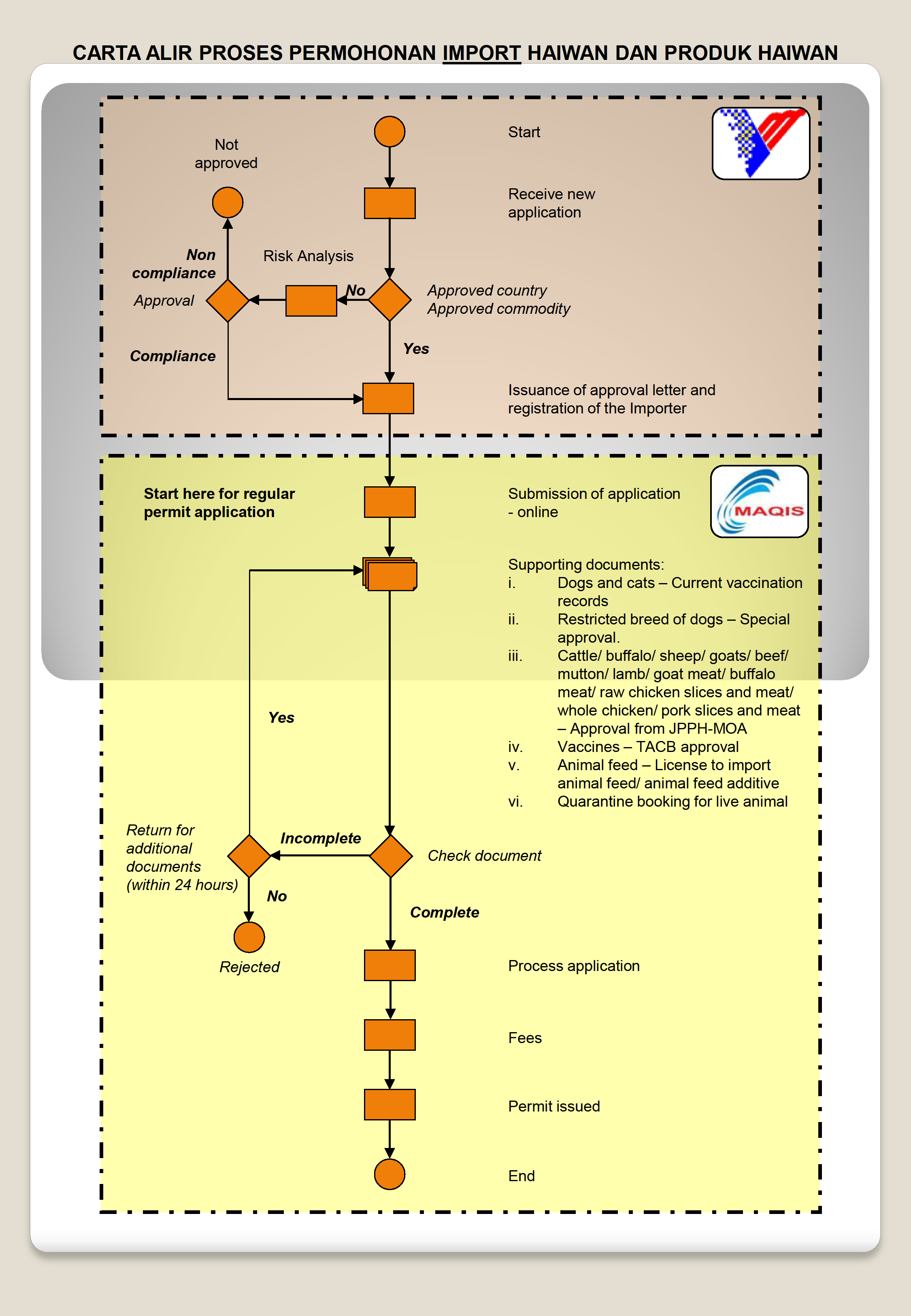
To apply for a permit from MAQIS, stakeholders must submit their applications in accordance with the prescribed procedures. For first-time imports of animal and animal products, the exporting country, facility, and commodity must be registered with the Department of Veterinary Services (DVS). In this stage, mandatory halal certification becomes a requirement for animal products as listed in Section “3 of the regulations under the Department of Veterinary Services (DVS).
Picture 1: Animal and Animal Product Import Application Process Flowchart
3. Regulations under the Department of Veterinary Services (DVS)
The Department of Veterinary Services (DVS) plays a crucial role in ensuring the health and safety of animals entering Malaysia. For animal and animal products being imported for the first time, registration with DVS is mandatory. The DVS follows its guidelines, such as the “General Procedure for Importing Meat, Poultry, Milk, and Egg Products to Malaysia”, which requires an application for halal certification.
Key DVS document
1. General Procedure for Importing Meat, Poultry, Milk, and Egg Products: It outlines the necessary steps for animal establishments intending to export to Malaysia. It mandates that:
Exporting establishments must undergo audits to ensure compliance with halal standards.
Halal certification must be obtained prior to export.
2. Implementation of Inspection Services at Foreign Abattoirs and Processing Plants: It ensures that all approved establishments conform to Malaysian Halal Standards (MS 1500:2009) and the Malaysian Protocol for Halal Meat Production issued by JAKIM.
Table 2: Summary of Regulations Under DVS
No. | Regulation name | Major content |
1 | General Procedure Import Meat, Poultry, Milk and Egg Products to Malaysia | Establishments or abattoirs intending to export meat (excluding pork), poultry, milk and eggs products to Malaysia need to fill up necessary forms related to halal certification for adequacy audit (document audit) by DVS and JAKIM on HALAL. |
2 | All approved establishments are required to comply with the Malaysian Halal Standards MS1500:2009 issued by Department of Standards Malaysia and Malaysia Protocol for Halal Meat Production issued by JAKIM | |
3 | Importation requirements for all kinds of animal products from different countries | Halal Certificate issued by a Halal Organization Body recognized by JAKIM is required for the importation of:
… |
4 | Approved enterprises and abattoirs for export to Malaysia | It lists overseas enterprises (milk, egg, pork, etc.,) and abattoirs approved by the DVS. |
4. Requirements under the Department of Islamic Development Malaysia (JAKIM)
The Department of Islamic Development Malaysia (JAKIM)'s role as the competent authority for halal certification in Malaysia is paramount. All imported animal products, excluding pork, must be halal certified by recognized foreign halal certification bodies. Additionally, processing plants must be inspected and approved by both JAKIM and DVS, ensuring compliance with the Malaysian Protocol for the Halal Meat Production (by JAKIM) and MS 1500:2009 Halal Food - Production, Preparation, Handling and Storage - General Guidelines (by the Department of Standards Malaysia).
Key content of aforementioned regulations
Malaysian Protocol for Halal Meat Production supports the implementation of import requirements under the Animal Rules 1962 and Animals Act 1953, ensuring that all relevant establishments comply with halal standards.
MS 1500:2009 outlines the requirements for halal food production, preparation, handling, and storage, establishing guidelines that must be followed by all stakeholders.
Malaysian Halal Certifications Procedure for International Manufacturing stipulates five schemes subject to halal certification, the requirements for applicants, application form and provided documents.
Table 3: Summary of Regulations Under JAKIM or Cited by JAKIM
No. | Regulation name | Major content |
Protocol |
| |
Malaysia standards (by the Department of Standards Malaysia) | MS 1500:2009 Halal Food - Production, Preparation, Handling and Storage - General Guidelines |
|
Malaysian Standard MS 1500:2019 Halal Food- General Requirements (Third Revision) | Providing general requirements in the manufacturing and handling of halal foods, including nutrient supplements. | |
Announcement & Circular | Malaysian Halal Certifications Procedure for International Manufacturing |
|
| ||
Guideline |
|
5. Regulations Under Ministries for Food Compliance
In addition to halal regulations, imported products must comply with the regulations set forth by various ministries for conventional foods, as summarized in Table 4. In brief:
The Ministry of Health (MOH) establishes regulations regarding food safety.
The DVS is primarily responsible for regulations concerning animal health.
The RMCD oversees regulations related to food importation and customs clearance
The MAQIS conducts inspections to ensure compliance with applicable standards."
Table 4: Summary of Involved Regulations for Food
No. | Competent authority | Regulation name |
1 | Ministry of Health, especially the Food Safety and Quality Program | |
2 | DVS |
|
3 | RMCD |
|
4 | MAQIS |
Read more about product compliance in Malaysia in ChemLinked’s Food-pedia.
 We provide full-scale global food market entry services (including product registration, ingredient review, regulatory consultation, customized training, market research, branding strategy). Please contact us to discuss how we can help you by