Request a Demo
Indonesia is the largest archipelagic country in the world with a population of 276 million, making it the fourth most populous country in the world. As one of the founding countries of the Association of Southeast Asian Nations (ASEAN) and the largest economy in Southeast Asia, Indonesia has a huge market potential that has attracted the attention of many overseas food companies.
However, its complex food compliance laws and numerous registration requirements have hindered foreign companies from entering the market. In response, ChemLinked has compiled the three main registration requirements for Indonesian food products, including registration through the Online Single Submission (OSS) system, the use of the new HALAL logo, and Indonesian National Standard (SNI), for companies' reference.
1. OSS System
From March 2023, Enterprises intending to sell or distribute health supplements, medicines, or quasi-drugs in Indonesia, shall apply for the Business Registration Number (Nomor Induk Berusaha, NIB) from Badan Pengawas Obat dan Makanan (BPOM, Indonesian food competent authority)1 via OSS system2.
What is OSS system?
OSS system is a one-stop online system for registering business entities prior to product distribution in Indonesia, aiming to simplify business licensing.
How to register new health supplement via OSS?
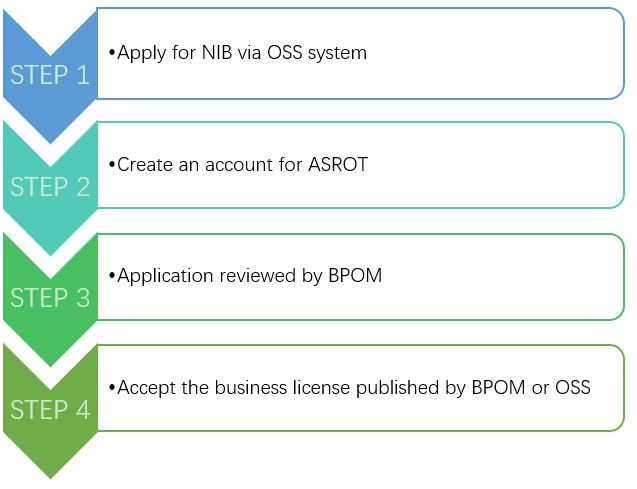
Enterprises shall first apply for the NIB via the OSS system. NIB is the only identification number for enterprises to conduct business in Indonesia. Enterprises shall pay attention when selecting the business type (as known as KBLI) for health supplements, which is supposed to be "46442". The registered responsible manager shall be a pharmacist.
After obtaining the NIB, the applicant can create an account of the Business management system ASROT3, and register the health supplement's information.
BPOM will then review the application and, if compliant, issue the business license either on the BPOM website or the OSS platform.
The application procedure is as follows:
2. New Halal Logo
Halal certification is essential in Indonesia due to the country's large Muslim population. Halal certification guarantees that a product meets the Islamic dietary requirements and is permissible for consumption by Muslims.
On March 1, 2023, a new version of the Indonesian Halal logo was implemented. The existing MUI logo can be used until February 2026 on halal-certified products. Notably, enterprises shall either adopt the new logo or the existing MUI Halal logo. It's prohibited to use both on one product.
This new halal logo is applicable to all halal-certified food products. In addition, the ID halal certification number must be indicated inside the frame of the new halal logo. The logo colours can be white and black in addition to purple.
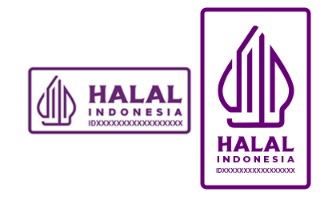
(New Indonesian Halal logo)
3. SNI Certification for Foods
Indonesian National Standard (SNI) is required for certain products before distribution or importation. The certified bodies, each specializes in a particular product range, will issue certificates upon completion of satisfactory audits. .
The food products subject to mandatory SNI certification include bottled water (mineral water), instant coffee (black), biscuits, salt, flour, canned mackerel, canned tuna, etc. Enterprise can check whether the product should be mandatorily registered to SNI certification according to the product's customs code and product information.
Then enterprises can apply for the SNI certification to LSPRO, the audit and certification body for the food sector. In receipt of the application, LSPRO will review the application dossiers, conduct on-site inspections, and issue the SNI certificate when the inspection result shows the products are compliant.
 We provide full-scale global food market entry services (including product registration, ingredient review, regulatory consultation, customized training, market research, branding strategy). Please contact us to discuss how we can help you by