Request a Demo
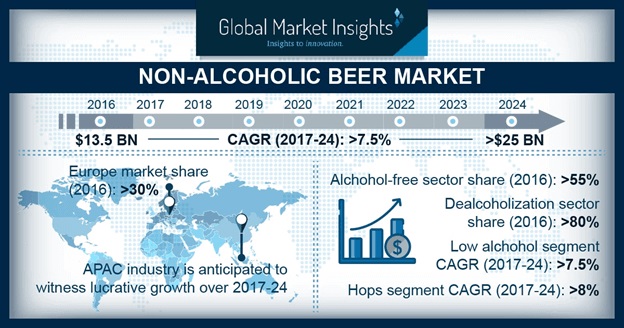
As revealed by the data from Global Market Insights [1], the global market size for non-alcoholic beer was valued at over USD 13.5 bn in 2016 and is expected to grow at a CAGR (compound annual growth rate) of 7.5 percent up to 2024. The value of the alcohol-free market in the Asia Pacific [2] was USD 1.5 billion and the annual average growth was 10%-15% in 2016. Health is the main driver of this trend. In the following part, ChemLinked will give a brief introduction of the corresponding market performance and regulatory requirements in some APAC countries.
China
China accounted for the largest revenue size of over USD 900 million in 2017, owing to the rapid & improved adoption of alcohol-free beer products. [3] Furthermore, as what ChemLinked analyzed in China’s beer importation performance [4], the growth rate of the import value and import volume of non-alcohol beer was 20% in 2019.
Import value & volume of non-alcohol beer in China, from 2017 to 2019
Year | Import amount (thousand liters) | YOY Growth rate | Import Value (thousand dollars) | YOY Growth rate |
2017 | 591.5 | — | 731.8 | — |
2018 | 1329 | +125% | 1779.5 | +143% |
2019 | 1656.6 | +25% | 2068.4 | +16% |
Source: GAC Data
Regulatory requirements:
In China, non-alcoholic beer refers to the product containing no greater than 0.5% ABV and whose origin gravity shall be no less than 2.0 °P. Besides, the products shall comply with other requirements regulated in GB/T 4927-2008 Beer [5].
Japan
Non-alcoholic beer in Japan first debuted in 2009. Out of good taste, the sales performance rose greatly in 2012 and kept stable afterward. According to a report of Suntory [6], in 2018, Japan sold 40.28 million cases of non-alcoholic beer. In 2019, the number was predicted to be 40.91 million cases (1 case= 250ml x 24 bottles). View the best-selling non-alcoholic beer here [7].
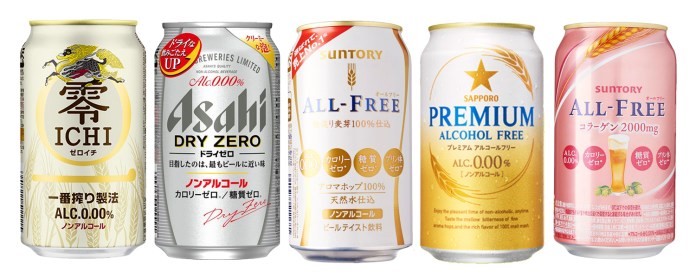
The growth is mainly propelled by the increasing healthiness consciousness. Moreover, the increased consumption tax rate [8] of beer (10%), which was enforced from Oct 1, 2019, also pushed enterprises to target the non-alcoholic beer (with the consumption tax rate of 8%) market.
Regulatory requirements:
According to the Liquor Tax Law [9] and Food Sanitation Law [10], non-alcoholic beers are classified as soft drinks, whose ABV shall be less than 1.0%. And such products can be labeled with “Alc. 0.00%” or “alcohol-free.”
For more production requirements, please check Food, Food Additive Specification Standards [11]. Labeling and advertising requirements are ruled in Standards for Advertising of Alcoholic Beverages and Labeling of Alcoholic Beverage Containers [12]. For example, the advertising of non-alcohol beer shall target adults aged 20 years and older.
South Korea
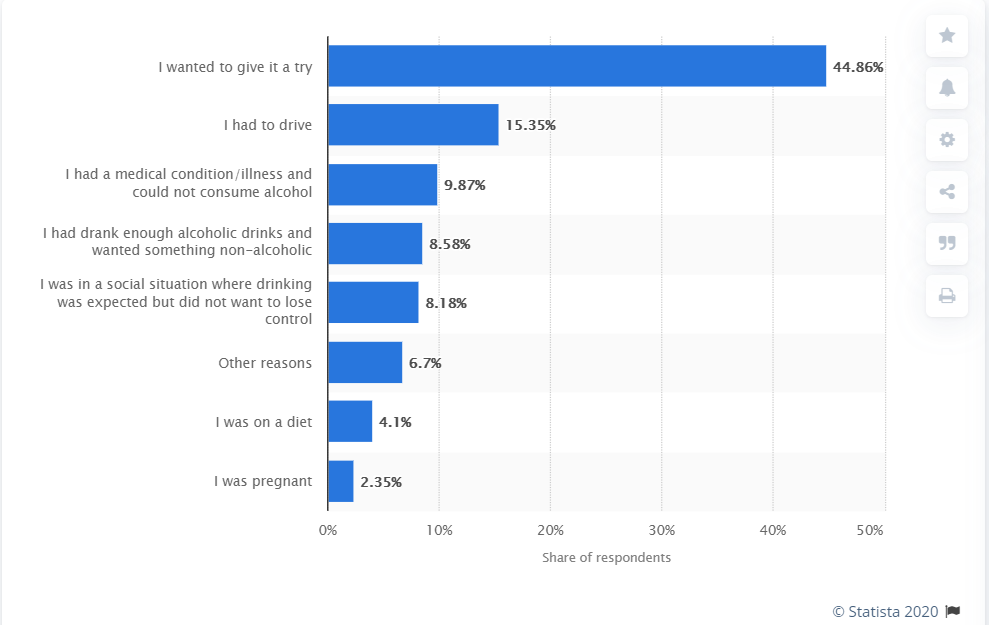
According to the data from Statista [13], the retail value sales of non-alcoholic beer in South Korea amounted to around 9.7 million US dollars. And in a survey conducted in 2019, around 44.9% of respondents stated that the last time they drank non-alcoholic beer was because they wanted to give it a try. And over 15% choose non-alcoholic beer due to the driving issue.
Reason for consuming non-alcoholic beer in South Korea as of October 2019
Source: Statista
Regulatory requirements:
Similar to the regulations in Japan, according to the Liquor Tax Law [14] in South Korea, non-alcoholic beer refers to products whose ABV is less than 1%. Although it belongs to the category of beverage, it still can not be sold to the minors [15].
The Labeling Rules of Foods [16] also specifies that such products must label the note “adults only,” such as “Non-alcoholic (<1% ABV, adults only)” and “alcohol-free (adults only).” And the font size of “adults only” shall be in the same size with words like “alcohol-free.” Furthermore, for foods that contain alcohol, the corresponding content must be labeled.
Singapore
“In Singapore, a large portion of the market doesn’t consume alcohol. Among beer drinkers, an estimated 73 percent also drink non-alcoholic beverages, so there is a significant overlap between both categories,” said Andy Hewson, Managing Director of Asia Pacific Breweries Singapore. In 2018, Singapore was the first city in Asia where Heineken 0.0 made its debut. As revealed by Kantar Worldpanel, in Singapore, the sales of non-alcoholic beers went up 58 percent in 2018 compared to the previous year, according to Kantar Worldpanel [17].
Regulatory requirements:
In Singapore, non-alcoholic beer is under the category of “non-alcoholic beverages.”[18] And the term “non-alcoholic” shall be reserved only for those products which contain no more than 0.5% (v/v) alcohol at 20°C, according to the Sales of Food Act [19].
Thailand
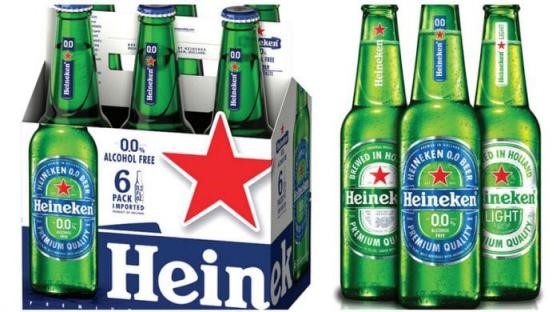 In Thailand, according to a market survey by FLANDERS Investment & Trade [20], non-alcoholic beer has been gaining traction in the past years as the players saw that it had been more and more popular globally. The non-alcoholic beer market is expected to be developed further due to the health trend. Growth at the rate of 15-20% would be foreseeable.
“In 2018, Heineken introduced Heineken 0.0 to Thailand, the 2nd market in the region after its first launch in Singapore. The company reported 10-15% growth this product category. The best-selling items were classic and fruit flavor,” the survey also disclosed.
Brands of non-alcoholic beer that have been tried by Thais in 2019
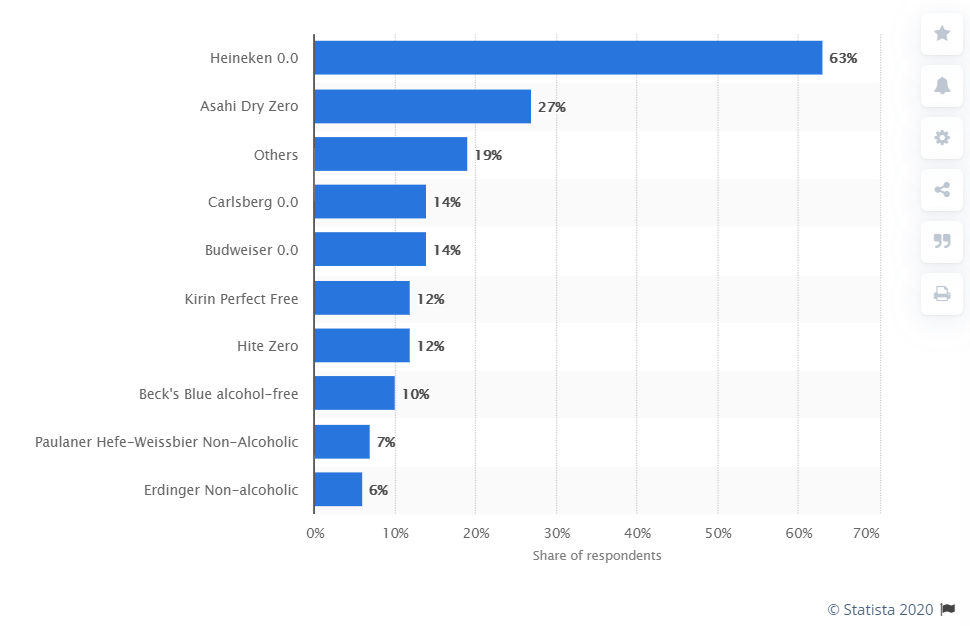
Source: Statista 2020 [21]
Regulatory requirements:
In Thailand, alcohol-free beer shall be registered as food products under FDA control. Such products shall be less than 0.5-degree proof and shall be brewed in the normal way [22] but which after fermentation has the alcohol removed in a process that preserves the flavor, smell and color of the beer.
But the advertising [23] featuring alcohol brand logos is broadly prohibited. “If it’s advertised as an alcohol-free malt beverage, there’s no problem. But if it’s advertised as an alcohol-free beer, we have to examine the intention and whether the advertising is breaking any law,” Dr Nipon Chinanonwet, director of the Disease Control department’s Office of Alcohol Control Committee, said. He further explained, the advertising of non-alcoholic products that could be advertised legally may at the same time creates a link in audience’s mind to other alcoholic products, which are restricted from advertising.
Besides, the Excise Department has announced that it will tax 0% alcohol beers in 2020 [24] in an effort to prevent new drinkers. They would be subject to more than 14% (regular drinks) but at less than 22% (beer containing alcohol).
India
Both AB InBev and United Breweries Ltd [25] launched their non-alcoholic beer products in India last year. As revealed by an FSSAI notice [26] released on June 23, 2020, the ABV level of alcohol-free beer shall be 0.0. For other parameters, alcohol-free beer shall comply with the limits specified for regular beer.
Malaysia
On June 20, 2019, Heineken 0.0 was first launched in Malaysia. As revealed by theFood (Amendment) (No.2) Regulations 2020 [27] released this year, non-alcoholic beer is categorized under dealcoholized alcoholic beverage, whose alcohol content has been removed and which contains not more than 0.5% volume per volume of alcohol.
As for labeling requirements, the word “dealcoholized” shall be written in the principal display panel in the label, in uniform lettering conjoined together with the name of the alcoholic beverage. And the following words are forbiddened to be labeled on dealcoholized alcoholic beverages:
a) “zero alcohol,” “0 alcohol,” “alcohol free,” “no alcohol,” “non-alcoholic” or other words or expression of similar meanings; and
b) “soft drink,” “juices” or any word or expression that indicates, suggests, or implies that the dealcoholized alcoholic beverage is a soft drink or juices
Summary: Regulatory Requirement of Non-alcoholic Beer in APAC regions
Country | Requirements of ABV |
China | <0.5% ABV; ≥3.0°P |
Japan | <1% ABV |
South Korea | <1% ABV |
Singapore | Not more than 0.5% (v/v) alcohol at 20°C
|
Thailand | Less than 0.5-degree proof |
India | The ABV level of alcohol-free beer shall be 0.0 |
Malaysia | Not more than 0.5% volume per volume of alcohol |
For more food regulatory requirements in other regions, please email [email protected].
 We provide full-scale global food market entry services (including product registration, ingredient review, regulatory consultation, customized training, market research, branding strategy). Please contact us to discuss how we can help you by