Request a Demo
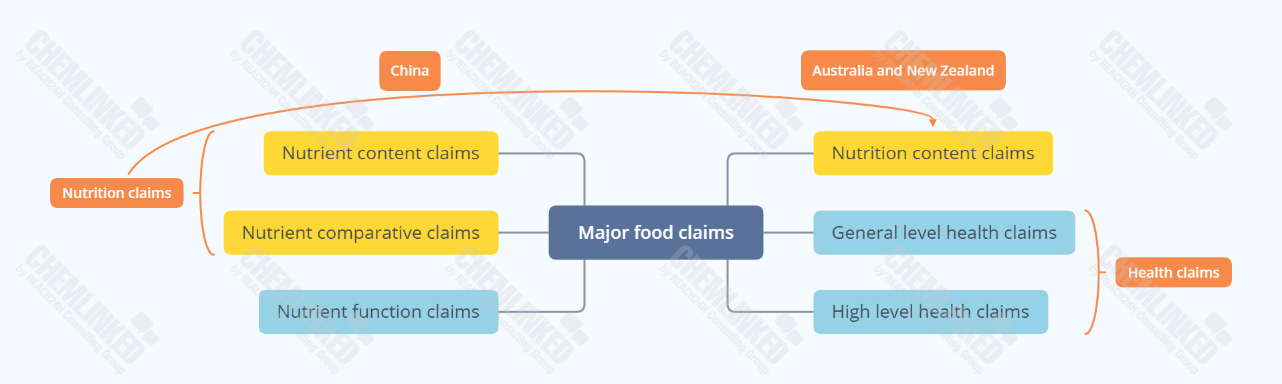
Nutrition and health claims on food labels and advertisements are known to significantly impact consumers' perception of the healthfulness of products and influence their food purchasing decisions. To specifically discuss health claims on foods, Australia and New Zealand have general level health claims and high level health claims, comparing to China's nutrient function claims. This article compares the regulations governing health claims in Australia and New Zealand with nutrient function claims in China. It is important to note that the classification mentioned in this article does not include claims related to health supplements.
Recommended article:
Health claims in ANZ cover effects related to diseases, whereas China's nutrient function claim definitions do not mention diseases.
In Australia, health claim is defined as a claim that states, suggests or implies that a food or a property of food has, or may have, a health effect. These claims are further categorized into two types:
General level health claims are about a nutrient or substance in a food, or the food itself, and its effect on health.
High level health claims are about a health effect relating to a serious disease or biomarker of a serious disease.
In China, nutrient function claims refer to claims indicating that a certain nutrient can maintain normal growth, development, and physiological functions of the human body.
While regulatory frameworks in both ANZ and China aim to provide consumers with information about the health benefits of food and nutrients, Australia and New Zealand allow for a broader range of claims, including those relating to serious diseases. In contrast, under China's regulatory approach, claims are only allowed to focus on the fundamental roles of nutrients in supporting normal body functions, without explicit references to disease-related effects.
Health claims in ANZ involve not only energy and nutrients but also types of foods and substances such as plant compounds.
In Australia and New Zealand, health claim conditions can be found in Schedule 4 of the Food Standards Code developed by Food Standards Australia New Zealand (FSANZ). In China, the major regulatory reference is GB 28050.
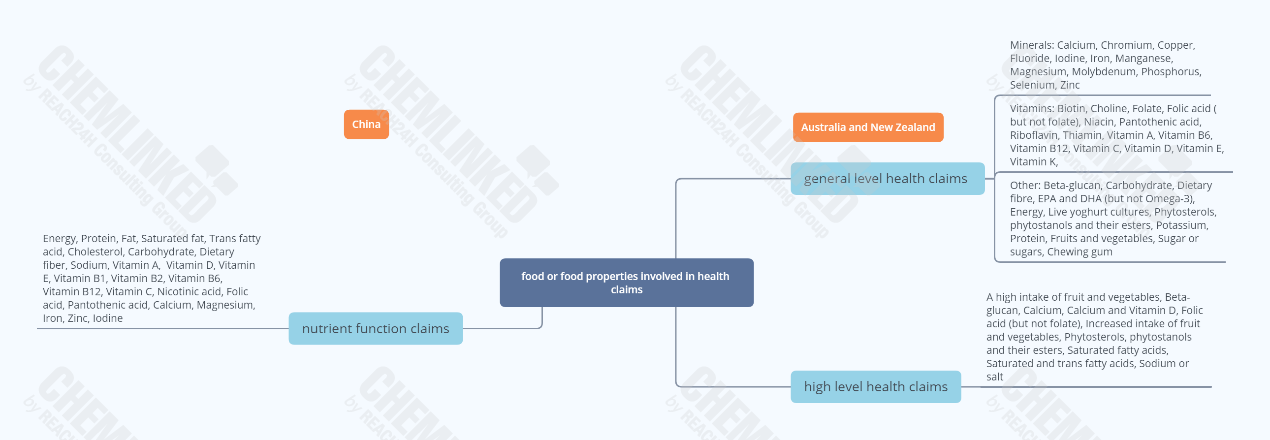
As illustrated in the figure below, FSANZ provides a more extensive list of food or food properties compared to nutrient function claims listed in China. To be more specific, health claims in Australia and New Zealand encompass not only energy and nutrients, but also various types of foods, such as fruits and vegetables, as well as biologically active substances like phytosterols, phytostanols, and their esters.
Furthermore, in China, Australia, and New Zealand, the nutrition information panel (NIP) must display information about energy, core mandatory nutrients, and any other nutrients mentioned in the health claims. In Australia and New Zealand, the NIP must declare the particulars of the nutrient or biologically active substance, including its name and average quantity. In China, the NIP must show the name and content of the nutrient, as well as the percentage of Nutrient Reference Value (NRV).
Claim conditions are more complex in ANZ, involving target population and dietary context statement.
In Australia and New Zealand, many health claims are accompanied by a dietary context statement. This statement should emphasize that the health effect must be considered in the context of having a healthy, varied diet, and appropriate for the specific claim being made. For instance, the high level health claim "calcium reduces risk of osteoporosis" should be accompanied by the context statement "diet high in calcium, and adequate vitamin D status".
Furthermore, in ANZ, if the health effect is applicable only to a specific group of the population rather than the general public, this information must be included as part of the health claim. For example, when making general level health claim “calcium contributes to normal growth and development”, the target population, children, must be specified.
In contrast, China's approach is simpler. When the declared nutrient content values meet the conditions for nutrient content or comparative claims, businesses can use one or more corresponding nutrient function claim standard wordings from GB 28050. The Chinese regulations do not mention requirements for dietary context statements or specifying relevant populations.
Countries | Example requirements for health claims |
ANZ | General level health claims: Calcium contributes to normal growth and development
Choline contributes to normal fat metabolism
|
High level health claims: Calcium reduces risk of osteoporosis
| |
China | Nutrient function claims: Calcium helps development of bone and tooth.
|
Australia, New Zealand and China have restrictions to infant formula products in the use of health claims.
In Australia and New Zealand, health claim must not be made about an infant formula product. In China, nutrient function claims should not be made regarding necessary ingredients in infant formula for infants aged 0 to 6 months. In addition, the Draft GB 13432 issued in 2022 further specifies that nutrients of infant formula aged 0 to 6 months shall not bear nutrient function claims.
Claim wording can be modified in ANZ while it cannot be deleted, added or combined in China.
In Australia, any statement required by the Food Standards Code can be modified, provided that the modification retains the same meaning as the original required statement. In contrast, in China. the nutrient function claims shall not be deleted, added or combined with other claims.
Additionally, in Australia and New Zealand, the use of split health claims is permitted, allowing a shortened version of the claim to be used separately from the complete statement. If a split health claim is made, the shortened statement must appear on the same label or same advertisement as the complete statement, and clearly indicate where the full statement is located.
ANZ allows general level health claims by notification of self-substantiated food-health relationships.
In Australia and New Zealand, when making general level health claims, businesses can establish food-health relationships through a systematic review as outlined in the Food Standards Code. The individual responsible for the claim must notify the FSANZ CEO about the specific details of the relationship between the food or property of food and the health effect. When a food-health relationship for a general level health claim is established via systematic review, any accompanying dietary context statement must align with the conclusions drawn from that systematic review.
Health claims in ANZ must follow nutrient profiling scoring criterion (NPSC)
In Australia and New Zealand, A health claim can only be made if the food meets the nutrient profiling scoring criterion (NPSC). However, special purpose foods, including infant formula products, foods for infants, formulated meal replacement, formulated supplementary foods, formulated supplementary sports foods and food for special medical purposes, do not need to meet the NPSC for health claims. A calculator to determine NPSC scores is available on the FSANZ website.
For any consultation services, please contact us.
 We provide full-scale global food market entry services (including product registration, ingredient review, regulatory consultation, customized training, market research, branding strategy). Please contact us to discuss how we can help you by