Request a Demo
As revealed by a notice1 released on December 23, 2022, China National Center for Food Safety Risk Assessment (CFSA) is soliciting public opinions on GB 13432 National Food Safety Standard Labeling of Prepackaged Foods for Special Dietary Uses. Any opinions can be sent to [email protected] prior to December 29, 2022.
Major Revisions Compared to the Current 2013 Version2
1. Expressions are simplified to avoid redundancy.
The definitions of nutrient and nutritional component are deleted from the consultation draft, since they have already been prescribed in GB 28050-2011 National Food Safety Standard General Rules for Nutrition Labeling of Prepackaged Foods3.
The expression “(Prepackaged foods for special dietary uses) shall not involve disease prevention and treatment functions” is deleted due to its presence in Food Safety Law4 and GB 7718-2011 National Food Safety Standard General Standard for the Labeling of Prepackaged Foods5.
2. The classification of foods for special dietary uses is revised and adjusted into the following categories:
Baby formula (including formula for infants, older infants, and young children);
Complementary baby food (including cereal-based complementary baby food, canned complementary baby food, and others);
FSMP (including FSMP for infants under 1 year old and other FSMP products for people over 1 year old);
Nutrition supplementary food (complementary nutrition supplements, nutrition supplements for the pregnant and lactating, as well as nutrition supplementary foods for other specific groups)
Sports nutrition foods;
Others, like foods with no or low gluten and formula food to help control weight.
3. The scope of permitted content claim and function claim is narrowed down.
In the current 2013 version, only the essential ingredients in infant formula (0-6 months) cannot bear content and functional claims. This consultation draft expands the prohibited scope to all nutritional components in infant formula (0-6 months), foods for special medical purposes (FSMP) for infants (0-12 months), and other FSMP products. The restriction on the former two categories aims to promote and protect breastfeeding. Regarding the special nutrition demand of FSMP’s targeted consumption groups, FSMP products are required to be consumed under the guidance of a doctor or clinical nutritionist. In this context, no claims are allowed for FSMP.
4. Requirements for mandatory labeling items are revised.
Items | Current 2013 version | Consultation draft |
Food name | Only when foods meet the definitions in 2.1 of this standard, can the food name includes “food for special dietary use” or relevant description of particular product properties. | Foods that meet the definitions in 2.1 of this standard shall be labeled “food for special dietary use” as well as corresponding food name. The revision of this point is to differ foods for special dietary uses from regular foods. |
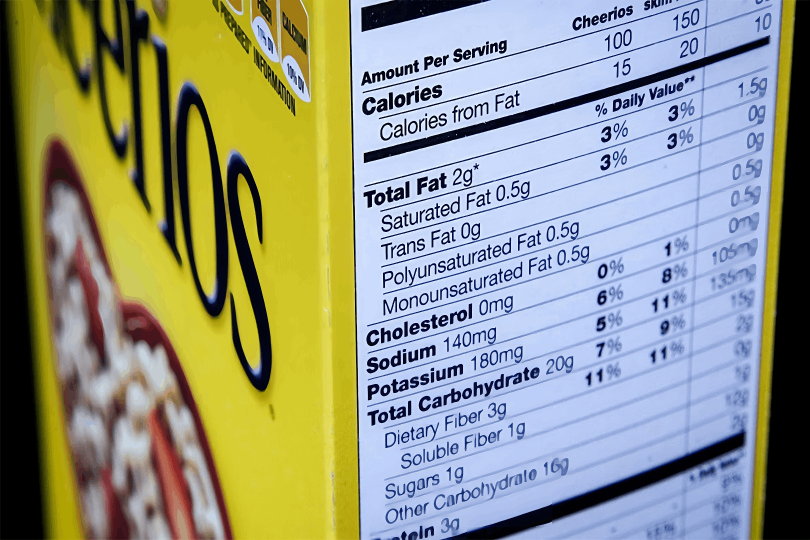
Labeling of energy and nutritional components | Energy, protein, fat, carbohydrates and sodium along with other nutritional components and their contents required by corresponding product standards shall be labeled in th format of table. | The draft divides this provision into two situations. For prepackaged foods for special dietary uses, excluding baby formula (all the 3 stages) and nutritionally complete FSMP—energy, protein, fat, saturated fat (or saturated fatty acid), carbohydrates, sugar and sodium along with other nutritional components with the contents required by corresponding product standards shall be labeled in the format of table. The addition of nutritional components (e.g., sugar) subject to mandatory labeling is to align with the draft of GB 28050.
For baby formula (all the 3 stages) and nutritionally complete FSMP—the labeling of nutritional components shall abide by product standard and relevant regulations. |
The quantity of per serving shall be indicated if per serving is adopted and the quality of per serving can be defined according to the food property or recommended amount. | The weight or volume of foods per serving shall be indicated on the same panel if per serving is adopted and the quality of per serving can be defined according to the food property or recommended amount. The revision is to align with the draft of GB 28050. | |
The actual values of energy and nutritional components shall not be lower than 80% of the labeled value. | The actual values of energy and nutritional components (excluding fat, saturated fat, sugar and sodium) shall not be lower than 80% of the labeled value. The actual values of fat, saturated fat, sugar and sodium shall not be higher than 120% of the labeled value. | |
Exemption of labeling items | Only the product name, net content, name and address of the manufacturer (or distributor), production date and shelf life are mandatory to be labelled if the largest surface area of the packaging or container of the prepackaged food for special dietary uses is smaller than 10cm2. | Only the product name, net content, name and address of the manufacturer (or distributor), production date and shelf life are mandatory to be labelled if the largest surface area of the packaging or container of the prepackaged food for special dietary uses (excluding infant formula for 0-6 months, infant FSMP, and other FSMP products) is smaller than 20cm2. The amendment is to align with the draft of GB 7718.
For infant formula for 0-6 months, infant FSMP and other FSMP products, where the largest surface area of their packaging or container is smaller than 40cm2, they can be only labeled with product name, net content, name and address of the manufacturer (or distributor), production date, shelf life and nutrition fact. Considering the specialty of these three foods, nutrition fact cannot be exempted from labeling. |
5. The requirements of optional labeling items are optimized, e.g., the term “content” is to be changed into “labeled value of content”.
6. Appendix B is added into this standard, which specifies the allowed content and function claims that can be used in specific products. These claims are basically the same as what explained in the Q&A document for GB 13432-2013, released in 2014. Therefore, the addition of Appendix B may have a little influence.
For further translation service of this draft, please contact [email protected].
 We provide full-scale global food market entry services (including product registration, ingredient review, regulatory consultation, customized training, market research, branding strategy). Please contact us to discuss how we can help you by