Request a Demo
Content Overview:
1. Overview of meat importation regulations in China, including the steps to get registered with CNCA.
2. The approved meat manufacturers in each country are listed.
China has a huge demand for imported meat products mainly due to its growing population, urban expansion as well as the numerous food safety scandals that have occurred during the past several years. Importation of meat products in China has seen consistent year on year growth, and represents an increasingly enticing market for international manufacturers.
Relevant laws and regulations:
The Import and Export Commodity Inspection Law of the People’s Republic of China and its implementing regulations
Law of the People’s Republic of China on the Entry and Exit of Animal and Plant Quarantine and its Implementing Regulations
Regulation on Inspection and Quarantine of Entry-Exit Meat Products
Regulatory environment:
The first prerequisite is the signing of a bilateral trade agreement between China's AQSIQ (GAC is in charge of this issue since Aug. 2018) and the corresponding authority in the export country. The agreement is signed after a detailed analysis and risk evaluation is conducted by Chinese authorities based on the documentation submitted by the exporting country.
The next factor is the approval of individual manufacturers within the country of origin. China CNCA is the authority entrusted by AQSIQ to be responsible for these registration issues (this responsibility was undertaken by GAC after department restructure). The steps to register a single manufacturer are as follows:
Registration process:
1. The foreign establishment should present a formal written application to their local authorities with the application form and other registration materials.
2. Authorities of the exporting country conduct their own inspection or document checks to pre-select eligible establishments.
3. Authorities of the exporting country send formal applications with pre-selected establishments to CNCA.
4. The CNCA experts committee evaluates eligibility of the establishments based on information provided by the authorities of the exporting country and decides whether the proposed facilities should be inspected.
5. CNCA informs authorities of the exporting country on the establishments to be inspected and requests its assistance.
6. CNCA sends an inspection team to the exporting country.
7. The CNCA experts committee reviews reports produced by the inspection team and decides whether the audited facilities are approved and/or recommends further actions to be taken to amend non-conformities.
8. CNCA assigns a registration number to each approved facility.
Each establishment in the supply chain must be registered and included in the current list of approved establishments. Further inspections will be required when an already approved establishment wants to register new products included in the same protocol agreement or an additional memorandum.
Registration with the Filing Management System:
Exporters are required to finish the online filing at http://ire.eciq.cn to confirm that foreign exporters of foodstuffs have been registered with CNCA. If the exporter has already been registered, there is no need to register for new exports.
Detailed information of approved manufacturers in each country (by Feb. 2015):
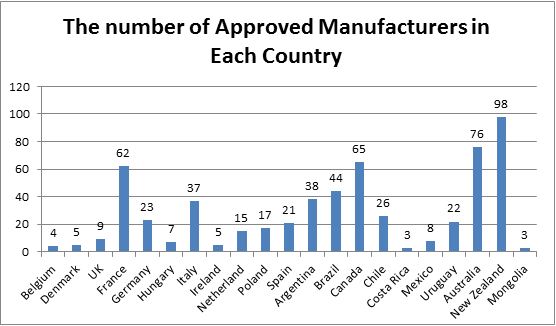
* Check the latest update in China Approved Overseas Manufacturers-Meat
 We provide full-scale global food market entry services (including product registration, ingredient review, regulatory consultation, customized training, market research, branding strategy). Please contact us to discuss how we can help you by