Request a Demo
In this article, we delve into the regulatory requirements for food labeling based on an article1 share by a local government, highlighting 20 crucial points that demand meticulous attention during the compliance process for food labels.
1. Quality Requirements for Food Labels
The requirement that food labels "should not separate from the food or its packaging" mandates that all label content must be securely affixed, printed, stamped, or embossed on the packaging or container. However, tags or instructions (such as recommended usage instructions for vegetable oils) that describe product features, characteristics, or usage methods may be detached from the food.
ChemLinked Notes:
“(Food labels) should not separate from the food or its packaging" is a basic requirement specified in Article 3, Paragraph 3.7 of GB 7718 National Food Safety Standard — General Standard for the Labeling of Prepackaged Foods (hereinafter GB 7718).
2. Normative Requirements for Labels
Food labels must be truthful, accurate, and must not use false, exaggerated, misleading, or deceptive words, graphics, etc., to describe the food, nor text size or color differences to mislead consumers.
“(Must not use) text size or color differences to mislead consumers” refers to the behavior that takes advantage of consumers’ false associations about the true attributes of the food. Changes in font size or graphics resulting from the use of heat-shrink film packaging do not belong to such behavior.
ChemLinked Notes:
This is a basic requirement specified in Article 3, Paragraph 3.4 of GB 7718. E.g., depicting a real cow on the label of a plant-based protein beverage; or naming a fruit-flavored beverage prepared with water, refined sugar, maltodextrin, citric acid, peach flavoring, vitamin A, and vitamin C, without adding any peach juice or peach pulp, as "Peach Juice".
3. Requirements for the Text on Labels (I)
Food labels "may simultaneously use Pinyin and minority ethnic scripts, with Pinyin not exceeding the corresponding Chinese characters."
In this requirement, "Pinyin" refers to Mandarin Pinyin, and minority ethnic scripts refer to languages such as Mongolian, Tibetan, and Manchu. Pinyin must be used simultaneously with Chinese characters and must not exceed the size of the corresponding Chinese characters. Minority ethnic scripts must be used concurrently with Chinese characters, with no size requirement. The spelling of Mandarin Pinyin should follow the "Pinyin Scheme for the Chinese Phonetic Alphabet."
ChemLinked Notes:
This is a basic requirement specified in Article 3, Point 3.8.1 of GB 7718.
4. Requirements for the Text on Labels (II)
Food labels "may use foreign languages simultaneously, but must have corresponding relationships with Chinese (except for trademarks, manufacturers and their address of imported foods, names and addresses of foreign distributors, and websites). All foreign languages must not exceed the corresponding Chinese characters (except for trademarks).”
ChemLinked Notes:
This is a basic requirement specified in Article 3, Point 3.8.2 of GB 7718.
5. Character/Letter Height and Label Area
When the maximum surface area of pre-packaged food labels exceeds 35 square centimeters, the height of mandatory labeling content (character/letter and numbers) should be equal to or greater than 1.8 mm
When the maximum surface area is greater than 10 square centimeters but less than 35 square centimeters, all mandatory contents should be labeled according to GB 7718 requirements, without following the character/letter height requirements.
For surface areas less than 10 square centimeters, only product name, net content, producer (or distributor) name and address should be labeled, without following the character/letter height requirements.
In addition, the minimum height of characters for net content should comply with the requirements in the following table:
Range of Net Content (Q) | Minimum Height of Characters (mm) |
Q ≤ 50 mL; Q ≤ 50 g | 2 |
50 mL < Q ≤ 200 mL; 50 g < Q ≤ 200 g | 3 |
200 mL < Q ≤ 1 L; 200 g < Q ≤ 1 kg | 4 |
Q>1kg; Q>1L | 6 |
When determining text height, the height of letters should be judged according to the height of uppercase letters or lowercase letters like b, d, f, g, h, j, k, l, p, q, y.
ChemLinked Notes:
The above requirements are stipulated in Article 3, Paragraph 3.9 and Article 4, Point 4.1.5.4 of GB 7718.
6. Sales Unit Composed of Multiple Pre-Packaged Foods
When the outer packaging (such as gift boxes, gift bags, combination packs, etc.) is easy to open to recognize the labeling items, it is permissible to omit repeating on the outer packaging the contents already indicated on each individual pre-packaged food package inside (the outer packaging).
ChemLinked Notes:
The requirement is stipulated in Article 3, Paragraph 3.11 of GB 7718.
7. Composite Ingredients
If an ingredient is a composite ingredient formed by two or more than two ingredients (excluding composite food additives), the name of this composite ingredient should be indicated in the ingredient list. When some original ingredients in the composite ingredient are the same as other ingredients in the food, their names can be merged and directly indicated in the ingredient list after calculation, with the sequence determined by the total amount of each ingredient in the final product.
ChemLinked Notes:
The requirement is stipulated in Article 4, Point 4.1.3.1.3 of GB 7718, and further explained in Question 27 of the QA of 7718.
8. Quantitative Indication of Ingredients
When emphasizing the absence or "low content" of certain ingredients or components, quantitative indication is required. When an additive is not approved by GB 2760 for use in a certain type of food, "no addition of" such additive should not be used to mislead consumers.
ChemLinked Notes:
The requirement is stipulated in Article 4, Point 4.1.4.2 of GB 7718, and further explained in the Implementation Guide of GB 7718.
9. Cases where Quantitative Indication of Ingredients is Not Required
When a food name mentions a certain ingredient or component without specific emphasis on the label, there is no need to indicate the amount of addition or content of that ingredient or component. Describing the flavor, taste, aroma, or ingredient source of the food with its true attribute name or illustration does not constitute specific emphasis, and quantitative indication of that ingredient is not required. For example, if a food product is named "Red Bean Ice Cream" but there is no mention or emphasis on red beans elsewhere on the label, the amount of red beans added does not need to be indicated in the ingredient list or at appropriate places on the label. Similar examples include "Jujube Yogurt."
The reminder of allergens in ingredients does not fall within the scope of quantitative indication, such as "This product contains peanuts."
ChemLinked Notes:
The requirement is stipulated in Article 4, Point 4.1.4.3 of GB 7718, and further explained in Question 40 of the QA of 7718.
10. Labeling of Food Additives (I)
The ingredient list should truthfully indicate food additives by their common names as specified in GB 2760. However, there is no requirement to establish an "item for food additives." For additives contained in composite ingredients where the addition is less than 25% of the total food, if the additives meet the take-over principle specified in GB 2760 and do not play any processing function in the final product, they are not required to be labeled.
ChemLinked Notes:
The requirement is stipulated in Article 4, Point 4.1.3.1.4 of GB 7718.
11. Labeling of Food Additives (II)
Ingredients that can be used both as food additives or as food nutrient fortifiers should be labeled according to their role in the final product. For instance, riboflavin, vitamin E, etc., can be used both as food additives and as nutrient fortifiers. When used as food additives, they should be labeled with their names as specified in GB 2760; when used as food nutrient fortifiers, they should be labeled with their names as specified in GB 14880.
ChemLinked Notes:
The requirement is explained in Question 37 of the QA of 7718.
12. Labeling of Food Additives (III)
For enzyme preparations listed in the "List of Enzyme Preparations for Food Use and Their Sources" in GB 2760, if the enzyme preparation loses its enzymatic activity in the final product, labeling is not required. If the enzyme preparation retains its enzymatic activity in the final product, it should be marked according to relevant provisions for the labeling of the ingredient list, indicating the added amount of enzyme preparation during the manufacture or processing of the food.
ChemLinked Notes:
The requirement is explained in Question 35 of the QA of 7718.
13. Labeling of Production Date and Shelf Life
Date labeling should not be additionally pasted, reprinted, or tampered with. This means that the production date and shelf life should not be separately affixed to an intact label, nor should dates be reprinted or arbitrarily changed on the original label. Entire food labels can be produced in the form of pressure-sensitive stickers, including contents such as "production date" or "shelf life," which are then affixed to the outer packaging of the food. For imported pre-packaged foods that only indicate shelf life and best before dates, businesses can correctly calculate and indicate the production date on the product label based on the indicated shelf life and best before dates on the imported pre-packaged foods.
ChemLinked Notes:
The requirement is stipulated in Article 4, Point 4.1.7.1 of GB 7718 and further explained in Question 58 of the QA of 7718. Please note that, products shall also follow other effective regulations. For example, according to the "Administrative Measures on Safety of Import and Export Food", the Chinese labels of imported health food and special dietary food must be printed on instead of affixed to the smallest sales package.
14. Labeling of Imported Food
Imported pre-packaged foods are not required to label product standard codes and quality grades. If product standard codes and quality grades are indicated, they must be truthful and accurate. According to GB 7718-2011, imported foods are exempt from indicating production license numbers, but this only applies when imported foods are not repackaged in China. If repackaging involves fully removing the original packaging and repackaging on a production line, the food production license number of the re-packager must be indicated. However, if only storage and transportation packaging is destroyed before repackaging or assembly, the food production license number of the repackager (or assembler) may not need to be indicated.
ChemLinked Notes:
The requirement is stipulated in Article 4, Point 4.1.10 of GB 7718 and explained in Question 56 of the QA of GB 7718.
15. Labeling of Production Place
"Production place" refers to the actual production place of the food, serving as a supplement to the manufacturer's address under specific circumstances. For example, for products manufactured by other enterprises under commission, if only the name and address of the commissioned enterprise are indicated, the term "production place" should indicate the region where the commissioned enterprise is located.
ChemLinked Notes:
The requirement is explained in Question 50 of the QA of GB 7718.
16. Nutrition Facts Table (I)
Sources for calculating nutrient content quantities in nutrition facts include a book called "China Food Composition" compiled by the National Institute for Nutrition and Health, Chinese Center for Disease Control and Prevention. For food categories and components not covered in the "China Food Composition" book, reference can be made to the “USDA National Nutrient Database for Standard Reference" and “USDA Table of Nutrient Retention Factors," “McCance and Widdowson's The Composition of Foods Tables” compiled by the Food Standards Agency and the Institute of Food Research, and authoritative databases from other countries.
ChemLinked Notes:
The requirement is explained in Question 50 of the QA of GB 28050-2011 General Rules for Nutritional Labeling of Prepackaged Foods.
17. Nutrition Facts Table (II)
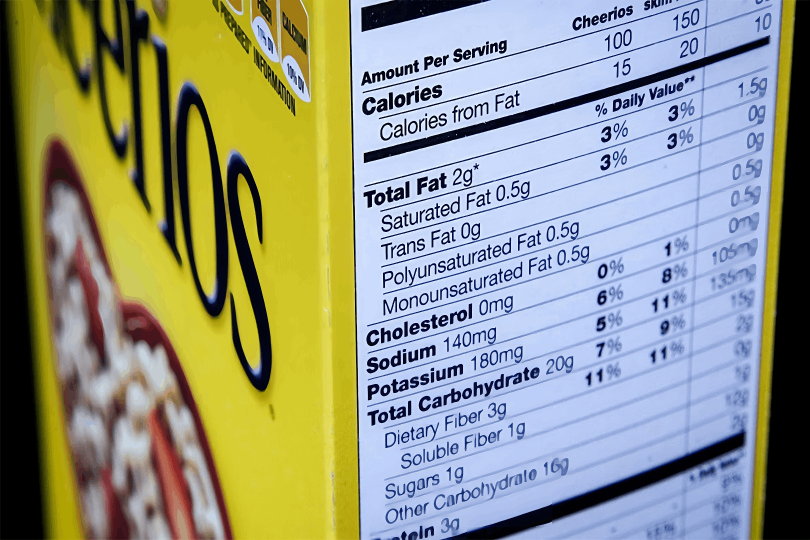
GB 28050 National Food Safety Standard General Rules for Nutrition Labeling of Prepackaged Foods stipulates mandatory requirements for nutrition labeling. Food enterprises must label required nutrition information in the following four cases:
All pre-packaged foods (excluding exempted foods) must bear mandatory label information on energy and the four core nutrients.
For nutritional claims or nutrient function claims other than energy and core nutrients, the information of the nutrient must be displayed.
If nutrient fortifiers are used, the information of the nutrient in the fortified food should also be marked.
If hydrogenated and (or) partially hydrogenated fats are used in the food ingredients, trans fat (acid) content should also be indicated.
ChemLinked Notes:
The requirements are stipulated in Article 4 of GB 28050.
18. Exemption from Mandatory Nutrition Labeling for Pre-Packaged Foods
GB 28050-2011 specifies categories of pre-packaged foods exempt from mandatory nutrition labeling, such as those with significant nutrient content fluctuations or difficulty in accurately labeling nutritional information, including fresh foods and freshly made and sold foods. The latter refers to foods made on-site, sold immediately, and can be consumed immediately. Food processing enterprises that centrally produce, process, and distribute pre-packaged foods to supermarkets, chain stores, retail stores, etc., must label nutrition information according to the standard.
ChemLinked Notes:
The requirements are explained in Question 8 and 13 of the QA of GB 28050.
19. Determination of Content Claims
When determining whether energy and nutrient content claims in food are qualified, the declared values of energy and nutrients in the label's nutrition facts table should be judged as the basis. To verify the accuracy of declared values, permissible tolerances should be applied.
For pre-packaged foods intended for consumption after reconstitution, such as solid beverages, the nutrient content can be labeled based on product’s state before or after reconstitution, or both states can be labeled at the same time. If both states are labeled, one should be chosen for calculating NRV% and clearly stated.
ChemLinked Notes:
The requirements are explained in Question 63 of the QA of GB 28050.
20. Warning Information
According to Article 15 of the "Regulations on Food Labeling Management," mixed non-food products that may be mistaken for food and, if used improperly, can cause personal injury, should be labeled with warning signs or Chinese warning instructions. Articles 27 and 28 of the Product Quality Law respectively stipulate that products, if used improperly, may cause damage to the product itself or endanger personal or property safety, must have warning signs or Chinese warning instructions.
For any compliance inquiry, label review service, translation service, please email [email protected].
 We provide full-scale global food market entry services (including product registration, ingredient review, regulatory consultation, customized training, market research, branding strategy). Please contact us to discuss how we can help you by