Request a Demo
On Aug 21, 2019, China National Center for Food Safety Risk Assessment (CFSA) opened the public consultation period on the proposed approval of 21 new varieties of food related products to public feedback, involving 11 additives and 10 resins used in food contact materials (FCM).[1]
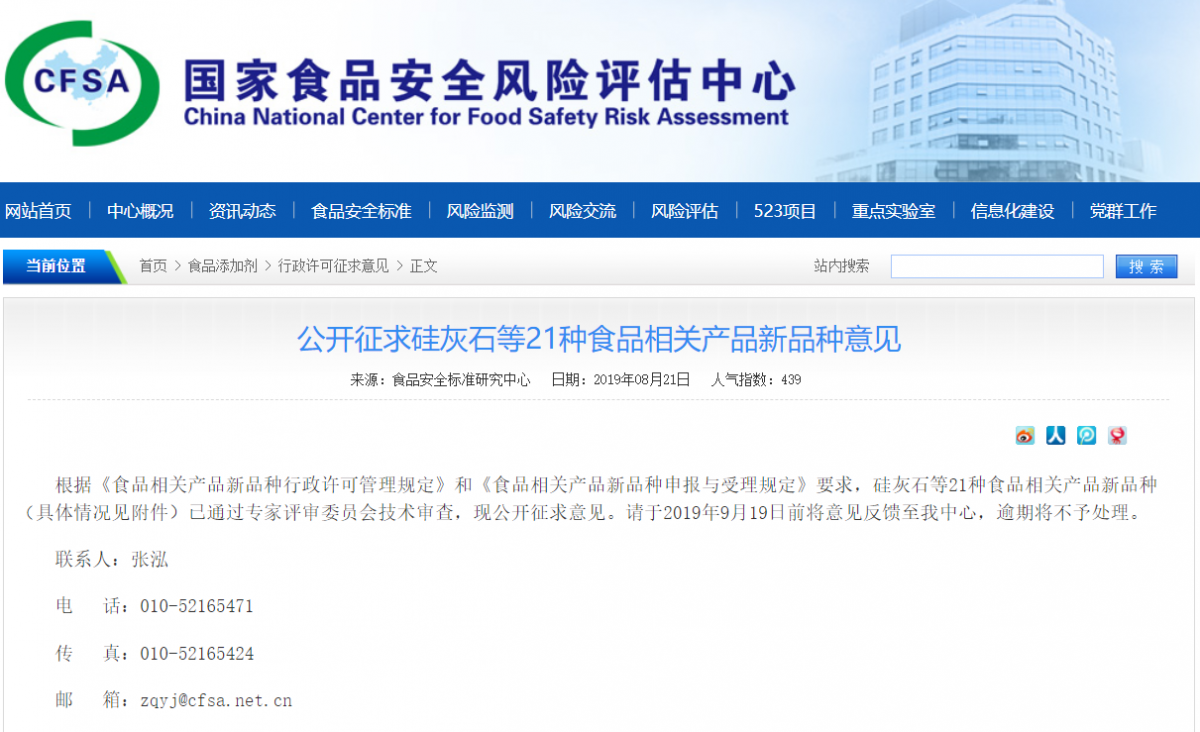 Details of the consultation are as follows.
6 FCM Additive with Expanded Application Scope[2]
| SN | Product Name | CAS No. | Application scope | Maximum usage/ % | SML/(mg/kg) |
| 1 | Wollastonite | 13983-17-0 | Rubber | 15 | — |
| 2 | Erucamide;cis-13-Docosenamide | 112-84-5 | Plastics: PVC | 1 | — |
| 3 | 3-Aminopropyltriethoxysilane | 919-30-2 | Plastics: PPS | 0.05 | — |
| 4 | 1,4-Benzenedicarboxylic acid, 1,4-dimethyl ester, polymer with 1,4-butanediol and α-hydro-ω-hydroxypoly(oxy-1,4-butanediyl) | 9078-71-1 | Plastics: PET | 18 | 0.05 (tetrahydrofuran); 5 (on 1,4-butanediol basis); 7.5 (on pure terephthalic acid basis) |
| 5 | Polymer sodium salts of 2-acrylic acid and 2-acrylamide | 25987-30-8 | Paper and paperboard | 0.5 (on dry basis) | 6 (on propenoic acid basis); ND (acrylamide, DL=0.01mg/kg) |
| 6 | 2-Propenoic acid, 2-methyl-, polymer with ethyl 2-propenoate and 2-propenoic acid | 30351-73-6 | Adhesives | As appropriate | 6 (on propenoic acid basis); 6 (on methacrylic acid basis) |
5 New Varieties of FCM Additives[3]
| SN | Product Name | CAS No. | Application scope | Maximum usage/ % | SML/(mg/kg) | QM/ (mg/kg) |
| 1 | Siloxanes and silicones, dimethyl, 3-hydroxypropyl group-terminated, diesters with poly(2-oxepanone), diacetates | 116810-47-0 | Coating and paint | 0.025 (on dry basis) | 0.05 (on 6-hydroxycaproic acid and caprolactone basis) | — |
| 2 | Polymer of 2,2-dimethyl-1,3-propandiol, ethylene glycol, isophthalic acid, dimethyl terephthalate, dimer acid and trimellitic anhydride | 157479-47-5 | Coating and paint | 2.5 (on paint formulation basis) | 0.05 (2,2-dimethyl-1,3-propanediol) ; 30 (on ethylene glycol basis); 5 (Isophthalic acid ); 5 (on trimellitate basis) | 0.05 (dimer acid) |
| 3 | Nepheline syenite | 37244-96-5 | Plastics | 50 | — | — |
| 4 | Copolymer of 1,2,4-benzenetricarboxylic anhydride, 4,4’-diphenylmethane diisocyanate, and 3,3’-dimethyl-4,4’-biphenylene diisocyanate | 133078-67-8 | Coating and paint | 50(on dry basis) | 5 (on 1,2,4-benzenetricarboxylic acid basis); ND (on isocyanate basis, DL=0.01mg/kg) | — |
| 5 | Zinc caprylate | 557-09-5 | Plastics: EVOH | 0.06 | 5 (zinc) | — |
3 FCM Resins with Expanded Application Scope[4]
| SN | Product Name | CAS No. | Application scope | Maximum usage/ % | SML/(mg/kg) | QM/ (mg/kg) |
| 1 | Styrene block polymer with 1,3-butadiene, hydrogenated | 66070-58-4 | Plastics and rubber | — | ND(1,3-butadiene,DL = 0.01 mg/kg) | 1 (1,3-butadiene); 0.5% (styrene) |
| 2 | Vinyl acetate, polymer with vinyl chloride, fumaric acid and glycidyl methacrylate | — | Adhesives, coating and paint, printing ink | As appropriate | 12 (vinyl acetate); ND (chloroethylene, DL=0.01); 0.02 (2-Propenoic acid, 2-methyl-, oxiranylmethyl ester) | 1 (chloroethylene) |
| 3 | 2-Propenoic acid, 2-methyl-, oxiranylmethyl ester, polymer with chloroethene and ethenyl acetate | 26781-49-7 | Adhesives, coating and paint, printing ink | As appropriate | ND(chloroethylene, DL = 0.01mg/kg); 12(vinyl acetate); 0.02(2-Propenoic acid, 2-methyl-, oxiranylmethyl ester) | 1 (chloroethylene) |
7 New Varieties of FCM Resins[5]
| SN | Product Name | CAS No. | Application scope | Maximum usage/ % | SML/(mg/kg) |
| 1 | 2-Propenoic acid, 2-methyl-, methyl ester, polymer with ethenylbenzene, 2-ethylhexyl 2-propenoate and methyl 2-propenoate | 74082-28-3 | Adhesives | — | 0.05(2-Propenoic acid, 2-ethylhexyl ester); 6(on acrylic acid basis);6(on methacrylic acid basis) |
| 2 | 2-Propenoic acid, 2-methyl-, methyl ester, polymer with butyl 2-propenoate, ethenyl acetate and 2-ethylhexyl 2-propenoate | 193542-91-5 | Adhesives | — | 0.05(2-Propenoic acid, 2-ethylhexyl ester); 6(on acrylic acid basis);6(on methacrylic acid basis); 12(Vinyl acetate) |
| 3 | 2-Propenoic acid, 2-methyl-, methyl ester, polymer with ethenyl acetate and 2-ethylhexyl 2-propenoate | 26794-25-2 | Adhesives | — | 6(on methacrylic acid basis);12(Vinyl acetate); 0.05(2-Propenoic acid, 2-ethylhexyl ester) |
| 4 | 2-Propenoic acid, 2-ethylhexyl ester, polymer with ethenyl acetate | 25067-02-1 | Adhesives | — | 0.05(2-Propenoic acid, 2-ethylhexyl ester); 12(Vinyl acetate) |
| 5 | 1,3-benzenedicarboxylic acid, polymer with 1,4-benzenedicarboxylic acid, 1,4-cyclohexanedimethanol and 2-methyl-1,3-propanediol | 164002-50-0 | Paint and coating | 85 (on dry basis) | 5(on isophthalic acid basis);7.5(on 1,4-dicarboxybenzene basis);5(on 1,2,4-Benzenetricarboxylic acid basis);5(2-methyl-1,3-propanediol) |
| 6 | 2,4-Hexadienoic acid, (2E,4E)-, polymer with 1,4-benzenediol, 2-(chloromethyl)oxirane, ethyl 2-propenoate, 4,4’-methylenebis[2,6-dimethylphenol], methyl 2-methyl-2-propenoate, 2-methyl-2-propenoic acid and 2-propenoic acid, reaction products with 2-(dimethylamino) ethanol | — | Paint and coating | — | 0.6(hydroquinone);6(on methacrylic acid basis);6(on acrylic acid basis);0.2[ on basis of the sum of 4,4'-Methylenebis(2,6-dimethylphenol), polymer of 4,4'-Methylenebis(2,6-dimethylphenol) and epichlorohydrin (TMBPF-DGE), TMBPF-DGE∙H2O, TMBPF-DGE∙2H2O];0.05(total of TMBPF-DGE∙HCl、TMBPF-DGE∙2HCl and TMBPF-DGE∙HCl∙H2O) |
| 7 | 5-Isobenzofurancarboxylic acid, 1,3-dihydro-1,3-dioxo-, polymer with 1,2-ethanediol | 43011-20-7 | Paint and coating | 5 (on dry basis) | 5(on trimellitate basis);30(on ethylene glycol basis) |
Any comments should be submitted prior to September 19, 2019. Contact information:
Contact: Zhang Hong
Tel: 010-52165471
Fax: 010-52165424
Email: [email protected]
| What is “food related products”? |
| According to Food Safety Law of the People’s Republic of China, “food related products” refers to food packaging materials and containers, food-applicable detergents, food-applicable disinfectants and equipment in contact with food during production.[6] What we call as “food contact materials and articles (FCM)” fall under the category of “food related products” and include food packaging materials, containers and equipment for food production. |
| Under what circumstances shall users submit application of new food contact substances? |
When any of the following situations exist, relevant stakeholders shall file an application for using new food contact substances, and the competent authority would conduct technical review and consult public feedback before official approval or rejection:
|
 We provide full-scale global food market entry services (including product registration, ingredient review, regulatory consultation, customized training, market research, branding strategy). Please contact us to discuss how we can help you by