Request a Demo
In August 2024, the State Administration for Market Administration (SAMR) consulted on Guidelines on Graphic Symbol of Front-of-pack Nutrition labelling in Prepackaged Food. The draft is a voluntary GB/Z standard on front-of-pack nutrition labelling (FOPNL), aiming to guide the rational intake of oil, salt and sugar. Any feedback can be sent before October 4, 2024.
Major contents
The proposal outlines four options of front-of-pack nutritional labels: warning labels, rating labels, encouragement labels, and informational labels. In principle, each package can have only one type of label.
Warning Labels
Warning labels are intended for foods marketed to children and student aged 3-15 years, excluding cheese and processed cheese. There are three kinds of warning labels, shown as below:
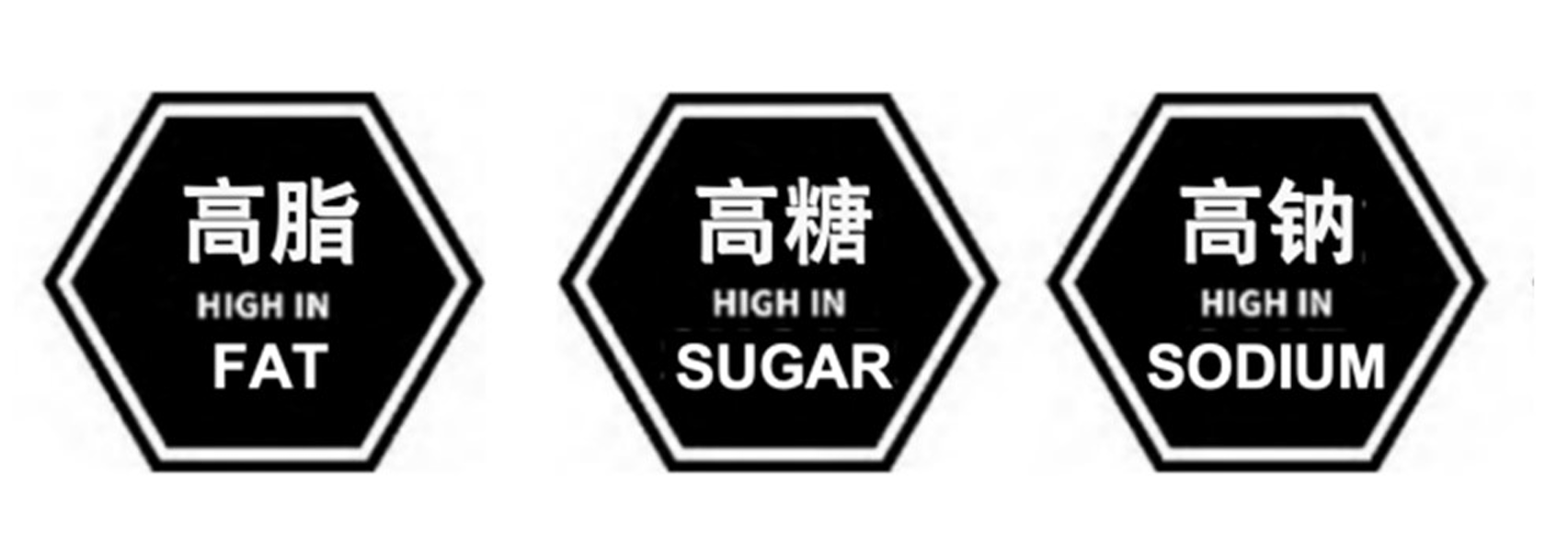
A warning label should be used if the fat, sugar, or sodium content exceeds thresholds. If multiple nutrients exceed their corresponding thresholds, all relevant warning labels should be displayed.
Nutrients | Solid foods | Liquid foods |
Fat | 20 g/100 g | 10 g/100 ml |
Sugar a | 23 g/100 g | 11.5 g/100 ml |
Sodium | 800 mg/100 g | 400 mg/100 ml |
a Lactose and galactose are not included Notes: Milk powder, reconstituted milk powder and solid beverages are calculated based on the amount after preparation into liquid. | ||
The label size must be at least 50% of the product name's font size.
According to the draft, products with these warning labels should no longer be marketed to children.
Rating labels
Rating labels is applicable to prepackaged foods, excluding cheese and processed cheese. Under the rating system, foods are categorized into four grades (A, B, C, D) based on fat, sugar, and sodium content. Please note that pasteurized, high-temperature, and sterilized milk are classified as Grade A. Rating labels with the Chinese characters "营养选择" (Nutrition choice) are shown as below:

Thresholds for solid foods
A | B | C | D | |
Fat (g/100 ml) | <1.5 | 1.5≤fat<5 | 5≤fat<10 | ≥10 |
Sugar (g/100 ml) a | < 0.5 | 0.5≤sugar<5 | 5≤sugar<11.5 | ≥11.5 |
Sodium (mg/100 ml) | <120 | 120≤sodium<200 | 200≤sodium<400 | ≥400 |
a Lactose and galactose are not included | ||||
Thresholds for liquid foods
A | B | C | D | |
Fat (g/100 ml) | <3 | 3≤fat<10 | 10≤fat<20 | ≥20 |
Sugar (g/100 ml) a | < 5 | 5≤sugar<15 | 15≤sugar<23 | ≥23 |
Sodium (mg/100 ml) | <120 | 120≤sodium<400 | 400≤sodium<800 | ≥800 |
a Lactose and galactose are not included Notes Milk powder, reconstituted milk powder and solid beverages are calculated based on the amount after preparation. | ||||
Label letters must not exceed the font size of the product name. In addition, consistency on the use of rating labels is required across the same product line.
Encouragement labels
Encouragement labels are applicable for ten categories of prepackaged foods, including cereal products, bean products, milk and dairy products, nuts and seeds, meat products, aquatic products, egg products, fruit and vegetable products, beverages and other foods. Appendix A of the draft specifies the requirements for each food type to display the label. Encouragement labels are shown as below. The Chinese characters "关注油盐糖" in the logo translate to "fat, salt and sugar intake needs your attention".

Despite each package can have only one type of label, foods rated as Grade A or B in the rating label system can also display the encouragement label.
It is free to choose icons of different colors as needed. In addition, the icon should not be larger than the font size of the product name on the front of the package.
Informational labels
Informational labels are for prepackaged foods sold directly to consumers. The label displays the content of fat, sugar, and sodium per 100g/ml or per serving, along with their percentage of the Nutrient Reference Value (NRV%). The informational labels are shown as below.
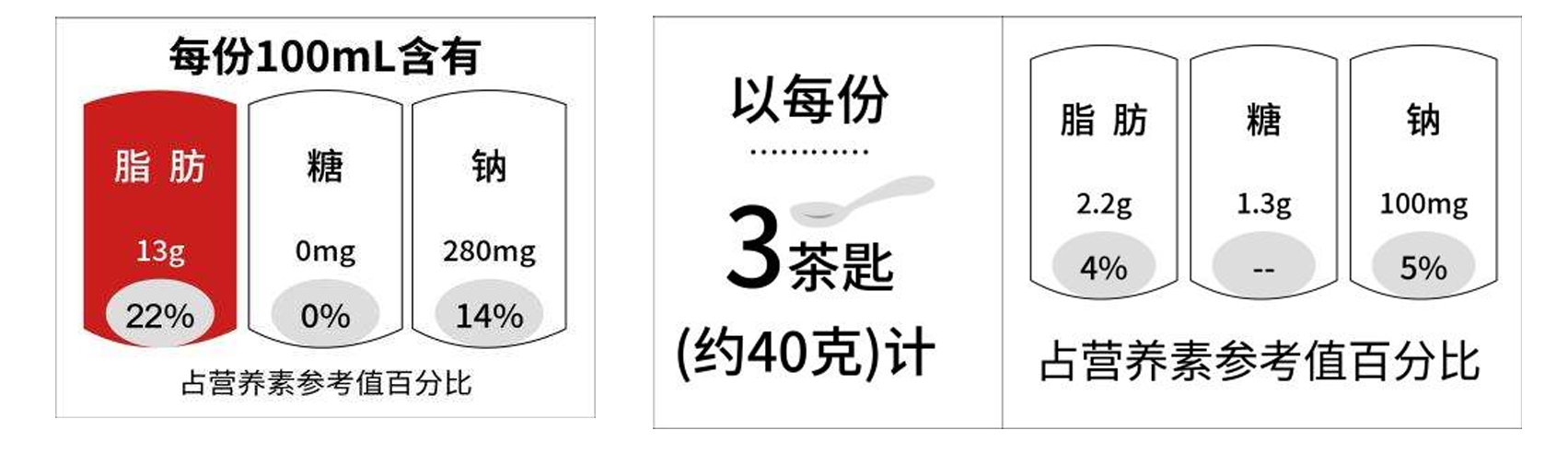
If nutrient levels exceed limits, they must be highlighted in red as the left image above.
Nutrients | Solid foods | Liquid foods |
Fat | 20 g/100 g | 10 g/100 ml |
Sugar a | 23 g/100 g | 11.5 g/100 ml |
Sodium | 800 mg/100 g | 400 mg/100 ml |
a Lactose and galactose are not included Note: Milk powder, reconstituted milk powder and solid beverages are calculated based on the amount after preparation. | ||
Text size in the icon must not be larger than the product name font size.
 We provide full-scale global food market entry services (including product registration, ingredient review, regulatory consultation, customized training, market research, branding strategy). Please contact us to discuss how we can help you by