Request a Demo
Sweeteners, also known as sugar substitutes, are food additives that provide sweetness to foods. They have been widely used worldwide for over a century, to partially or entirely replace sugar. Despite being subject to strict pre-market approval systems, there is much controversy in the media and public opinion regarding the safety and health effects of sweeteners. In response to this, China Food Information Center (CFIC) conducted a survey and provided insight into consumers' attitudes towards sweeteners based on the survey result.
The survey was conducted online, covering 32 provinces, autonomous regions, and municipalities directly under the central government. Among 5,112 valid questionnaires received in total, 2,488 of the respondents are male (48.67%) and 2,624 are female (51.33%).
Key investigation results include:
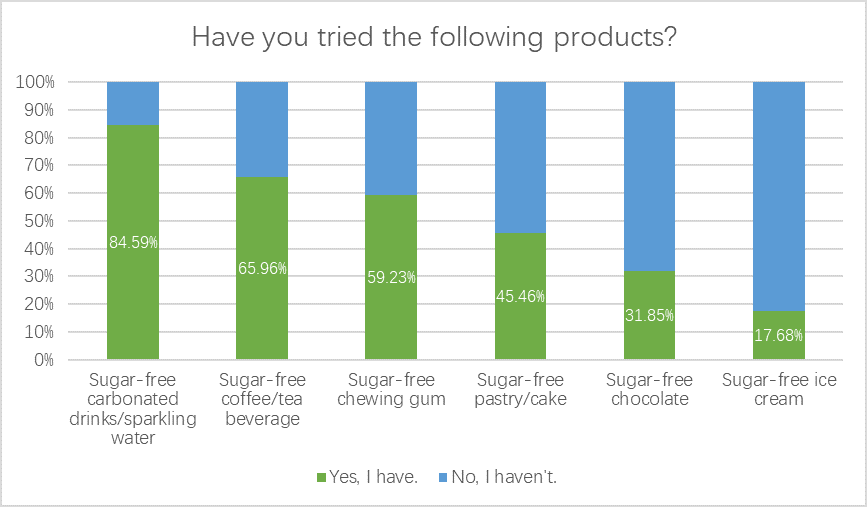
1. Sugar-free drinks have the highest penetration rate in F&B market.
Under the trend of healthy food consumption, sugar-free foods and beverages are emerging and becoming increasingly abundant. Among various categories, the penetration rate of sugar-free drinks is the highest. The survey showed that 84.58% consumers have tried sugar-free carbonated drinks or sparkling water, followed by sugar-free coffee or tea drinks (65.96%) and sugar-free chewing gum (59.23%). Sugar-free ice cream and sugar-free chocolate still have room for further development.
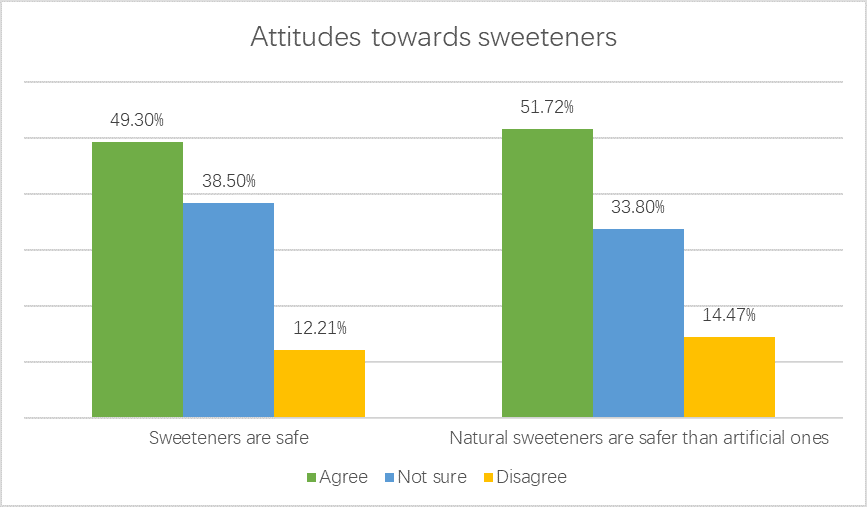
2. Nearly half of consumers have doubts about the safety of sweeteners.
12.21% of consumers believe that sweeteners are unsafe, and another 38.50% of consumers have doubts about their safety, which adds up to almost half. This is likely because many consumers consider food additives as "chemical substances," and sweeteners cannot escape from this bias. Among all sweeteners, consumers are more confident in the safety of natural sweeteners than artificial ones. Sweeteners made from natural plants such as stevia, monk fruit, and licorice are expected to have a promising future for applications.
3. Natural sweetener xylitol is well accepted by consumers.
Chinese consumers prefer natural options when it comes to sweeteners. Xylitol and maltitol are two sweeteners with the highest acceptance degree of 58.06% and 55.79%, respectively. This is mainly because xylitol has been widely used in chewing gum for years, and sufficient consumer education has made it deeply ingrained in people's minds with a healthy image. The acceptance of erythritol, stevioside, and mogroside is also relatively high.
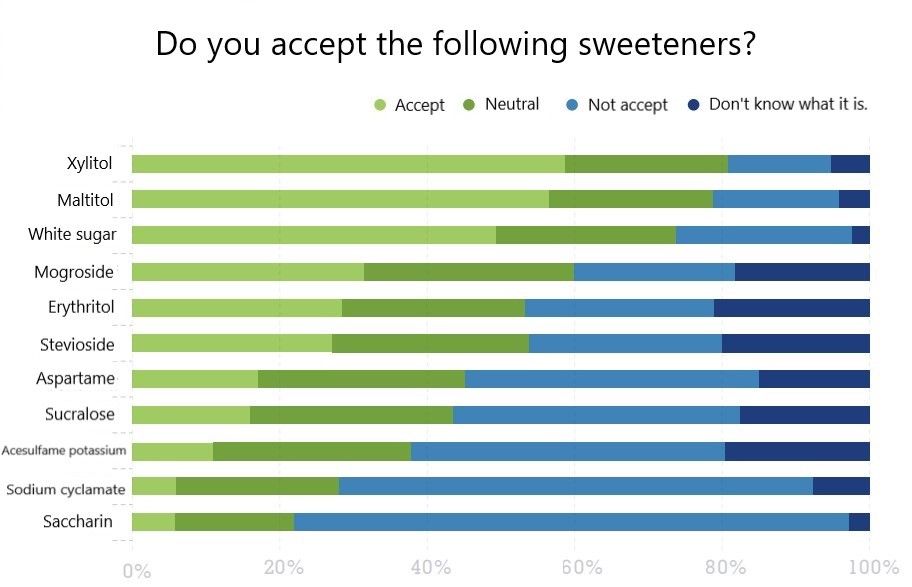
Picture from “Investigation Report on Chinese Consumers’ Awareness of Sweeteners”, by CFIC
4. Claims like "zero sugar" are the key basis for consumers to choose sugar-free products.
Nearly 80% of consumers determine whether a product is sugar-free through labels. They will also check if there’s any sugar-containing ingredients in the ingredient list, such as honey, concentrated fruit juice, fruit jam, etc. In addition, the survey found many consumers might misunderstand "zero sucrose" as "zero sugar." To avoid consumer taking "zero sucrose" products as "zero sugar" products mistakenly, ChemLinked suggests the use of "zero sugar" claims instead.
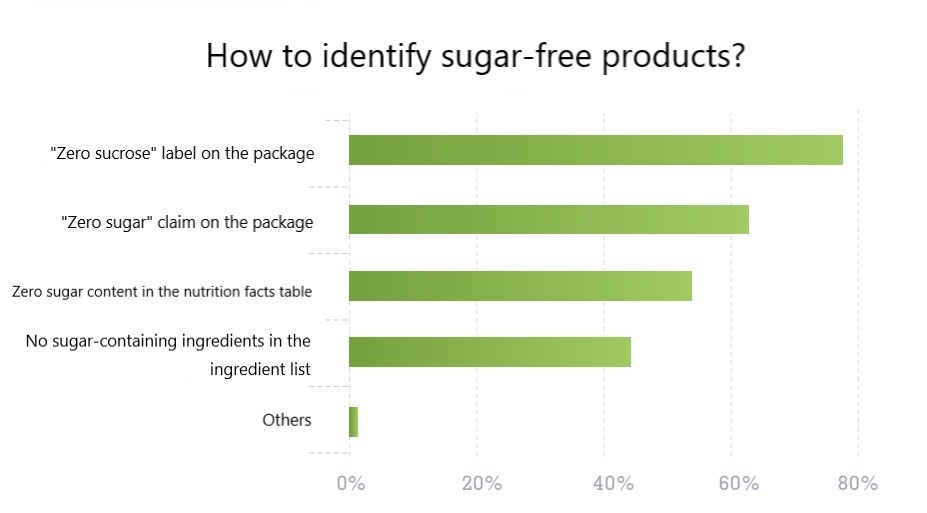
Picture from “Investigation Report on Chinese Consumers’ Awareness of Sweeteners”, by CFIC
Read the full text of the report here.
 We provide full-scale global food market entry services (including product registration, ingredient review, regulatory consultation, customized training, market research, branding strategy). Please contact us to discuss how we can help you by