Request a Demo
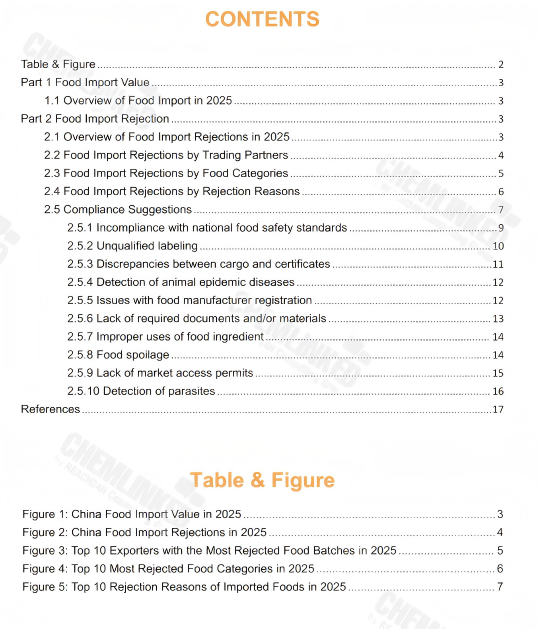
ChemLinked releases A Look Back at 2025: China's Rejected Imported Food Review Report, offering a comprehensive analysis of China's food import performance, customs rejection trends, and regulatory compliance landscape over the past year. Based on official data published by the General Administration of Customs of the People's Republic of China (GACC), the report reviews key developments in import value, rejection volume, major trading partners, high-risk product categories, and the primary causes behind customs clearance failures in 2025.
Stable Import Value Amid Sustained Regulatory Scrutiny
According to GACC statistics, China's total food import value in 2025 reached approximately 1.32 trillion yuan, representing a slight year-on-year decline of 1.5%. While the overall trade value remained generally stable, border inspection intensity did not ease.
In 2025, a total of 4,889 batches of imported food products were rejected by China Customs, marking a 16.4% year-on-year increase. Following the spike observed in 2024, the number of rejected batches once again exceeded 4,000, reflecting continued high regulatory vigilance at China's borders.
US, Japan, and Ecuador Top the Rejection List
Rejected food products in 2025 originated from 92 countries and regions, highlighting the diversified structure of China's food import sources.
The United States ranked first with 1,002 rejected batches (20.4%), mainly involving meat products and processed fish and meat products. Notably, the figure rose sharply compared with 2024.
Japan ranked second with 383 batches (7.8%), primarily alcoholic beverages.
Ecuador ranked third with 303 batches (6.1%), largely aquatic products.
Compared with 2024, the ranking landscape shifted, with Spain, Hong Kong S.A.R., Argentina, and India entering the top ten, while some previous major exporters dropped out. In addition, despite tariff fluctuations, China continues to serve as a critical market for U.S. food exports.
Meat Products Become the Most Rejected Category
By product category, meat products ranked first in 2025, accounting for 27.6% of total rejections (1,350 batches), overtaking aquatic products compared with the previous year. The majority of rejected meat products originated from the United States, Spain, and Brazil.
Animal-derived products and alcoholic beverages continue to represent areas of heightened inspection sensitivity under China's import control system. Meanwhile, "miscellaneous foods"—covering health supplements, sauces, solid beverages, and other diverse products—frequently faces compliance issues because of the wide variety of products it includes.
Top Rejection Reasons: Safety, Labeling, and Documentation
In 2025, the leading causes of rejection were:
Non-compliance with national food safety standards – 1,581 batches (32.3%)
Unqualified labeling – 937 batches (19.2%)
Discrepancies between cargo and certificates – 614 batches (12.6%)
The core compliance risks remain concentrated in product safety conformity, labeling accuracy, and document consistency, accounting for nearly 64% of all rejected batches.
Regulatory Developments Enterprises Must Watch
Beyond the rejection data itself, 2025 also marks a year of regulatory transition.
Notably, the GACC Decree No. 280 was issued in October 2025 and will take effect on June 1, 2026, replacing Decree 248. The new decree introduces a simplified "list registration" pathway and unifies the application procedures for overseas manufacturers. Enterprises exporting to China should prepare for this transition to avoid disruptions to registration status.
In addition, China released updated labeling standards:
Both standards will take effect on March 16, 2027, introducing new mandatory labeling items, optimized nutrition declaration requirements, revised NRVs, and clearer digital labeling provisions, among other updates. Given that labeling remains one of the top causes of rejections, early alignment is strongly recommended.
Meanwhile, nearly 50 new or revised GB standards are scheduled to enter into force in 2026, covering food additives, nutritional fortification substances, testing methods, hygienic practices, and food contact materials—further increasing the compliance complexity for exporters.
To access more contents covered in this report, including detailed statistical charts, in-depth analysis of rejection reasons, practical compliance recommendations, and regulatory updates, please click the download button at the end of this article to obtain the full report.
 We provide full-scale global food market entry services (including product registration, ingredient review, regulatory consultation, customized training, market research, branding strategy). Please contact us to discuss how we can help you by