Request a Demo
According to the WTO TBT agreement, WTO members are obliged to notify other members of any new/updated domestic regulations. Other WTO members and relevant stakeholders can raise opinions on newly notified regulation to avoid unfair or unnecessary imposition of technical barriers and to help protect their own trade interests. For example, in April this year EU commented on China’s infant formula registration policy, complaining that this policy constitutes an anti-competitive technical barrier to trade. In addition, EU made its own suggestions on how China should change its current infant formula international trade policy going forward.
In international trade between WTO members, each WTO member strives towards the most beneficial trade environment possible under WTO rules and for this reason it is desirable that international stakeholders operating in China have a basic understanding of WTO TBT intermember dynamics and the procedures and formalities associated with TBT development and notifications in China. As the world’s largest market, the development of new trade policy, legislation, regulation and subordinate rules, notices and standards in China are hugely important on a global scale. Any non-tariff trade measures issued by China, such as TBT and SPS, may have huge impact on global trade and China market access. In this article, we will look at the internal process China uses to formulate its food trade policy and the associated WTO notification process.
What influences development of China’s food policy?
Domestic market environment
In China certain TBTs are shaped by and developed based on market conditions or in response to specific occurrences or activities of the players operating in the market. The “Melamine Scandal” which occurred 10 years ago in the infant formula sector of China’s dairy industry exemplifies this principle and precipitated development of a slew of policy, legislation, regulation etc. which have significantly impacted international trade. After the scandal the government realized the dangers of using nitrogen as a surrogate marker to test for overall protein levels and designed new testing methodologies and specific melamine testing standards to deal with the issues which arose from unscrupulous enterprise exploiting weaknesses inherent in China’s previous administrative and regulatory measures. China’s subsequent development of regulations to further curtail and shape the infant formula market are also prime examples showcasing how China develops TBTs in response to on market conditions. This is probably best exemplified by the implementation of China’s infant formula registration policy. Prior to the implementation of this regulation, there were over 2300 product lines, manufactured by 108 domestic manufacturers. Some manufacturers/enterprise were circulating more than 180 different products. Many of these products were identical in terms of their production and formulation but were differentiated based on their branding, pricing, target consumer demographic or target region. Additional serious problems which undermined the safety and credibility of China’s infant formula sector were the commonplace utilization of exaggerated labeling/advertising claims replete with often fallacious or unsubstantiated scientific terminology either directly or indirectly implying functional efficacy associated with beneficial impact on infant physiology. Based on this we have seen China update infant formula labeling requirements and dramatically decrease the scope of permitted labeling claims and permitted terminology (in combination with heightened supervision and enforcement of regulations).
International standards updates
Development of food safety standards in more developed countries often precedes or guides development of Chinese food safety standards, especially for food additives, pesticide residues etc. China often uses Codex standards or attempts to align with international best practices to facilitate international trade. Compared to its global counterparts in the US, the EU, Japan etc., China’s food safety standard system is comparatively underdeveloped and for this reason China will often use the standards utilized in more developed regulatory frameworks as a reference when developing its own domestic standards. For example, China referenced the GSFA food additive standards when developing its own domestic food additive standard GB 2760-2011, which integrated the usage requirements of phosphoric acid, sodium pyrophosphate and so on. Furthermore, some international code systems are contained in China’s food safety standards, such as INS code and FEMA code in GB 2760.
How China formulates its domestic standard?
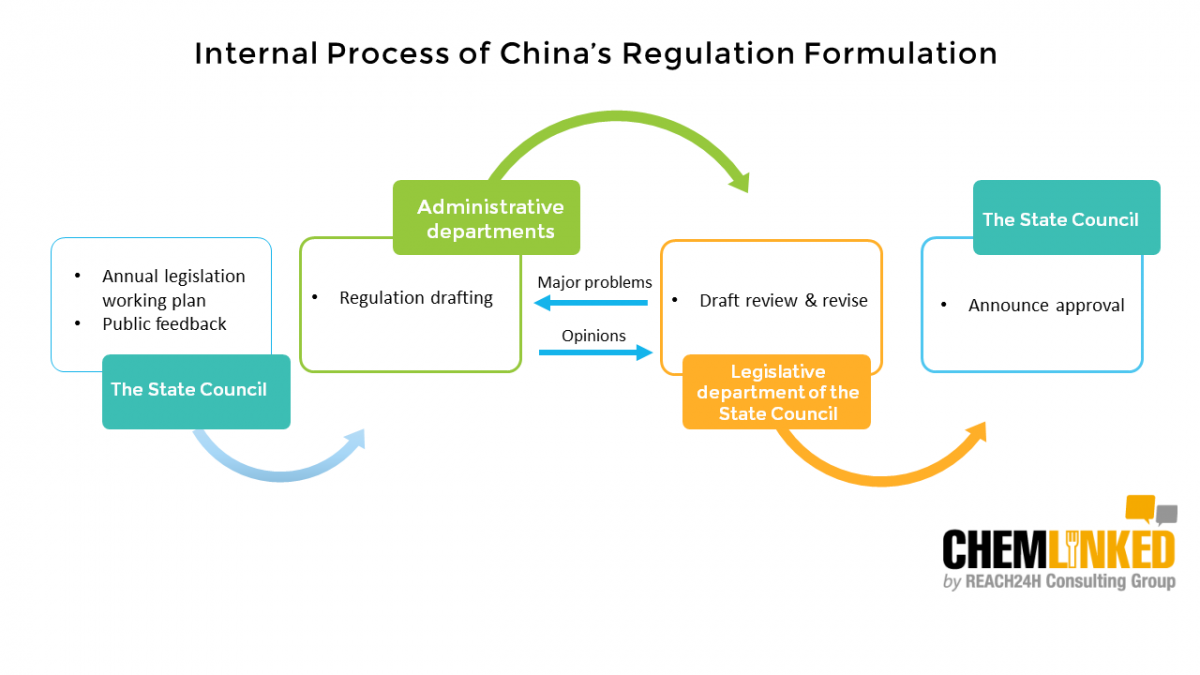 The State Council prepares the annual legislation working plan (draft version subject to public consultation before finalization) at the beginning of each year. Generally speaking, the legislation plan should follow the national development strategy such as the 13th five-year plan.
Ministries or departments under the State Council will be assigned to draft subordinate administrative regulations. If development of regulations requires technical/professional knowledge, relevant experts are used, and the department could also entrust related education/research institutes, social organizations to help during development of legislation/regulation/standards. All draft versions should be opened for public feedback, and it will be delivered to the State Council for review.
The legislative department of the State Council is responsible for the review of proposed regulations submitted in drafts, and if necessary the draft will also be sent to relevant ministries, local government, and organizations for their opinions. Furthermore, public hearing may also be held if there are far reaching implications for society as a whole. After these steps are complete the legislative department will revise the draft for review and apply for approval to the State Council. The State Council will finally announce the approval of the regulation if preceding steps have been completed smoothly. The regulation will be published both online and offline.
WTO notification
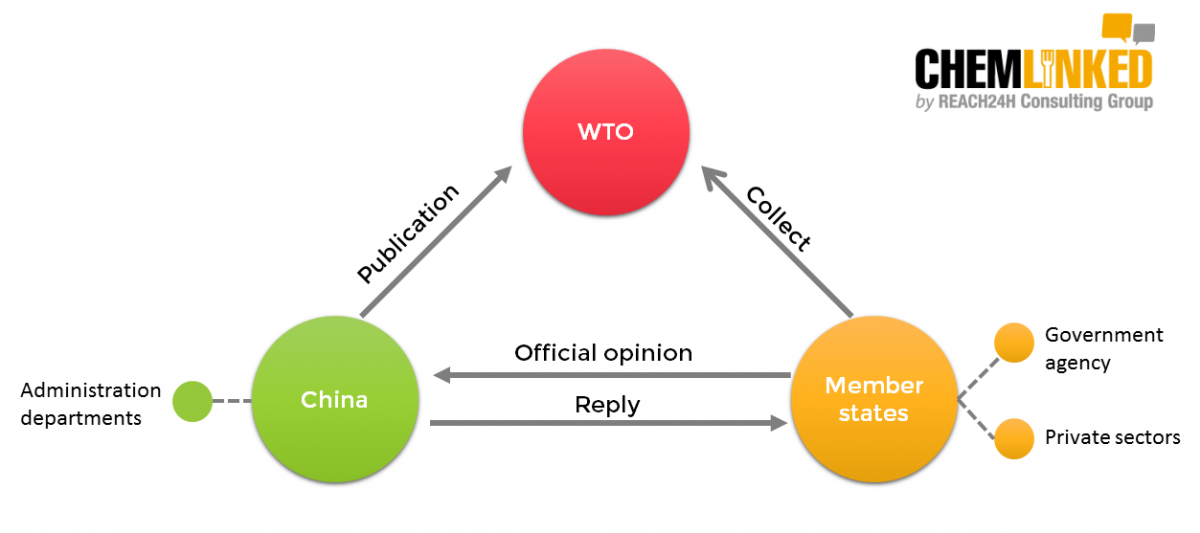
As one of WTO members, China is obliged to notify the other members of new or revised regulations that may have an impact on international trade. First of all, the competent authority in the notifying country should submit the TBT notification application to the corresponding SPS National Notification and Enquiry Center in that country. After preliminary content review, by the EP/NAA in the country of origin, the notification will be sent to WTO Secretariat before finally being published. Once published the secretariat will disseminate details on the notification to the national EP/NAA departments in each member state.
How can overseas enterprise/government comment on China’s TBT/SPS
Enquiry Point (EP) and National Notification Authority (NNA) are the authorities tasked with dealing with WTO notification issues. These authorities have bases in nearly all WTO member states. In some countries the Enquiry Point and NNA are the same. After the publication of China’s TBT/SPS notifications, Enquiry Point or National Notification Authority in corresponding states will collect and then alert relevant government agencies, private sector of TBT/SPS notifications that could affect exports. Generally speaking there will be at least 60 days for public feedback. During this period stakeholders can put forward their opinions, and EP or NNA will coordinate those comments to formulate an official comment representing its country/region.
Those comments from various WTO members will then be received by China SPS National Notification and Enquiry Center through email, fax, or letter and then translated. After translation, comments and questions will be sent to corresponding administration departments for further reply.
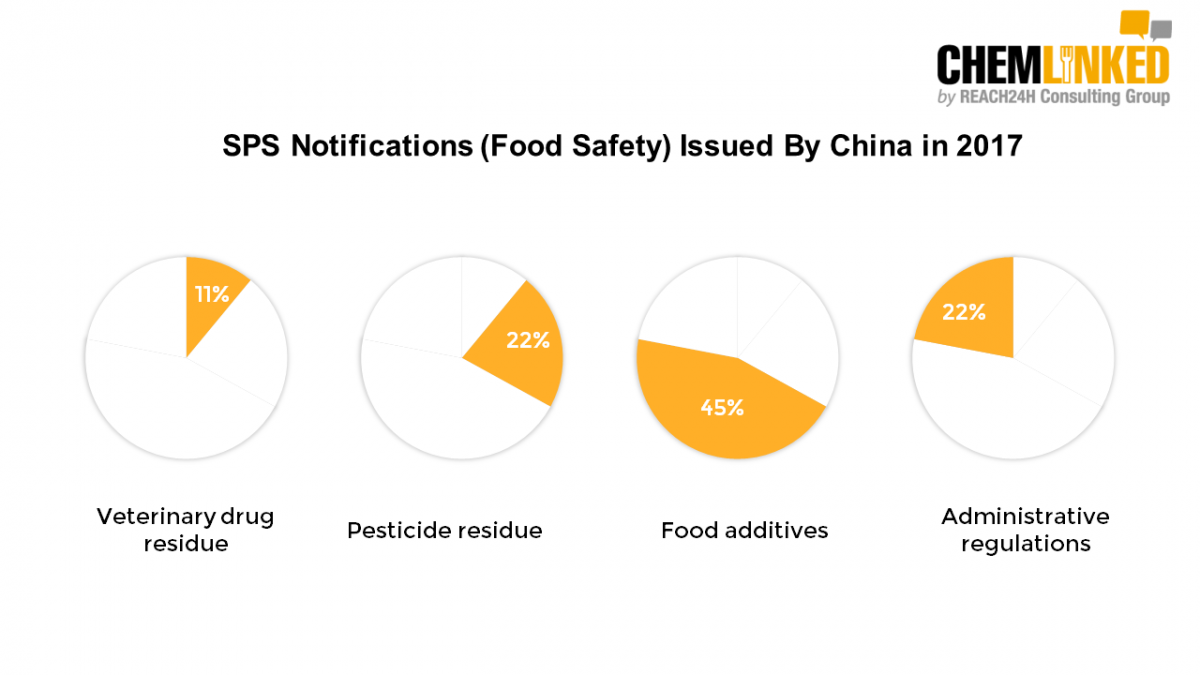
In 2017, China issued 11 TBT and SPS notifications related to food safety. 9 of them are SPS notifications, concerning pesticide and veterinary drug residue, food additives and administrative regulation. Food additives accounted for the majority of notifications (45%). It is worth noting that 2 significant regulations, “Administrative Measures on Imported and Exported Food Safety” and “Implementation Rules of Food Safety Law”, were notified to the WTO last year.
2 TBT notifications issued in 2017 are listed below:
Administrative Measures on the Inspection of Imported and Exported Prepackaged Food’s Labeling
Administrative Measures on the Attached Certificate of Imported Food
Summary
At present, compared to China, developed countries/regions such as EU perform better in terms of TBT/SPS negotiation. Industry associations in the EU are very active in dealing with TBT measures, including regulatory interpretation, advocacy, lobbying of government etc. However, some developing countries like China still lack an adequate TBT/SPS response system. Technical barriers are becoming increasingly significant for international trade, necessitating that each WTO member be more actively engaged in monitoring of new notifications and subsequent policy negotiation.
 We provide full-scale global food market entry services (including product registration, ingredient review, regulatory consultation, customized training, market research, branding strategy). Please contact us to discuss how we can help you by