Request a Demo
Nutritional labeling is a fundamental section of the label of a food product. It shows the nutritional characteristics and related nutritional information of foods and is the main way consumers understand the nutritional components of foods. The management of food nutrition labels has received more and more attention. This article offers a comparative analysis of nutrition label requirements in mainland China, Hong Kong and Taiwan.
1. Guidelines on Major Regulations and Standards Related to Nutrition Labels
Mainland China, Hong Kong and Taiwan have formulated regulations or standards related to nutrition labels and guidelines to specify the requirements for nutrition labels. Here are the main rules, standards, and guidelines for the three regions.
2. Mandatory Labeling of Nutrients
The nutrients that must be indicated on the nutrition label in mainland China are “1+4” (energy + 4 core nutrients), and those in Hong Kong and Taiwan are “1+7”. The mandatory nutrient labeling in the three regions is shown in Table 1.
Nutrients | Mainland China | Hong Kong | Taiwan |
Energy | ✔ | ✔ | ✔ |
Protein, fat, carbohydrate, sodium | ✔ | ✔ | ✔ |
Saturated fatty acid, trans fatty acid, sugar | ✘ | ✔ | ✔ |
Table 1
In the three regions it is required to indicate nutritional content for any food nutrition claims. In addition, Hong Kong also stipulates that if a nutrition claim involves fat, it must also be labeled with cholesterol content. Mainland China stipulates that the content of trans fat (acid) should be marked any time if hydrogenated and/or partially hydrogenated fats are used in food ingredients or during production. In Taiwan, amino acid, dietary fiber and cholesterol are voluntary labeling items. If indicated, dietary fiber needs to be listed under carbohydrates and marked as sugar; cholesterol or other fatty acids need to be listed under fat and marked after trans fatty acids; Amino acids need to be listed under the protein item.
3. Nutrient Label Format Requirements
Mainland China
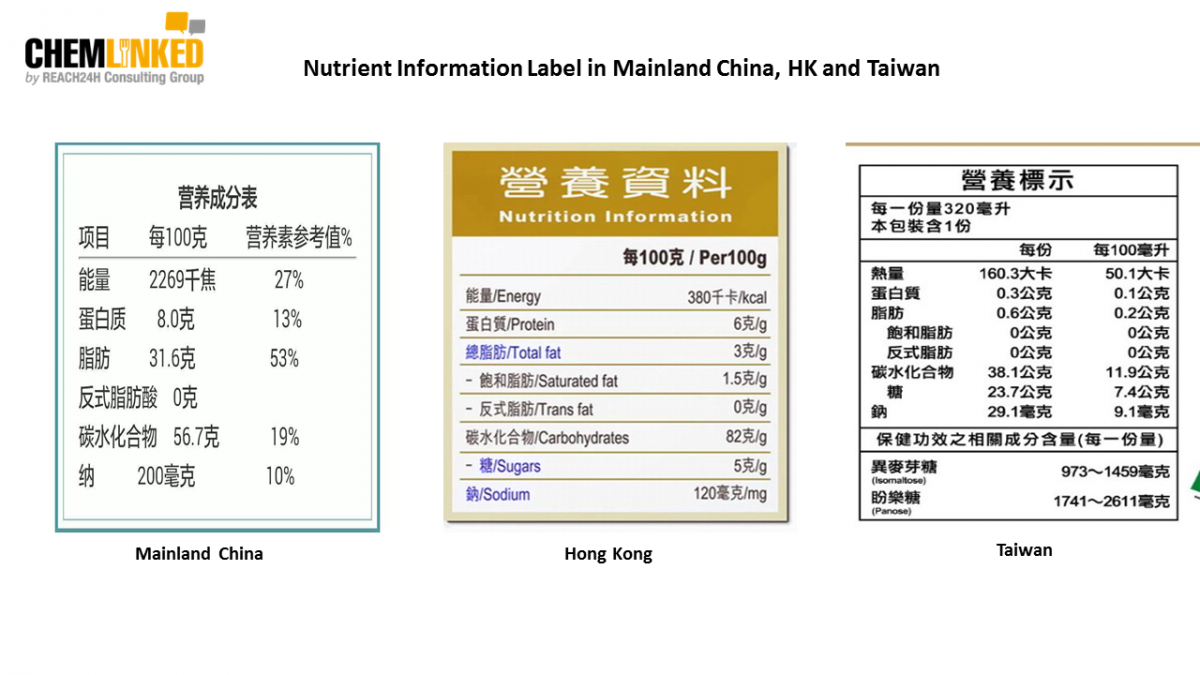
The nutrition facts shall be titled with “Nutrition Information”, expressed in the form of a “square table” (except in special cases). Percentage of Nutrient reference value (NRV) of energy and core nutrients must be indicated, and they should be highlighted when other nutrients are marked.
Hong Kong
The suggested title for nutrient information in Hong Kong is “Nutrition Labeling,” “Nutritional Information,” or “Nutritional Ingredient,” and the format of the nutrient composition must be listed in a tabular format. Additionally, NRV is not mandatorily required in the label.
Taiwan
The nutrition table in Taiwan is named “Nutrition Labeling” and lists the nutrient content as a table. NRV is optional for common packaged foods while it is mandatory for capsule-shaped foods.
4. The "0" Limit Value
Regulations state that nutrient content can be marked as zero if it falls below a certain value. Mainland China has set standards regarding the limit value of "0" for 37 nutrients, including energy, protein, and various vitamins and mineral substance, etc. There are 8 and 10 nutrients subject to “0” indication rules in Hong Kong and Taiwan respectively. The conditions of the “0” limit value for some common nutrients in the three regions are shown in Table 2.
Region | Mainland China | Hong Kong | Taiwan |
Unit | (per 100g or 100mL) | ||
Energy | ≤ 17kJ | ≤ 17kJ or 4kCal | ≤ 4kCal |
Protein | ≤ 0.5g | ||
Carbohydrate | ≤ 0.5g | ||
Fat | ≤ 0.5g | / | ≤ 0.5g |
Total fat | / | ≤ 0.5g | / |
Saturated fatty acid | ≤ 0.1g | ≤ 0.5g | ≤ 0.1g |
Trans fatty acid | ≤ 0.3g | ≤ 0.3g | ≤ 0.3g or total fat ≤ 1.0g |
Sodium | ≤ 5mg | ||
Sugar | ≤ 0.5g | ||
Dietary fiber | ≤ 0.5g | ≤ 1.0g | / |
Cholesterol | ≤ 5mg | ≤ 5mg | / |
Table 2
5. Allowable Error and Rounding Interval of Nutrient
Mainland China, Hong Kong and Taiwan all have clear requirements for the allowable errors of nutrient indicated values, and that vary with nutrient variety. As can be seen from Table 3, the allowable errors for most nutrients in the mainland China and Hong Kong regions are the same, and the specific allowable errors in the three regions are shown below.
Nutrient | Mainland China | Hong Kong | Taiwan |
Energy, total fat, saturated fat, trans fat, cholesterol, sodium, sugar | ≤ 120% indicated value1 | ≤ 120% indicated value | ≤ 120% indicated value |
Protein, carbohydrate | ≥ 80% indicated value | ≥ 80% indicated value | 80%-120% indicated value2 |
Vitamin (excluding Vitamin A and Vitamin D), mineral substances (excluding Sodium), dietary fiber | ≥ 80% indicated value | ≥ 80% indicated value3 | ≥ 80% indicated value |
Polyunsaturated fat and monounsaturated fat (fatty acid) | ≥ 80% indicated value | ≥ 80% indicated value | / |
Sugar (lactose) | ≥ 80% indicated value | / | / |
Amino acid | / | / | ≥ 80% indicated value |
starchiness | / | ≥ 80% indicated value | / |
Vitamin A, Vitamin D | 80%-180% indicated value | 80%-180% indicated value | 80%-180% indicated value |
Added vitamin and mineral substance (excluding Vitamin A and Vitamin D) | / | ≥ indicated value | / |
Other nutrient components | ≥ 80% indicated value | / | ≥ 80% indicated value |
Notes: 1. Sugar (except lactose); 2. For ingot-shaped and capsule-shaped food, ≤ 120% indicated value; 3. Excluding vitamin and mineral substance added | |||
Table 3
6. Nutrient Claims
Nutrition claims refers to the descriptions and claims of the nutritional properties of a food, such as energy level or protein level. It can be indicated on the package as long as corresponding requirements are met. Generally speaking, nutrient claims requirements are more similar between mainland China and Hong Kong.
Mainland China
Nutrient claim is optional in mainland China, including nutrient content claim (decribe the content level with words like “contain”, “high”, etc.) and nutrient comparative claim (made after comparing content value with well-known food of the same type by using the words like “added”, “reduced”). Energy and other 8 nutrients, such as protein, fat, carbohydrate, can both have content claim and comparative claim, and carbohydrate and sugar are isolated items when it comes to comparative claim. The claims’ standard terms and their synonyms are stipulated in C.2 and C.3 of GB 28050-2011.
Besides, if a nutrient’ content indicated value meets the standard of content claim or comparative claim, nutrient function claim (a kind of health claim) can be applied with those fixed terminology indicated in appendix D of GB 28050-2011 (see the detailed in Handbook on Food Label Claims in China).
Hong Kong
Guidelines released by CAC act as the primary regulatory reference for claim regulation in Hong Kong. Here nutrient claims include nutrient content claim, comparative claim and funtion claim. There are also specific standard for content claim and comparative claim. For those proposed to decalre function claim, the nutrient must be listed in table that content claim is permitted (appendix 8 of Food and Drug (Composition and Label) Regulation), its function is supported by scientific documentation. Examples of acceptable nutrient function claims are given here.
Taiwan Unlike mainland China and Hong Kong, nutrient claims in Taiwan are made based on nutrient property, and that is classified into “restrained ingestion” nutrient claims, and “encouraged ingestion” nutrient claims. Nutrients like energy, fat, cholesterol, sugar may have negative impact on health if they are excessively consumed, hence they are subject to “restrained ingestion” nutrient claims, indicating with words like “without”, or “no”. However, deficiency of certain nutrients such as dietary fiber, Vitamin, Calcium will also do harm to people’s health, so “encouraged ingestion” nutrient claims are applied to these nutrients with words like “high”, “fortified”. Certainly only when the nutrient contents meet specific standard can these claims be indicated.
7. Food Category Exempted from Nutrition Labeling
Mainland China
Fresh food, such as packed raw meat, raw fish, raw vegetables and fruits, eggs, etc.;
Alcoholic beverages that contains 0.5% or more alcohol;
Packaged food with total surface area ≤100 cm2, or the largest surface area of the package ≤20 cm2;
Non-prepacked food sold on the site where it is produced;
Packaged drinking water;
Prepackaged foods of daily intake amount ≤ 10g or 10ml
Other prepackaged foods exempted from nutrition labels according by other laws, regulations or rules;
Hong Kong
Fresh food
Alcoholic beverages that contains 1.2% or more alcohol;
Ready-to-eat food provided by catering services
Dessert and preserved fruit product
Prepackaged food whose annual sales volume is less than 30000 units (application is required)
Others (please click here for the detail)
Taiwan
Fresh food
Packaged drinking water
Herb
Spice and salt
Food whose calories and nutrient contents all subject to “0” labeling
Food and raw materials that are not directly available to consumers
 We provide full-scale global food market entry services (including product registration, ingredient review, regulatory consultation, customized training, market research, branding strategy). Please contact us to discuss how we can help you by