Request a Demo
Implementation Rules of Food Safety Law (English Version by ChemLinked) [1], published on Oct. 31, 2019, details the standards, business operation requirements and legal liability of the special food sector for the first time. Legal requirements and punitive measures for violations have been bolstered as articulated within chapter 9 of the rules which includes 12 provisions. Punitive measures will target legal representatives, principal persons in charge, directors and other responsible persons. They will face a fine of between 1 to 10x the amount of their income from the previous year. (Article 68, 69 and 75)
when enterprises break the law purposely
when violations are particularly egregious
when the illegal acts have resulted in grave consequences
Local authorities prohibited from developing local special food standards
According to article 13 of Standardization Law of the People’s Republic of China,[2] “local standards may be developed to address local special technical requirements, such as natural conditions and customs”. This provision has enabled some enterprises to develop special functional foods which comply with localized standard and violate national standards. In response, China has tightened these loopholes in the newly published Implementation Rules of Food Safety Law whereby— “health food, food for special medical purposes and infant formula are not subject to local standards, therefore it is prohibited to formulate local standards for these special foods.” It means health food, infant formula and FSMP must comply with national standards and undergo registration/filing accordingly. (Article 12)
Stricter supervision requirements
Health food manufacturers must have adequate technical capacities for extraction and purification
The new rules stress that “for health foods involving pretreatment procedures such as extraction and purification, manufacturers shall have corresponding capabilities to extract and purify raw materials”, in accordance with requirements outlined in Detailed Rules for Examination of Health Food Production Licensing.[3] Relevant health food manufacturers must have adequate pretreatment capabilities and facilities. (article 35)
Sampling Inspection requirements
Article 40 makes it clear that health food sampling inspection criteria will require compliance with the technical requirements of registration/filing, relevant test items and test methods. For health foods that are frequently found adulterated and containing prohibited ingredients, detection tests would play a more important role than ever during market supervision. In October, SAMR introduced quick detection methods for detecting sildenafil (commonly known as Viagra), tadalafil (commonly known as Cialis) rosiglitazone maleate (a diabetes medication used for blood sugar management), glyburide ( a sulfonylurea insulin secretagogue used in diabetes) and barbital type chemicals.[4]
Special food: key targeted category in food traceability system
According to article 17, infant formula, FSMP, health food and other high-risk products will be priority targets for development and implementation of an optimized food traceability system. This requirement has actually been implemented domestically on the infant formula sector for several years. Up to now, there are 113 domestic infant formula manufacturers that have satisfied this requirement when applying for production permits.
Stricter inspection requirements
Besides, FSMP manufacturers shall conduct batch by batch inspection of final products according to the testing items required in national food safety standards. (Article 36)
Labeling requirements: functional claims prohibited on all foods except health foods
Except for health food, food products are prohibited to declare any health food functional labeling/advertising claims or related terminology purporting to reduce specific disease risk factors, indicate therapeutic efficacy or amelioration of specific physiological parameters (does not apply to nutrient function claims). (Article 38)
This year the government has underscored the importance of compliance with rules that special food labels and specification manuals cannot include content beyond registration/filing information. This aligns with an overall clamp down on the use of false and misleading advertising, labeling and promotional claims. Retail outlets stocking health food will also be required to check the compliance of labels/specifications and registration/filing information. (article 39)
*Other labeling requirements for infant formula
Infant formula containing optional ingredients listed in GB standards are not allowed to be named after this optional ingredient. (Article 38) Product name shall conform to the labeling requirements specified in the Administrative Measures for Registration of Infant and Young Children Milk Powder Formula Recipes.[5]
Designated special food sales areas are mandatory and must be separated from general foods
Retailers will be banned from placing special foods and medicines in the same sales areas as general foods as this might mislead consumers to think a common food is a functional food and health foods and FSMP are pharmaceutical drugs. (Article 39)
Under the new requirements business operators shall set clearly designated specific sales areas with signs such as “Particular sales area (or counter) for health food/infant formula/FSMP products”. The notice board shall be white text on a green background. The font shall be “SimHei”. The size of the characters depends on the size of the counter or the area. (article 39)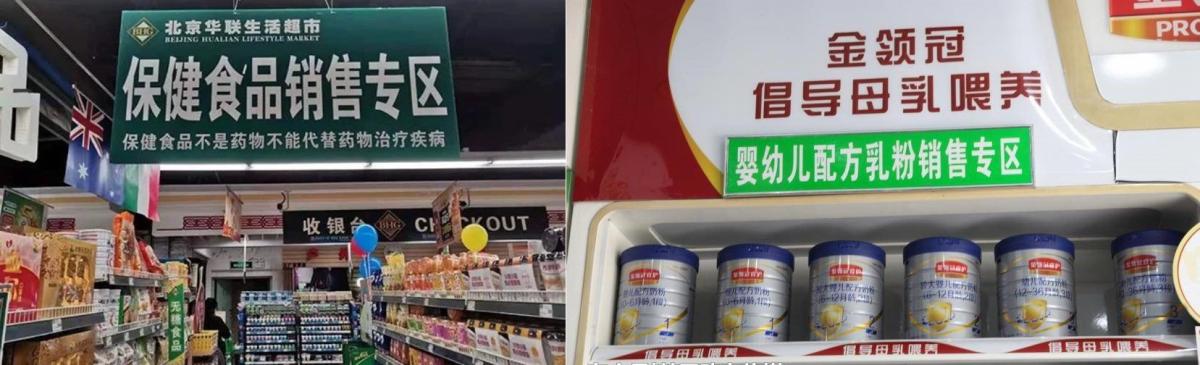 *Other demands for FSMP products
It’s worth noting that Specific Full Nutritional Formula Food of FSMP shall only be sold through medical Institutions or drug retail enterprises. There is no requirement for these medical institutions or drug retail enterprises to obtain a Food Business License to sell this category of FSMP. However according to Article 36 of the Rules other medical institutions and drug retail enterprises shall obtain the Food Business License when selling other categories of FSMP products.
Summary: Article 38 and 39 above mainly prohibit false claims/advertising of common food, and stipulate requirements to separate FSMP products/health food from common food in all retail environments, which mainly aims to prevent business operators from misleading consumers. Here’s a case study highlighting the importance of these changes.
| Case study |
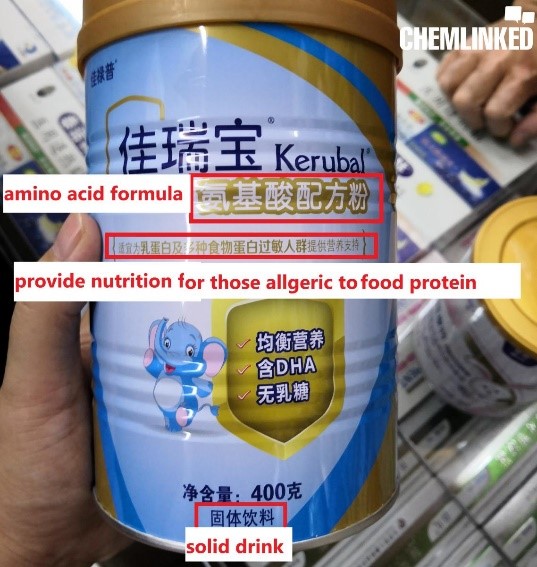
| In May 2019, consumers found several products sold at stores in the vicinity of hospitals which used labeling terminology including the terms “solid drink” and “formula powder”. Claims also indicated the products were hypoallergenic and suitable for consumption by sensitive groups. The labeling claims used on these products are designed to mislead consumers and obviously in violation of China’s food safety law and multiple subordinate administrative rules, regulations, national standards etc. One particular product shown below uses a labeling claim indicating that the product is a “functional formula” and a food for special medical purposes, despite not being a registered FSMP product or the manufacturer holding a FSMP production license. On June 6th, SAMR urged local departments of market regulation to strengthen supervision over food enterprises which fit the following criteria:
 |
Advertising: marketing of special foods using prohibited content presented in conferences, lectures and health consultations is banned
Earlier this year the State Administration for Market Regulation (SAMR) embarked on 100-day campaign to crack down on illegal practices (such as false advertising, counterfeit or substandard products) involving health food products in China, during which it found that marketing of special foods using prohibited content presented in conferences, lectures and health consultation-type marketing is ubiquitous in China. It is reported that the empty nest elderly aged 65+ are the most vulnerable group to this type of health-related fraud. They’ve got savings, time to attend these “community health lectures”, are health conscious but most important lack an understanding of basic medical and scientific principles. 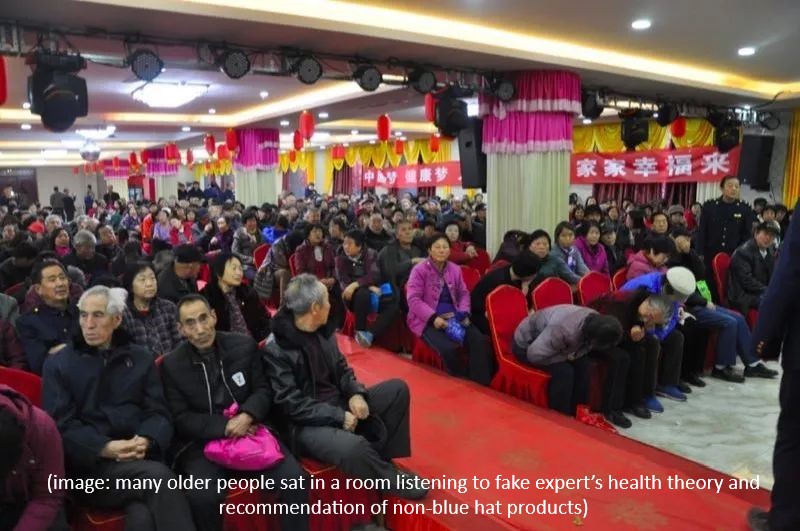 Although SAMR’s rectification campaign was successful it really only scratched the surface on China’s epidemic of snake oil salesmen that operate using an increasingly innovative array of conferences, forums, meetings etc. The new rules outlaws all false and misleading marketing of food in all conferences, lectures and health consultations. This article also applies to infant formula and FSMP products. (article 34)
*Strictest advertising management on specific full nutritional formula FSMP
Different from infant formula and health food, the advertisement of Specific Full Nutritional Formula Food of FSMP shall be regulated as prescription medicine, and that of other FSMP shall be supervised as OTC. (Article 37) It means Specific Full Nutritional Formula Food of FSMP can only release advertisements on medical and pharmaceutical journals jointly designated by NHC and National Medical Products Administration instead of public media. And it’s forbidden to give these medical and pharmaceutical journals out as gifts to promote the prescription medicines among the public; or release ads on the Internet, publications and TV programs. Up until now, no specific full nutritional formula food of FSMP has been registered.
 We provide full-scale global food market entry services (including product registration, ingredient review, regulatory consultation, customized training, market research, branding strategy). Please contact us to discuss how we can help you by