Request a Demo
Fish oil products started to gain traction amongst Chinese consumers in the nineties. The ability of fish oils to reduce important cardiovascular disease risk factors (triglycerides) and its other strong associations with improved cognition, memory, joint health etc. have elevated fish oils to one of the most popular food categories in China. According to data from CBN cardiovascular health is the most important consideration for elderly health food consumers and fish oil products are the second most popular health food product amongst the middle aged and elderly population.
According to “Health Food Registration and Filing Administrative Measures”, fish oil products bearing functional claims on the label (e.g. reduce triglycerides) currently require registration. However pending changes to regulatory compliance requirements could see fish oil as an active ingredient added to the list of approved health food raw materials which would mean in future, fish oil health foods would only require filing (entails greatly reduced regulatory compliance requirements which translate to expedited market access and greatly reduced investment requirements).
Regulatory compliance of fish oil products
Ingredients
In 2009 fish oil was granted approval as new food raw material [1]. According to the approval announcement issued by Ministry of Health, it shall be sourced from marine fish. Currently most fish oil used in health foods are formulated as triglycerides, ethyl esters or to a lesser extent high concentration triglyceride.
SC/T 3503-2000 Polyunsaturated Fish Oil Products stipulates that fish oil used for health food products shall conform to first-class refined fish oil standard specified in SC/T 3502. Here are the sensory and physicochemical requirements detailed in SC/T 3502 Fish Oil.
Sensory requirements
| Items | Refined fish oil |
| Appearance | Light yellow or orange red, clear and transparent, deposit-free |
| Odour | A little bit fishy smell peculiar to fish oil, without rancid odor |
Physicochemical indicators
| Items | Refined fish oil—first class |
| Moisture and volatile matter, % | ≤ 0.1 |
| Acid value (calculated as KOH), mg/g | ≤ 1.0 |
| Peroxide value, meq/kg | ≤ 5.0 |
| Anisidine value | ≤ 20.0 |
| iodine value, g/100g | ≥ 140 |
| insoluble impurities, % | ≤ 0.1 |
| unsaponifiable matter | ≤ 1.5 |
EPA (eicosapentaenoic acid) and DHA (docosahexaenoic acid) are the functional components of fish oil [2]. The basic level for DHA and EPA contained in fish oil shall comply with the following standard with reference to its new food ingredient approval announcement
| Items | Fish oil | Fish oil extracts |
| DHA contents | ≥ 36mg/g | ≥ 125 mg/g |
| EPA contents | ≥ 27 mg/g | ≥ 80 mg/g |
| DHA+EPA | ≥ 144 mg/g | ≥ 230 mg/g |
Notes: if the DHA content ranges between 36-125 mg/g, then the label and specification shall indicate “fish oil”; if DHA content exceeds 125 mg/g, then “fish oil extract” shall be indicated.
The current standards do not stipulate the minimum or maximum level of fish oil when it is processed and used in health food products. Fish oil health foods registered in China are approved on a case by case basis. Each product must demonstrate clinical efficacy at the stated recommend dosage of the product. According to scientific consensus, the effective dosage of fish oil (calculated as EPA+DHA) necessary to achieve a clinically significant reduction in blood triglycerides ranges from 0.92-6.78g per day.
Functional claims
Currently only 27 functional claims are permitted for registered health food, including enhancing immunity, assisting blood lipids reduction and etc. (click here to see all). If sold as a health food, fish oil manufacturers could apply to use one or several of these labeling /advertising claims as long as the clinical efficacy of the product can be substantiated through scientific research. After searching cnki.net (China Integrated Knowledge Resources Database), blood fat reduction [3] and memory improvement [4] are the most studied, recognized and used claims for fish oil products in the Chinese market.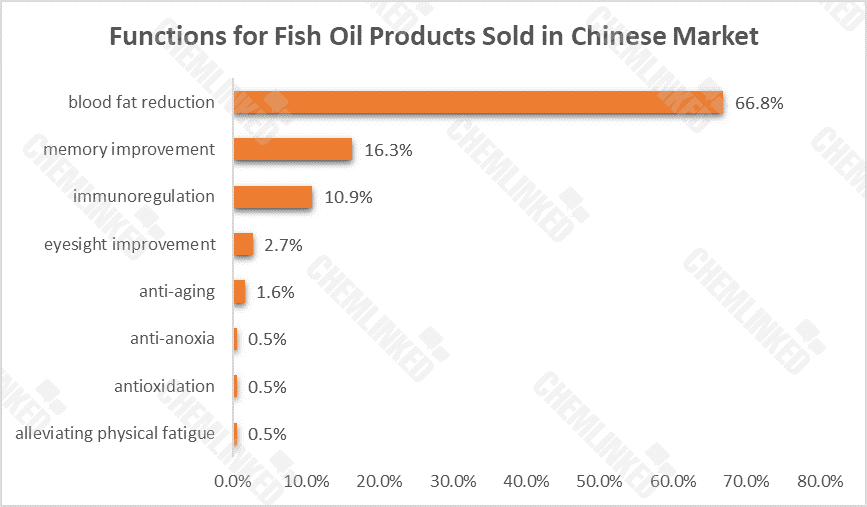
Opportunities for fish oil products
In Mar. 2019, China SAMR proposed to append heath food raw materials directory with 5 new functional ingredients, including fish oil, coenzyme Q10 and etc. If the expansion in scope is approved, products using these ingredients bearing designated functional claims will be eligible for health food filing which entails greatly reduced compliance obligations compared to health food registration.
In reference to the technical requirements detailed in the draft amendment to health food regulations, the functional claim which will be allowed for use on filed fish oil health foods will be limited to “reduce serum triglycerides”.
Following on from this on Aug. 20, 2019, China SAMR unveiled “Administrative Measures on Directory of Health Food Raw Materials and Directory of Health Functions”. Under the new system companies and individuals will be able to propose the addition of new ingredients to the health food raw materials directory and also expand on the list of permitted functional claims. Based on this, manufacturers will be able to expand on the functional claims permitted to be labeled on fish oil products provided the following stipulations are met:
The purposes are to supplement dietary nutrition substances, maintain and improve body wellness or reduce risk factors of illness
There shall be clear demand for these functions, and they can be perceived or understood correctly by the public
There is a body of scientific research to support the active ingredient and associated claim
Functions based on Chinese traditional health beliefs should comply with traditional Chinese medicine requirements
Suitable group and unsuitable group shall be specified.
Market saturation means product differentiation is vital
Lower market access threshold will inevitably lead to greater competition in this sector. At Chemlinked we have noticed a high level of market saturation in the fish oil health food product sector and based on this we are advising stakeholders to place a high priority on product differentiation during new product development. More specifically we have noted that most products have very similar formulations and utilize a low concentration of fish oil. After analyzing ingredient composition for fish oil products currently sold in China (excluding CBEC-traded products), ChemLinked found that the EPA and DHA concentration of most products are less than 50%. Only 13.6% of fish oil products have functional ingredients which exceeded 50% of total concentration, and only a handful of products had concentrations over 70%. Given that the clinical efficacy of fish oil is dose dependent we feel stakeholders could easily realize effective product differentiation by simply increasing the relative concentrations of active ingredients in their products.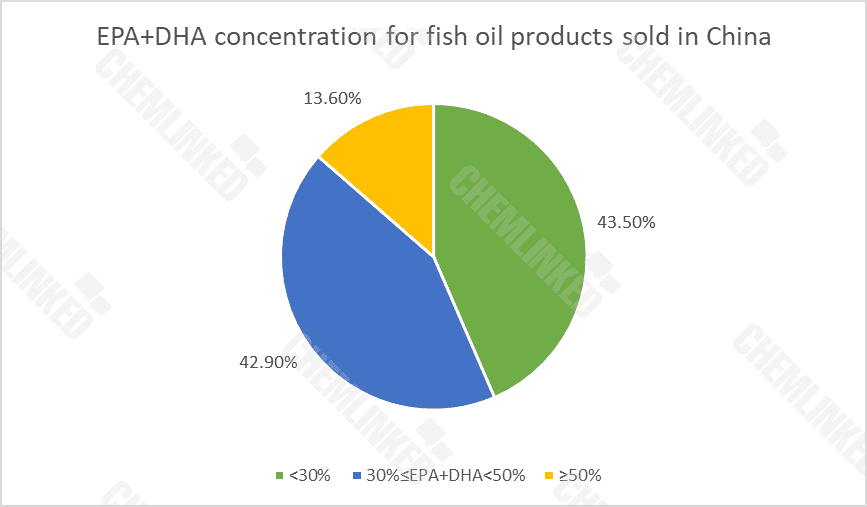
According to the REDUCE-IT results delivered at 2018 AHA Scientific Sessions in Chicago [5], the consumption of purified eicosapentaenoic acid (EPA) product can reduce the risk of adverse cardiovascular outcomes by 25%. After around five years of subjects consuming 4g per day, test subjects demonstrated a 31% lowered risk of heart attack, a 28% reduced risk of stroke and a 20% reduction in cardiovascular death. Additionally, “Chinese Guidelines for the Prevention and Treatment of Dyslipidemia in Adults 2007” [6] states that only when the amount of EPA and DHA concentration exceed 85% in ethyl polyenoate products, will products realize clinically relevant reductions in serum triglycerides.
There are only a handful of enterprises operating in China which use the technology required to extract high purity fish oil. With more and more stakeholders getting involved in this profitable market, high concentration fish oil products are a great bet for future investors and stakeholders looking to set themselves apart from the pack.
 We provide full-scale global food market entry services (including product registration, ingredient review, regulatory consultation, customized training, market research, branding strategy). Please contact us to discuss how we can help you by