Request a Demo
Introduction
GB 29922-2013 National Food Safety Standard General Rules for Foods for Special Medical Purposes defines Food for Special Medical Purposes and its various subgroups:Nutritionally Complete, Specific Nutrient Profile and Nutritionally Incomplete foods. FSMP for infants also belongs to this category.
This kind of food has special rules in China (like naming, labeling and registration stamp) and importing it in the country’s territory is a particularly complex process that we covered in past articles. After a recap of recent regulatory changes on FSMP registration in China, this article will deal with their influence on the development of this market.
Brief Chronology of Recent Regulatory Updates
On March 7, 2016, China CFDA released the “Administrative Measures on Registration of Food for Special Medical Purpose”, stipulating that all food for special medical purpose (FSMP) sold in China, either domestic or imported, must be registered in a national directory. This measure was implemented on July 1, 2016 and featured a grace period to guarantee the smooth implementation of registration process to last until 1st January 2018.
On the 14th of July 2017, CFDA announced that all the FSMP imported before 1st January 2018 can be sold until its expiration in China. CFDA also stipulated that all product must have undergone compliance inspection and approval before that date to be eligible for this measure.
On August 2017, a registration fee was introduced for FSMP.
In September 2017, CFDA published the 2017 revisions of “Requirements for Application Materials for Registration of Foods for Special Medical Purpose (Trial)” and “Stability Study Requirements for Foods for Special Medical Purpose (Trial)”, amending the previous versions of these provisions.
On November 20th 2017, China CFDA released the first batch of registered FSMP. 3 imported FSMP products for infants from two overseas manufacturers were approved: Neocate amino acid formula powder from SHS and 2 kinds of partially-hydrolyzed lactoprotein infant formula powder made by Abbott (check the details in Chemlinked F-list) . On the 22nd, CFDA announced the extension of Grace Period of one year to last until 2019 1st January. From Jan 1st, 2019, only CFDA registered FSMPs can enter the Chinese market. Domestic and imported FSMP products manufactured prior to December 31 2018 can be still sold in China until expiration date.
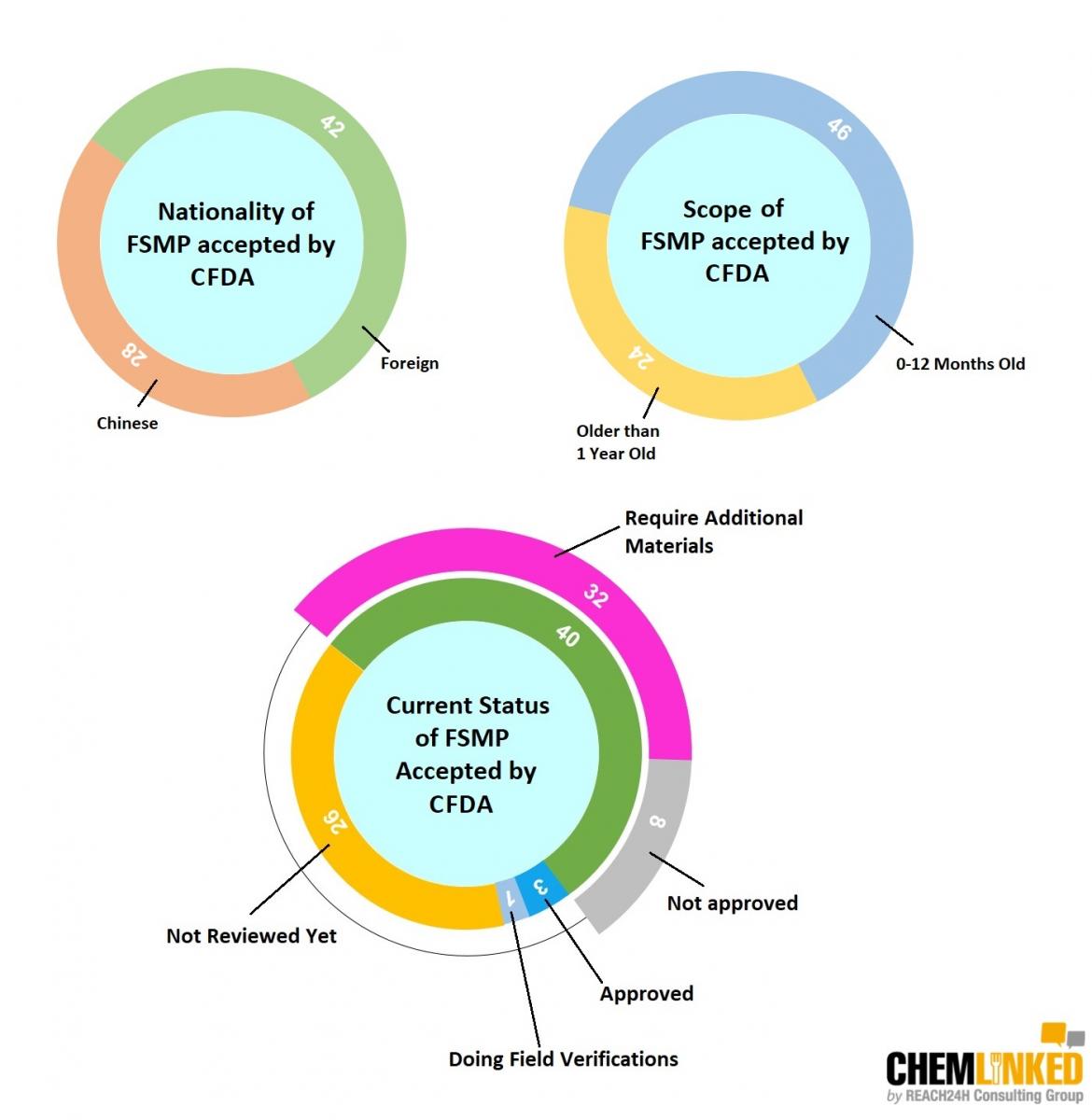
The following chart highlights some characteristics of the 70 types of FSMP currently accepted by CFDA.
How will Registration Policies Impact FSMP market?
At the recently concluded 2017 China Special Food International Conference, experts from this sector offered some suggestions on future development in FSMP industry. Many pointed out that despite the impressive development of a comprehensive regulatory framework, China's FSMP industry is still in its infancy, product development and technical capacities are still comparatively primitive.
Another problem of the Chinese market is that unlike many foreign countries, the inclusion of some FSMP in medical insurance reimbursements is not yet a common practice. Another issue is that many Chinese consumers still misunderstand the scope of FSMP utilization.
Chuang Wen Yan, manager at Fresenius Kabi said that in order to get ready for future challenges in the Chinese market, FSMP companies should take into high consideration three aspects of FSMP in China: State policies, industry and capital.
State Policies
CFDA established a complete FSMP registration management system within a relatively short period of time, clearly defining legal requirements. However, enterprises interested in this market should analyze in detail the future development research goals and policies formulated by the State to determine whether they are capable of meeting compliance demands.
The establishment of such policies and regulations lays the foundation for the orderly development of FSMP industry, giving a clear signal “registration, R & D and production inspection are all very demanding”.
Although the grace period and expiration date extensions have somewhat alleviated short term compliance demands industry is still facing a relatively short time period in which to gather relevant clinical and scientific data to substantiate product safety and efficacy. FSMP companies will hopefully make early efforts towards compilation of a compliant registration dossier in order to avoid delays and ensure normal supply to the market. The following chart shows some of the most common reasons for noncompliance during FSMP registration for FSMP companies:
Application form: |
-Applicant name and address given at the application and registration certificate are not the same |
Attached materials |
-Attached documentation is not complete. |
Seal |
-No official seal |
Industry
Despite its foreseeable growth in the near future, China’s FSMP industry is still relatively underdeveloped and lags behind its major global counterparts. Currently, the major FSMP global markets are North America, Europe and Japan, while China only accounts for 1% of the total. This market will require quite a long time to grow and operators should be aware that it will take a long time for FSMP to gain traction and garner consumer awareness particularly given inherent advertisement and retail restrictions. It is crucial for enterprises to develop products that are suitable for Chinese consumers, strengthening safety, efficacy and clinical studies and converting such scientific research into a language understandable by most people.
Capitals
R & D in FSMP Industry requires big financial and time investment. Production costs are generally very high but both the tempting size of this market and optimistic growth projections predict an influx of large amounts of Capital. On the other hand, growth in the FSMP sector might be hindered by new regulatory thresholds and wary consumers. Despite all this we can see Nestlé is gambling on the success of this market and has invested 650 million Yuan in Taizhou China Medical City.
 We provide full-scale global food market entry services (including product registration, ingredient review, regulatory consultation, customized training, market research, branding strategy). Please contact us to discuss how we can help you by