Request a Demo
Overview
Yogurt is a type of fermented milk with symbiotic cultures of Streptococcus thermophilus and Lactobacillus delbrueckii subsp. Bulgaricus, while fermented milk is simply a milk product obtained by fermentation. Despite China’s historical eschewance of dairy, yogurt has actually featured as a dietary component in some geographical locations in China, especially in the northern and western part of the country. However the growth in dairy consumption amongst the Chinese Han population really only began in earnest in recent history. Notably yogurt has seen a sharp increase in consumption over the last few years.
During the first years of this boom, foreign brands were very prominent in the market but only a few of them have survived the test of time. Heavy competition, changing regulations and evolving consumer preference and purchasing behaviors have all been major stumbling blocks for foreign enterprise.
After years of promotion, yoghurt is now regarded in China as highly nutritious, capable of aiding digestion and weight loss. This perception, and the increased spending power of Chinese consumers coupled with China being one of the most lactose-intolerant countries in the world has spurred huge growth in the yogurt sector.
Yoghurt is also a crucial source of revenue and profit for Chinese dairy companies as the average profit margin stands at 40%. This is one of the reasons why several dairy companies were able to cope with slowdowns in dairy demand and decline in prices due to oversupply (both of which contributed to the stock-price implosion of Huishan Dairy last november).
Market Data and projections
According to Euromonitor, the $55bn dollar Chinese dairy market is the world’s second biggest after the US. Yoghurt occupies a significant market share and is also the fastest growing sector. China's demand for yoghurt has significantly outpaced global demand. Market value went from 80 billion yuan in 2015 to 100.6 billion yuan in 2017 and is expected to reach 122 billion yuan in 2017, overtaking milk for the first time.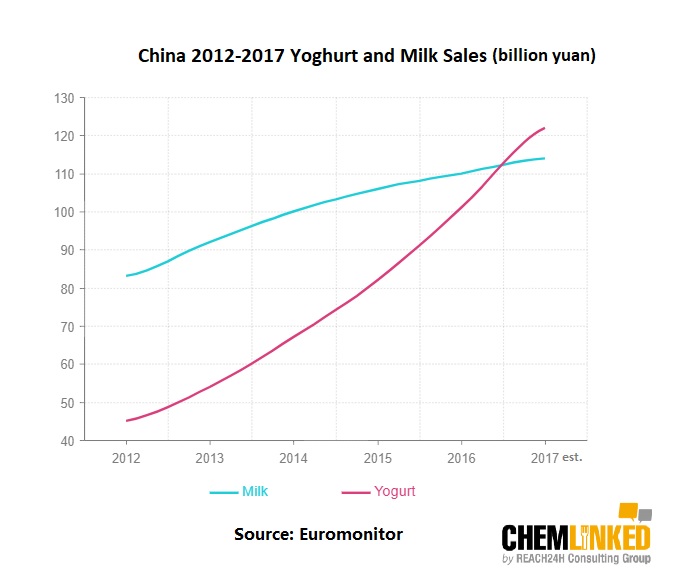
In fact, in 2017 Chinese milk sales grew only 4% compared with the previous year, while yoghurt sales rose 18%. Observing the phenomenon from a wider perspective, total sales of yogurt in China have risen by 108.6 percent from 2013 to 2017, whereas milk grew by just 18 percent in the same period. A reason for this can be found in the fact that in China profit margins for yogurt are nearly double those of plain milk, according to independent dairy analyst Song Liang. It is also noteworthy to mention that functional and fortified yogurts also performed well, year on year growth in 2016 was 23 percent, reaching a value of 43 billion yuan.
An Askci survey showed that in China 67% of consumers stated they consumed more yogurt than three years ago, compared to the average 50% in 5 other countries (Brazil, France, Poland, Turkey and the United States). According to their statistics the per capita consumption of yogurt (including fermented milk and lactic acid bacteria beverage) reached 4.8 kg per capita in 2015. This growth has spurred sustained price increases driven by the premium section of this market, reaching an average unit price rise of 13.5% year-on-year from 2012 to 2014 of which an estimated 7% -9% came from premium products. The same survey also forecasts a slight decline form 2015-2020, but until 2020 CAGR will still be 18%.
Market Concentration
Depending on different data sources, anywhere from 70% to 85% of the yogurt market in China is controlled by only three companies: Mengniu, Yili and Guangming. This chart shows the first 16 positions according to Chnbrand.
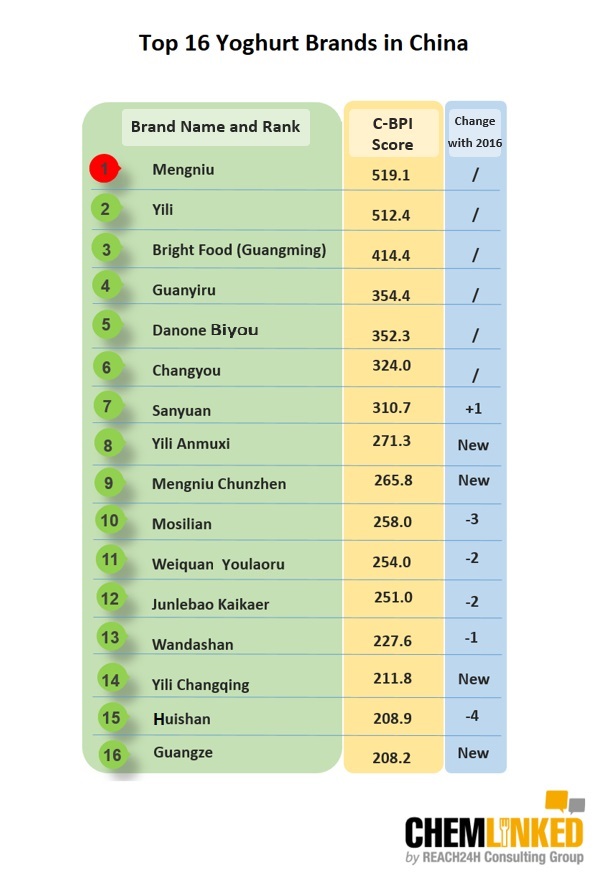 An interesting phenomenon is that the brands occupying the first six positions are the same as 2016, showing consolidation and an increasing stranglehold on the market by its biggest players.
Some data on the top three yoghurt brands in China
In 2017 Mengniu, the biggest yoghurt brand in China saw its profit grow 4.7 per cent to Rmb1.13bn. One of their recent moves was the sale of a 10% stake in their company to Danone, affording them access to new technologies and branding.
Yili Dairy Group net profit rose 4.5 per cent over the first half of 2017 compared with the same period in 2016, to Rmb3.37bn. Their Ambrosia yogurt, co-developed with the Greek Academy of Agricultural Science accounts now for 37% of shelf-stable yoghurt. In the last year sales enjoyed a three digit growth rate (106%). Its advertisement expenditure for 2016 accounted for more than 2.52 billion yuan.
Bright Food believed in shelf-stable yoghurt at a very early stage, as its Momchilovtsi brand made with bacteria imported from Bulgaria was launched in 2012, but has since lost some market share to its rivals.
Conclusion
The landscape of the yogurt and fermented drink market in China is an ever-changing one. Market trends and consumer purchasing preferences and behaviors are rapidly evolving. Technological innovation is also spurring change. A good example of this is can be seen in the development and success of shelf-stable yogurt, an innovative product that despite appearing on the shelves only a few years ago has already carved out a significant market share in China. Sales for this product are expected to account for 56 % of all sales and reach 75 billion yuan by 2022, surpassing USA. It is estimated that per capita yogurt consumption will catch up with that of UK and the US even earlier, by 2020. With such an optimistic forecast it is no wonder the market is garnering huge attention from international enterprise and witnessing the entry of numerous new brands.
 We provide full-scale global food market entry services (including product registration, ingredient review, regulatory consultation, customized training, market research, branding strategy). Please contact us to discuss how we can help you by