Request a Demo
In my last article, I emphasized the importance of deepening infant formula sales channels, especially developing offline channels like maternal stores. However, besides this, enterprises can consider diversifying their product development scope, and utilize the concept of “generational care” to develop nutritious products for the whole family.
Milk powder for adults: new trend—milk powder designed for the whole family
In China, adult milk powder mainly includes whole milk powder, skimmed milk powder, milk powder for the middle-aged, the elderly, and also for pregnant women. Adult milk powder plays a common performance in China, but there is still room for growth. According to Syntun Data [1], the online sales value of adult milk powder in 2019 has already exceeded the 2018 figures by 120%. Multiple factors contribute to the upturn in this segment of the dairy industry, including government policy support, increasing health awareness amongst consumers, and brand promotion via various channels such as promotion by KOLs.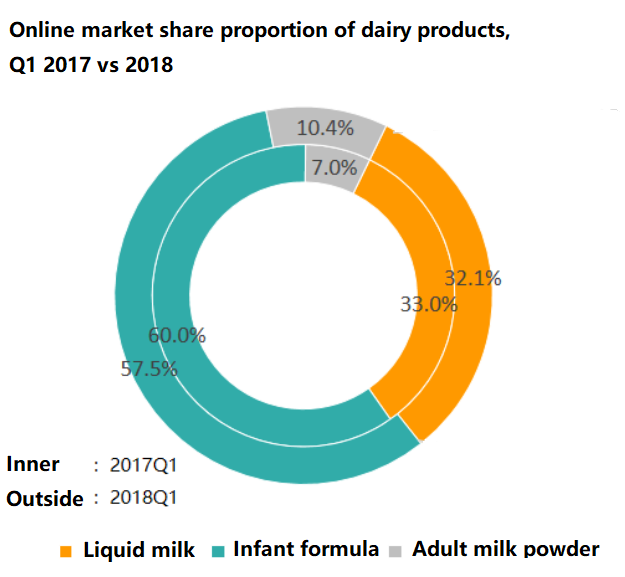 Adult milk powder brands like Devondale and Maxigenes are now doing well in China’s market, especially Maxigenes, which has experienced an unexpected but thoroughly welcome upturn in its fortunes.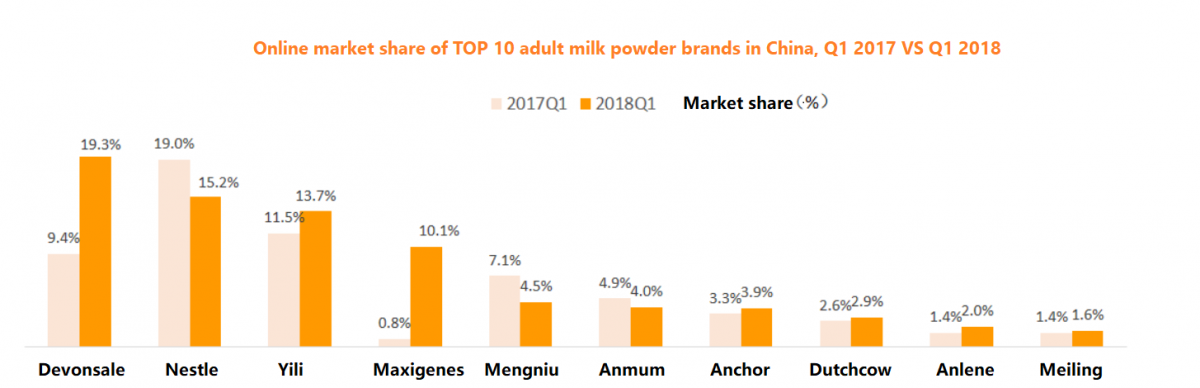
In recent months, Nestle, Yashily, and Ausnutria have all launched new milk powder products for adults, including a general milk powder suitable for all the family, including children, adults, and the elderly. According to Nielsen [2], up until August 2019, the sales value of milk powder designed for the whole family sold offline reached 1.5 billion RMB, while online sales were 1.8 billion RMB. The rate of growth of online sales in 2019 surpassed 2018 sales by 15%.
During the 2nd China International Import Expo (CIIE) [3], we also noticed that many multinational enterprises have developed and launched new adult milk powder products.
| Company | Product | Notes |
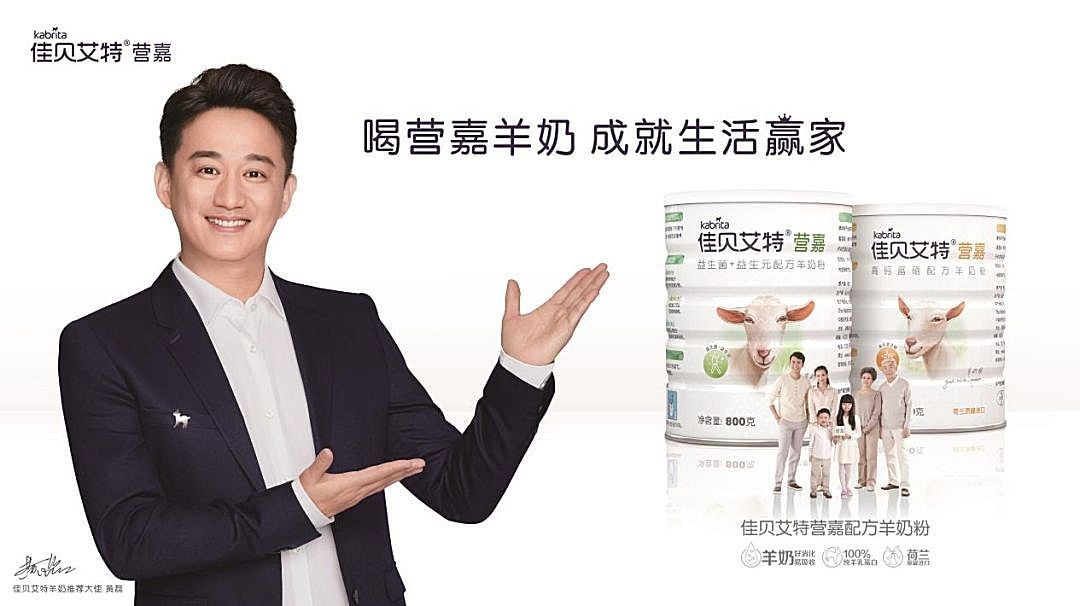
| Ausnutria | Goat milk powder for the whole family called “营嘉” | High-end with two series:
|
| Organic milk powder for pregnant women called “淳璀” | Manufactured by its Australian factory | |
| Nestle | Milk powder designed for the whole family called “NIDO”, FSMP for infants called Alfare, etc. | Alfare has passed China’s FSMP registration already |
| Mille | Milk powder for pregnant women, and for children | |
| Viplus | Milk powder for pregnant women, adults milk powder and one FSMP product | Will be traded to China via CBEC |
| … | ||
Children’s milk powder and pregnancy nutrition
Different from milk powder designed for the whole family, children’s milk powder and pregnancy nutrition are more niche sectors designed for specific consumers with specific demands. Both maternal milk powder and children formula milk powder (milk powder products consumed by children aged at 3 to 6 years old) are comparatively underdeveloped segments of the wider dairy sector. The online sales value of children’s milk powder reached a YOY growth rate of over 250% in the first quarter of 2018, according to the data from Syntun data.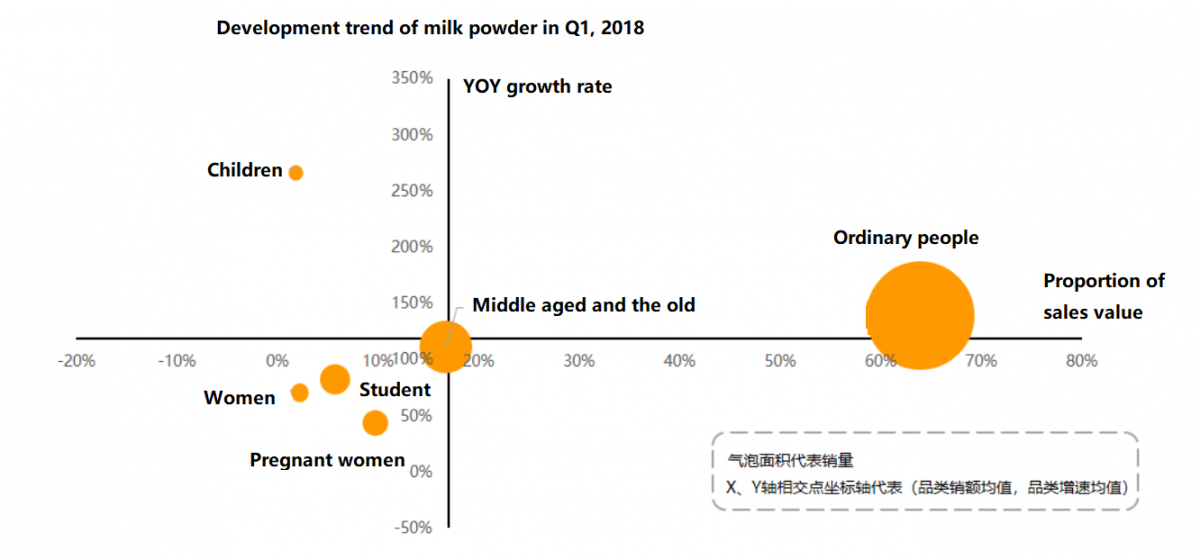 Besides, according to AC Nielsen data, children milk powder is a high growth category, and many industry experts predict that the market size will surge to 10 billion RMB in the future.
View more about pregnancy nutrition at China Infant Formula Sector: 2019 Market Movement & Growth Strategy [5].
Elderly nutrition
According to a report [6] released by China National Committee on Aging, the number of Chinese residents aged over 60 was 249 million at the end of 2018, accounting for 17.9% of the Chinese population.
Malnutrition is a big problem for elderly populations, particularly deficiency diseases related to inadequate intake of specific micronutrients. According to Nutrition and Health Report of the Elderly [7] in China, 48.4% of older persons suffered from malnutrition. Studies referenced in the report also found that up to 80%~90% of older persons did not consume enough micronutrients such as calcium, zinc, vitamins, and more than half of those surveyed consumed inadequate dietary protein.
China’s government has developed several strategies and policies to combat these issues best exemplified by the National Nutrition Plan (2017-2030), which lists combating deficiency diseases in the elderly as a critical task. Moreover, in September 2018, China also consulted on a new national standard titled General Standard of Food for Older Person (draft) [8]. The standard is still under development after already undergoing the public consultation period. View more at Data | The Elderly Food and Nutrition in China [9].
Policy support and positive growth projections are prompting the industry to target this sector, and we are just beginning to see a new wave of products launched on the market. According to a report released by the China National Committee on Aging, older people are more willing to spend money on healthcare and nutritional products. According to Kantar, the growth rate of milk powder for the elderly was 19% in 2018.
Infant FSMPs
Finally, there is a special food category called FSMP, which is a food product designed to meet the dietary requirements of sick people or those with specific diseases or other medical conditions.
Market Potential of FSMP products
In China, it is possible to categorize FSMP into FSMP for infants (from 0-12 months) and products designed for all other groups. The FSMP for infants is a special food that aims to aid the growth and development of children diagnosed with specific diseases or suffering from certain conditions. For example, babies that are allergic to cow’s milk protein can consume products such as extensively hydrolyzed milk protein formula food.
As revealed by NHC, the rate of congenital conditions in 2015 was around 5.6% [10] in China. Furthermore, the rate of preterm births was around 7.0% (prematurity was also the number 1 cause of death in neonates). Amino acid metabolism disorders, such as PKU, have an incidence of 1/16500. In 2014, there were around 120,000 children with PKU. However, only 20,000 have received a diagnosis. Also, along with the trend of later marriage and later childbirth, the age of mothers is increasing and is associated with a higher incidence of congenital issues, prematurity, and atopic conditions. This market environment has placed an exceedingly high ceiling on the growth potential of the FSMP industry in China.
Challenge: Stringent regulatory requirements favor large corporations
FSMPs are subject to stringent regulatory requirements in China, which places an often prohibitively high market access barrier for all but the largest multinational enterprise. In China, the placement of FSMP on the market requires registration, which is contingent on the demonstration of the product's clinical efficacy and safety, established through rigorous clinical trials and substantial scientific evidence. OEM manufacturing is forbidden, and brands must own their manufacturing facilities, which must be operating as per Chinese national standards. National standards define the limitations of ingredient usage and the relative concentration of ingredients used.
Regulatory barriers have meant that only a handful of companies have successfully registered products. As of Nov. 12, 2019, there were only 40 registered foods for special medical purposes, 27 are overseas products. Twenty of them are infant FSMP. (f-list: Foods for Special Medical Purpose Registration in China [11]) Fewer products on the market is translating to increased market share for manufacturers with a handful of products. Interestingly, FSMP appears on China's cross-border e-commerce positive list, which means they are eligible for trade and retail through CBEC platforms in China, such as Tmall. This theoretically allows companies to access China's markets while circumventing stringent regulatory requirements.
FSMP By product segment
| Type (Target Group) | Formula | Registered products |
| Infant FSMP | Premature or low birth weight infant formula food | 11 |
| Partially hydrolyzed milk protein formula food | 5 | |
| Infant lactose-free formula food or low lactose formula food | 5 | |
| Extensively hydrolyzed milk protein formula or amino acid-based formula food | 2 | |
| Infant nutrition supplement | 3 | |
| Amino acid metabolism disorder formula food | 2 |
By manufacturer/brand
| Manufacturer/brand | Number of registered products |
| Nestlé | 10 |
| Abbott | 8 |
| Danone | 4 |
| Synutra | 4 |
| Mead Johnson | 3 |
| Beingmate | 3 |
| Maeil Dairies | 2 |
| Suzhou Hengrui (苏州恒瑞) | 2 |
| Yili (伊利) | 1 |
| Wyeth | 1 |
| Nantong Richen (南通励成) | 1 |
| Aumix Dairy(天津澳斯乳业) | 1 |
New moves by big players: Ausnutria and Danone
The potential of China's FSMP market has prompted many companies to develop infant FSMPs. On Nov. 9th, 2019, according to the interview, the infant formula company Ausnutria confirmed its plan to develop FSMP products. According to our sources, Ausnutria has already submitted one product to authorities for approval. It is also currently investing heavily in R&D of FSMP products for the Chinese market. It is worth noticing that, the former general secretary of China’s health food association, Liu Xuecong, was hired by Ausnutria and is now serving as the director-general of Ausnutria’s special nutritional product division. Liu's wealth of experience and abundant contacts and resources will no doubt be leveraged to great success by Ausnutria.
During the CIIE 2019, Danone also displayed its new FSMP products for infants called Pepti-junior, which is suitable for infants with cow’s milk protein allergy. Danone also has set up an exclusive CBEC store on Tmall Global [12], to sell FSMP products designed for Chinese babies. As stated on its website, the production of this FSMP product conforms Hong Kong regulatory requirements.
Compliance Tips: Product Standards & Labeling Requirements
General milk powder products
All milk powder products, including milk powder for pregnant women, for children, adults, and the elderly, shall follow the product standard of GB 19644-2010 National Food Safety Standard Milk Powder [13]. Manufacturers must ensure that any nutrient function or nutrient content claims used on products shall comply with requirements stipulated in GB 28050 General Rules for Nutrition Labeling of Prepackaged Foods [14], for example, it is permitted to say "Vitamin A helps maintain scotopia (darkness visual acuity)." However, if the product involves some health food functional claims, such as improving memory, it shall be verified through a clinical trial, and the manufacturers need to apply for health food registration in China.
For Elderly Food
In September 2018, China consulted on the national standard titled General Standard of Food for Older Person (draft). The standard is still under development and is currently in the public consultation period.
The consultation draft clarified the definition of food for the older person and set requirements for physical properties, energy, nutrients (both mandatory & optional), the upper level of contaminants and microorganisms. In this draft, food for the elderly falls into three types. Furthermore, once the official version came out, products can label themselves as "Elderly Food".
| Easily consumed food | A kind of special dietary food whose physical property is changed to meet the dietary demand of older people who suffer from dysphagia or odynophagia. From liquid to solid form, it has five sub-categories. |
| Nutrition formula food | A kind of special dietary food whose main ingredients are dairy products, dairy protein products, soybean protein products, grain, and its products, and contains extra vitamins, minerals, and other ingredients. Its target consumers are older groups suffering from malnutrition. It can meet all their daily nutrition demands. |
| Nutrition supplementary food | A kind of special dietary food whose primary material are derived from dairy and are dairy protein products, and soybean protein product with vitamins, minerals, etc. The product is designed to supplement the nutritional diets of elderly consumers. |
View more at Data | The Elderly Food and Nutrition in China.
For FSMP products
The production of FSMP products must conform to the Food Safety Law [15], Administrative Measures for FSMP registration [16], and other official files [17]. For FSMP for infants, they must also conform to GB 25596 [18], and for other FSMP products, they need to follow GB 29922 [19].
As for the labeling, it must follow the Labeling and Instruction Manual Requirements for FSMP products [20]. For example, the product cannot claim functions related to "disease prevention" and "disease treatment," and cannot use the nutrient function claims stipulated in GB 28050 General Rules for Nutrition Labeling of Prepackaged Foods. However, it is permitted to label details relating to product features and efficacy. The description must be simple, scientific, and objective. As for the advertising, according to Article 37 of the Implementation Rules of Food Safety Law [21], the advertisement of infant FSMP shall conform to the same advertising requirements of OTC.
Specific products that are allowed to be produced as infant FSMP products
| Classification | Specified products allowed to be produced |
| FSMP for infants (0~12 months) |
|
 We provide full-scale global food market entry services (including product registration, ingredient review, regulatory consultation, customized training, market research, branding strategy). Please contact us to discuss how we can help you by