Request a Demo
To help stakeholders in food sector navigate the constantly evolving regulatory landscape, ChemLinked offers Global Food Regulation Highlights, a concise monthly report that focuses on key regulatory developments worldwide. Find out what's new on food regulation worldwide in April 2025 below.
For thorough and comprehensive monitoring of developments in specific business sector and markets, we highly recommend our customized risk alert and monitoring report service. This service empowers you to effectively stay informed about all the regulatory dynamics that can impact your business. With the added advantage of expert interpretation and analysis, our service offers you a comprehensive understanding of the significance and consequences of these regulatory changes. For more detailed information, we invite you to click on the provided sample of regulatory monitoring report. |
|

China
On April 15, 2025, China's National Health Commission (NHC) released a draft of the 2025 National Food Safety Standard Legislative Plan. The draft outlines 60 priority GB food standards slated for development or revision to enhance risk prevention, ensure industry compliance, and address urgent needs. These standards span a wide range of areas, including food products, labeling claims, additives, food contact materials, testing methods, hygiene requirements, and more. The NHC is accepting public comments via fax at 010-68792408 until April 24. (Read more)
More highlights in Chinese Mainland:
China GACC Rejected 231 Batches of Imported Food in March 2025
China Issues a Q&A Document for the Product Registration of Infant FSMP Under the New GB Standard
Highlights in other areas of China:
Taiwan Proposes Usage Restrictions for Food Ingredients: UV-Treated Agaricus Bisporus Powder
Taiwan Revises Assessment Methods for Bone Health Efficacy of Health Foods
Hong Kong Proposes Regulation on Konjac-containing Jelly Confectionery
South Korea
On April 21, 2025, South Korea Ministry of Food and Drug Safety (MFDS) announced amendments to the Food Labeling Standard. Most provisions will come into effect on January 1, 2026, except for the revisions concerning updated terms and definitions and Korean labeling on exported foods, which take immediate effect. (Read More)
More regulation highlights in South Korea:
South Korea to Revise the Enforcement Rules and Decree of the Act on Labeling and Advertising of Foods, to Strengthen Monitoring of Unfair Food Labeling and Advertising Online
Japan
On April 21, 2025, Japan's Consumer Affairs Agency (CAA) issued a notice requesting enterprises to conduct voluntary inspections of the use of Food Red No. 3 (Erythrosine, CAS 16423-68-0) in food products. This action follows the U.S. Food and Drug Administration's (FDA) decision to revoke its authorization for Food Red No. 3 in food, beverages, dietary supplements, and ingested drugs. In response, Japanese authorities conducted a safety assessment of the additive. (Read More)
More regulation highlights in Japan:

Southeast Asia
On April 28, 2025, the Indonesian Food and Drug Authority (BPOM) released Decree No. 278 of 2025 on the Program for the Preparation of Laws and Regulations in 2025. This roadmap prioritizes the development and revision of regulations aimed at enhancing safety, transparency, and competitiveness across the food and supplements sectors, addressing key areas such as product labeling, registration, importation, distribution, recalls, and more. (Read More)
More regulation highlights in Southeast Asia:
Indonesia Notifies Mandatory Standard for Paper and Paperboard for Food Packaging
Indonesia Launches 1 Million Quota for Free Halal Certification for MSEs
BPOM Clarifies the Registration Requirements for High PH Value Drinking Water
India
On April 16, 2025, the Food Safety and Standards Authority of India unveils a consultation paper on the provisions of "Analogue in Dairy Context", in a move aimed at tightening the regulatory treatment of dairy substitutes. Comments are invited via a Google Form within 60 days of notification. (Read More)
European Union (EU)
EU issued three regulations regarding food additive regulatory updates in April 2025. Involved food additives include Mono- and diglycerides of fatty acids (E 471), Carnauba wax (E 903), Lecithins (E 322), Fatty acids (E 570), Steviol glycosides from fermentation (E 960b), Sodium carboxy methyl cellulose, Cellulose gum (E 466), etc. Read More. (Read more)
More regulation highlights in the European Union:
EU Issues Three Regulations Regarding the Compliance Use of Three Novel Foods in April
EU Amends the MRLs for Fluralaner in Foodstuffs of Animal Origin
United States (US)
On April 22, 2025, the U.S. Food and Drug Administration (FDA) and the Department of Health and Human Services (HHS) jointly announced a nationwide plan to phase out all petroleum-based synthetic dyes from the food supply. This move marks a key milestone in the administration's broader "Make America Healthy Again (MAHA)" strategy. (Read More)
More regulation highlights in the United States:
Australia and New Zealand
On April 7, 2025, the Therapeutic Goods Administration (TGA) of Australia released an official alert addressing concerns over the sale and promotion of medicines that claim to contain or influence levels of nicotinamide adenine dinucleotide (NAD, NAD+, NADH) or nicotinamide mononucleotide (NMN). The TGA reminded sponsors, manufacturers, and retailers that all therapeutic goods sold, imported, or exported in Australia must be included in the Australian Register of Therapeutic Goods (ARTG) unless otherwise exempt or authorised. Currently, NAD and NMN are not permitted ingredients in listed medicines. (Read More)
More regulation highlights in Australia and New Zealand:
FSANZ Approves Regulatory Change Allowing Sugar Claims on Alcoholic Beverages
FSANZ Approves Cultured Quail as Novel Food Following Regulatory Reforms
FSANZ Releases Amendment No. 236 to Amend the Code, Involving Two Processing Aids and One GM Food
Upcoming Webinars in May
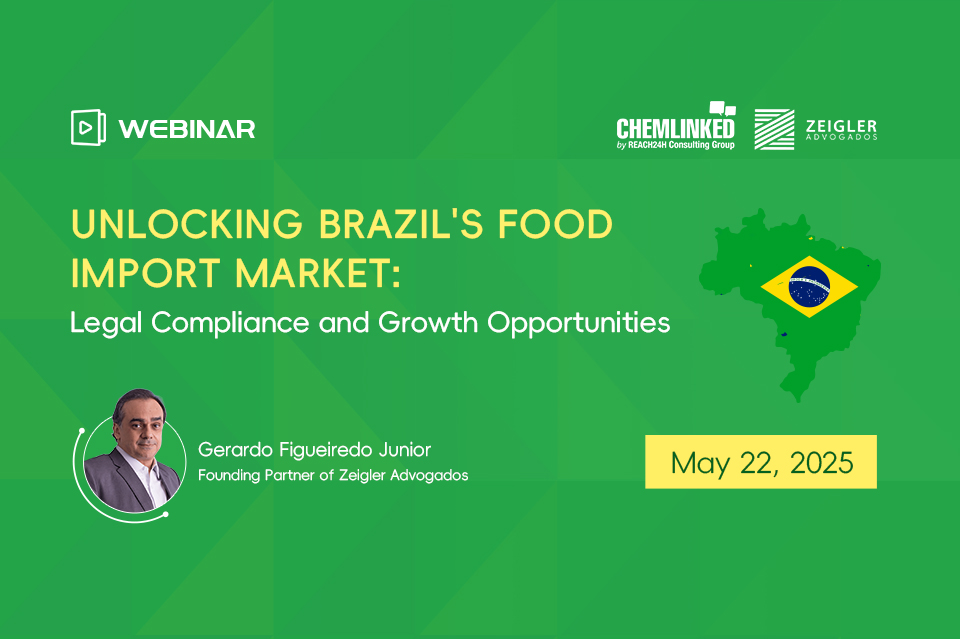
ChemLinked invited an experienced regulatory specialist, Gerardo Figueiredo Junior from Zeigler Advogados, to talk about Brazil's Food Import Market: Legal Compliance and Growth Opportunities This session will decode the food compliance landscape, equipping businesses to avoid common pitfalls and efficiently navigate Brazil's dynamic market.
Recommended reading:
 We provide full-scale global food market entry services (including product registration, ingredient review, regulatory consultation, customized training, market research, branding strategy). Please contact us to discuss how we can help you by