Request a Demo
In Taiwan, while most prepackaged foods do not require prior review and registration(a regulatory process involving the evaluation, testing, and issuance of permits), six designated food categories must undergo this process before manufacturing, processing, repackaging, importing, or exporting activities can commence. These six categories include health foods, food additives, imported foods in tablet or capsule form, genetically modified foods, special dietary foods (including infant formulas and follow-up formulas, formulas for certain diseases, and special nutritional foods for rare diseases), and locally produced vitamin products in tablet or capsule form. For overseas companies exporting the first five food categories to Taiwan, product registration with the Taiwan Food and Drug Administration (TFDA) is essential to ensure compliance with food composition, quality, and safety requirements. In this article, ChemLinked outlines the review and registration requirements for each category.
Review and Registration of Health Foods
Taiwan adopts a dual-track system for health food registration:
Track 1: Individual Case Review
In this pathway, importers of health foods must apply to the authority and submit safety and efficacy data. The Health Food Review Committee will evaluate the evidence to verify product safety and validate the claimed health care effect. Only upon approval is a health food permit issued, with a permitted health care effect based on the submitted scientific evidence. Currently, 13 health care effects are recognized, including: bone health, blood iron absorption support, dental health, blood pressure regulation support, anti-fatigue, liver protection, anti-aging, prevention of body fat accumulation, blood lipid regulation, blood sugar regulation, allergy moderation, digestive support, and immune regulation.
The importer shall apply with the following dossier and pay the application fee:
Ingredient and specification table
Safety assessment report
Health care effect assessment report
Identification and testing methods of functional ingredient
Stability testing plan and results for the product and functional ingredient
Nutrient analysis report
Sanitary inspection report
Manufacturing flowchart
GMP compliance documentation
Chinese label, package, and information leaflet
Importer's business registration certification
Official certification of overseas manufacturer
Other supporting studies or literature
Notably, the safety assessment must follow the Guidelines of Health Food Safety Assessment, which categorize functional ingredients into four types with corresponding toxicity testing requirements. Besides, the health care effect assessment shall be conducted in accordance with the Guidelines of Health Food Health Care Effect Assessment.
Track 2: Specification Standards Review
This pathway applies to health foods whose functional ingredients meet prescribed specification standards. In this case, safety and efficacy assessments are waived; instead, test results demonstrating compliance with prescribed specification standards are sufficient. Currently, only two ingredient categories—fish oil and red yeast rice—fall under this pathway. Approved products under this track may only carry standardized health claims including:
Fish oil products: "This product may help reduce triglycerides; the effect is based on scientific theory, not clinical experiment.”
Red yeast rice products: "This product may help reduce total cholesterol; the effect is based on scientific theory, not clinical experiment.”
The importer shall apply with the following dossier and pay the application fee:
Ingredient and specification table
Identification and testing methods of functional ingredient
Stability testing plan and results for the product and functional ingredient
Nutrient analysis report
Sanitary inspection report
Manufacturing flowchart
GMP compliance documentation
Chinese label, package, and information leaflet
Importer's business registration certification
Official certification of overseas manufacturer
For both tracks, each application only covers one health care effect or specification standard. Products with multiple health care effects or specification standards must file separate applications. Additionally, functional ingredient identification, stability testing, nutrient analysis, and sanitary tests must each be performed on at least three batches of products, with at least two batches' test reports issued within the past three years. Detailed requirements are outlined in the Regulations for Application of Health Food Permit.
Applications can be submitted through the online portal with scanned documents attached. The authority may request additional documentation during review. Supplementary materials must be submitted in due time. Failure to submit supplementary materials on time will result in rejection. (This also applies to registration applications for the following food categories)
After the preliminary review, a secondary review is mandatory for track 1 applications, but not required for track 2 applications unless safety or efficacy concerns arise. In such case, the application for secondary review must be submitted with the requested information within 15 days of notification. Moreover, if product inspection is deemed necessary, the applicant should provide a sample in intact packaging to the designated inspection body within one month of notification.
The processing time (excluding time for supplementary documents) is as follows:
Individual case review-preliminary review: 60 working days
Individual case review-secondary review: 180 working days
Specification standards review-preliminary review: 120 working days
Specification standards review-secondary review: 180 working days
Upon final approval, the authority will issue a written notification and request payment of the certificate fee, after which the health food permit will be granted. Notably, permit number formats differ between tracks, which is "MOHW Health Food No. A00000" for track 1 (individual case review) and "MOHW Health Food Specification No. 000000" for track 2 (specification standards review).
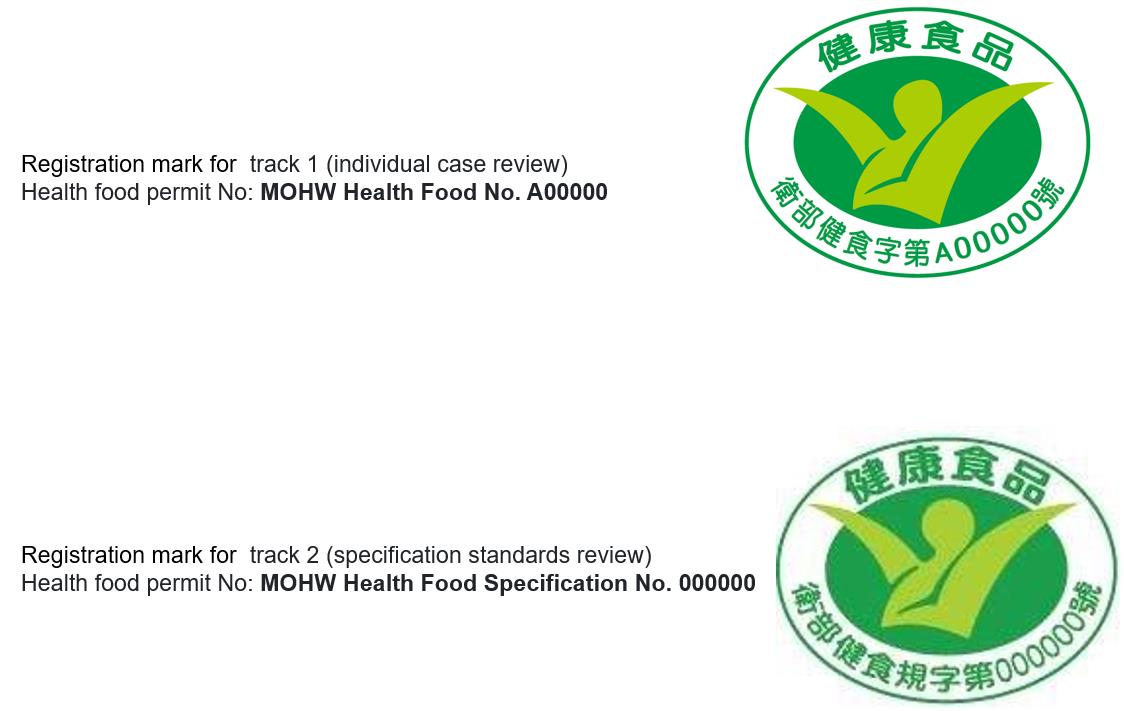
Health food registration mark and permit number
The permit is valid for five years and may be renewed upon application three months before expiration. Applicants may also apply for amendment, transfer, replacement, or reissuance of the permit as needed.
Review and Registration of Infant Formulas and Follow-up Formulas
Infant and follow-up formulas include infant formulas for infants up to six months, follow-up formulas for infants aged six to twelve months, and infant formulas for special medical purposes. Before these products can be imported into Taiwan, they must be registered and approved by the central competent authority.
Importers are required to apply with the following documents and pay the application fee:
Application form
Product ingredient table detailing all food ingredients and food additives
Product specification sheet indicating specifications for hygiene and nutrients. The calories and nutrients shall meet prescribed specifications for infant formula, follow-up formula, or special medical purpose formulas.
Product hygiene and nutrient analysis report
Documents showing overseas market availability or a clinical trial report with at least 20 participants
Summary of the manufacturing process
Official certification of overseas manufacturer
Physical copies or color drafts of Chinese labels, containers, outer packaging, and instruction leaflets
Importer’s business registration certification
Intact product samples
For products that are repackaged after importation, additional documents are required:
A repackaging certificate issued by the original manufacturer
Business registration certificate of the local repackaging facility
Hygiene and nutrient analysis report of the repackaged product
Chinese labels, containers, outer packaging, and instruction leaflets for the repackaged product
Sample of the repackaged product
Other documents, if requested by the authority
The processing time is 180 working days without considering the time for submitting supplementary documents. Upon approval, a five-year permit will be issued, renewable upon application within three months before expiration. Applicants may also apply for amendment, transfer, replacement, or reissuance where applicable.
Review and Registration of Formulas for Certain Diseases
Formulas for certain diseases are specially formulated products intended for individuals with physiological disorders caused by illness, resulting in the inability to consume, digest, absorb, or metabolize regular food or certain nutrients, or with other medically recognized special nutritional needs. These products are designed to meet specific dietary requirements that cannot be easily fulfilled through normal dietary adjustments.
Formulas for certain diseases are classified into the following
Nutritionally complete formulas suitable as a single source of nutrition:
Nutritionally complete foods with balanced formulas
Nutritionally complete foods with customized formulas
Nutrition supplement formulas not suitable as a single source of nutrition:
Nutrition adjusted supplementary formulas
Special modular formulas
Notably, except for the special modular formulas for which no specific nutrient composition standards are established, all three other categories must comply with prescribed nutrient specifications. Special modular formulas must use nutrient sources classified as nutritional additives listed under the Standards for Specification, Scope, Application and Limitation of Food Additives. If a product contains more than one nutritional additive, those additives must belong to the same category.
To register formulas for certain diseases, the importers must apply with the following dossier and pay the application fee:
Application form
Product ingredient table detailing all food ingredients and food additives
Product specification sheet indicating specifications for hygiene and nutrients
Product hygiene and nutrient analysis report
Summary of the manufacturing process
Official certification of overseas manufacturer
Physical copies or color drafts of Chinese labels, containers, outer packaging, and instruction leaflets
Importer’s business registration certification
Intact product samples
For products that are repackaged after importation, additional documents are required:
A repackaging certificate issued by the original manufacturer
Registration certificate of the local repackaging facility
Hygiene and nutrient analysis report of the repackaged product
Chinese labels, containers, outer packaging, and instruction leaflets for the repackaged product
Sample of the repackaged product
Documentation required for all categories except nutritionally complete food with balanced formulas:
Explanation and supporting documents showing that the target users have special nutritional requirements due to illness or medical conditions.
Evidence that these nutritional needs cannot be met through regular dietary intake.
Rationale behind the product design.
Information on how the intended use and quantity of intake of the product can fulfill the stated special nutritional needs.
Clinical human consumption study report
For high-protein disease-specific formulas, information on the protein efficiency ratio (PER), protein digestibility corrected amino acid score (PDCAAS), or other internationally recognized protein determination indicators is required
Other documents if required
During the review process, in addition to document review, the authority may convene an expert panel for further evaluation. If necessary, the applicant may be required to attend the meeting to answer questions. In this case, applicants will be notified if additional documents are needed and will be given a deadline for submission.
The processing time for document review is 140 days. If meeting reviews are required, the first and second meeting reviews, if applicable, each take 100 days. Upon approval, a five-year permit will be issued, renewable upon application three months before expiration. Applicants may also apply for amendment, transfer, replacement, or reissuance where applicable.
Review and Registration of Genetically Modified Food
Genetically modified foods refer to foods that are produced from raw materials consisting of genetically modified organisms. According to the Act Governing Food Safety and Sanitation, only approved genetically modified food raw materials can be used as legitimate food raw materials. Therefore, importers must apply for registration of genetically modified food raw materials before importing any genetically modified food products.
The importer shall apply with the following dossier and pay the application fee:
Basic information of the applicant company
Basic information of the genetically modified food raw material
Abstract of the safety assessment report for the genetically modified food material
Full safety assessment report of the genetically modified food material
Relevant literature search report on safety related to genetically modified food raw materials, along with a comprehensive list
Photocopies of approval documents from other countries and a corresponding list
Product sample:
For genetically modified grains (seeds) and their conventional controls: 1 kg each
For genetically modified rapeseed and its conventional control: 0.5 kg each
Importantly, the safety assessment must be conducted in accordance with the Methods for the Safety Assessment of Genetically Modified Foods. This Methods outlines the requirements and necessary documentation for the safety assessment of genetically modified plants, stacked-trait genetically modified plants, and genetically modified microorganisms. Generally, the safety assessment involves three phases: Phase I is a comprehensive evaluation of the submitted documentation. If Phase I results indicate the potential presence of toxins and/or allergens, Phase II is initiated to assess potential toxicity and allergenicity. If data from Phases I and II are insufficient for a conclusive safety determination, Phase III requires properly designed animal studies on the whole food product.
The processing time for the application review of genetically modified food raw materials is 540 working days without considering the time for submitting supplementary documents. Upon approval, a five-year permit will be issued, renewable upon application within three months before expiration. Applicants may also apply for amendment, transfer, replacement, or reissuance where applicable.
Review and Registration of Food Additives
Taiwan regulates food additives through a positive list—Standards for Specification, Scope, Application and Limitation of Food Additives, which covers 798 food additives across 17 functional categories. Importation of food additives listed in the positive list is subject to review and registration.
The importer shall apply with the following dossier and pay the application fee:
Product ingredients and content
Product specifications (including identification, purity, assay and specification, etc.)
Test methods and results
Information of key manufacturing process
Color photos of the product label and packaging
Importer's business registration certification (business scope must include food additive importation)
Official certification of overseas manufacturer
Importer's sanitation staff employment certificate
Affidavit
The processing time is 60 working days excluding supplementary document time. Upon approval, a five-year permit will be issued, renewable upon application three months before expiration. Applicants may also apply for amendment, transfer, replacement, or reissuance where applicable.
Review and Registration of Imported Foods in Tablet or Capsule Form
To register imported foods in tablet and capsule form, the importer shall apply with the following dossier and pay the application fee:
Product ingredient & content table
Official certification of overseas manufacturer
Importer's business registration certification
Intact product sample
Food details sheet
Registration information sheet
Affidavit
Other documents, if requested
The product ingredient table must clearly list the names and content levels of all food ingredients and additives used in the product, including empty capsule shell ingredients for capsule products and excipients for tablet products. It is also worth noting that although labeling is not part of the registration review, compliance with labeling requirements is mandatory for market access. More detailed requirements are available in the Guidelines on Registration of Imported Food in Tablet or Capsule Form.
The processing time is 60 working days excluding supplementary document time. Upon approval, a five-year permit will be issued, renewable upon application three months before expiration. Applicants may also apply for amendment, transfer, replacement, or reissuance where applicable.
Summary
Successfully exporting designated foods to Taiwan requires careful navigation of Taiwan’s food registration regulations. From understanding the regulatory framework to preparing comprehensive documentation and conducting safety and efficacy testing in accordance with local standards, each step plays a critical role in securing approval. A well-planned registration strategy not only expedites the approval process but also minimizes the risk of costly delays or rejections. Moreover, due to the time-consuming nature of food registration, sufficient lead time should be considered in the market entry plans to avoid disrupting launch schedules.
 We provide full-scale global food market entry services (including product registration, ingredient review, regulatory consultation, customized training, market research, branding strategy). Please contact us to discuss how we can help you by