Request a Demo
On March 27, 2025, China National Health Commission (NHC) unveiled 50 national food safety standards (GB standards) and 9 amendment sheets, including GB 28050-2025 National Food Safety Standard General Rules for Nutrition Labeling of Prepackaged Foods, which will come into effect on March 16, 2027.
Notably, the release of GB 28050-2025 underwent three consultation drafts since 2018. (Read more: the 1st Draft; the 2nd Draft; the 3rd Draft)
Key Revisions Compared with GB 28050-2011
Compared to the current effective GB 28050-2011 version, the 2025 version introduces the following amendments:
1. Exemptions for Nutrition Labeling
Foods with a maximum surface area of packaging or packaging containers ≤40 cm² are exempt from nutrition labeling, replacing the current exemption criteria of "total packaging surface area ≤100 cm² or maximum surface area ≤20 cm²".
Exemptions in 2011 version | Exemptions in 2025 version |
Fresh foods, such as packaged raw meat, raw fish, fresh vegetables and fruits, poultry eggs, etc. | Fresh foods and grain seeds, such as livestock and poultry meat, fish, shrimp, crabs and shellfish, fresh eggs, fresh vegetables and fruits, fungi and algae |
| / | [Addition] Single-ingredient dried products obtained through simple physical processing without the addition of other ingredients, such as grains and other cereals |
Packaged drinking water | Packaged drinking water and tea |
Alcoholic beverages with an ethanol content ≥0.5% | Alcoholic beverages with an alcohol content of 0.5% vol or above |
Prepackaged foods with a daily consumption amount ≤10 g or 10 mL | Prepackaged foods with a daily consumption amount of ≤10 g (mL) and single-ingredient seasonings |
| Foods whose total packaging surface area ≤100 cm² or maximum surface area ≤20 cm² | Foods with a maximum surface area of packaging or packaging containers ≤40 cm² |
| Foods prepared and sold immediately | [Deleted] |
Other prepackaged foods that are exempt from nutrition labeling as specified in relevant laws and regulations | Other prepackaged foods that are exempt from nutrition labeling as specified by relevant laws, regulations, and national food safety standards |
2. New Mandatory Labeling Items
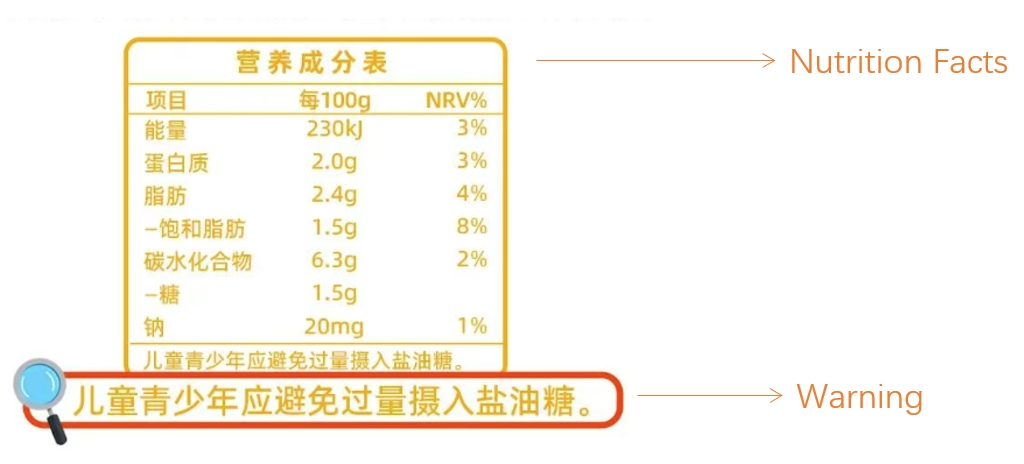
The mandatory labeling components are expanded from "1+4" (energy + protein, fat, carbohydrate, sodium) to "1+6", adding saturated fat (acid) and sugar.
Compulsory nutrients in 2011 version | Compulsory nutrients in 2025 version |
Content of the following items and their percentages of NRV
| Content of the following items and their percentages of NRV
|
Additionally, the warning "Children and adolescents should avoid excessive intake of salt, oil, and sugar" must be displayed under the Nutrition Facts label. Labeling method for this warning is detailed in Point 7.2 of this article.
3. New Optional Labeling Nutrients
Four nutritional components are added to the optional labeling list:
n-3 polyunsaturated fatty acids (or ω-3 polyunsaturated fatty acids)
α-linolenic acid
Eicosapentaenoic acid (EPA)
Docosahexaenoic acid (DHA)
4. Revised Content Claims, Comparative Claims, and Nutrient Effect Claims
4.1 Content Claims
Annex C (Table C.1) revises content claims as below and deletes the "low protein" claim.
No. | Item | Content claim types | Content requirements | Restriction conditions |
1 | Energy | No energy → No energy; or no cal, no kcal, or no calories | ≤17 kJ/100g (solid) or 100ml (liquid) | Energy from fat ≤ 50% of total energy → Fat energy contribution ratio ≤50% |
| Low energy → Low energy; or low cal, low kcal, or low calories | ≤170 kJ/100g (solid) ≤80 kJ/100ml (liquid) | |||
2 | Fat | Skim | Liquid milk and yogurt: Fat content ≤ 0.5% Milk powder: fat content ≤ 1.5%
→ ≤ 0.5 g/100g (liquid milk) ≤1.5g/100g (milk powder) | Limited to dairy products → Other dairy products shall comply with corresponding national food safety standards |
[Addition] Source of n-3 polyunsaturated fatty acids (or ω-3 polyunsaturated fatty acids) OR Contain n-3 polyunsaturated fatty acids (or ω-3 polyunsaturated fatty acids) | [Addition] α-Linolenic acid ≥ 0.3 g per 100 g (for solids) or 100 mL (for liquids)
The combined total of EPA and DHA ≥ 40 mg per 100 g (for solids) or 100 mL (for liquids) | |||
[Addition] High in or rich in n-3 polyunsaturated fatty acids (or ω-3 polyunsaturated fatty acids) | [Addition] α-Linolenic acid ≥ 0.6 g per 100 g (for solids) or 100 mL (for liquids)
The combined total of EPA and DHA ≥ 80 mg per 100 g (for solids) or 100 mL (for liquids) |
4.2 Comparative Claims
Table C.2 of Annex C permits a new comparative claim for “reduced saturated fat”. The product should reduce saturated fat by 25% or more in comparison with referenced food. The data scope of reference food is detailed into two types: 1) The content regarding nutritional components of same category or same type of foods from the same enterprise; or 2) The content regarding nutritional components of same category of foods as indicated in the "China Food Composition Table”.
In addition, the following comparative claims are deleted from the permitted table:
"Reduced protein"
"Reduced dietary fiber"
"Reduced vitamin"
"Reduced mineral"
"Reduced cholesterol"
"Increased or reduced carbohydrate"
4.3 Nutrient Effect Claims
To avoid confusion with health food claims, the“function claims" of energy and nutritional components are renamed “effect claims". Annex D of GB 28050-2025 amends the following standard effect claims. In addition, the effect claims for cholesterol and carbohydrate are deleted.
No. | Item | Standard effect claims in 2011 version | Standard effect claims in 2025 version |
1 | Protein | Protein helps build or repair body tissues. | Protein is an important component that constitutes body tissues. |
Protein helps in the formation and growth of tissues. | Protein helps in the formation and repair of tissues. | ||
/ | [Addition] Protein supports muscle growth and maintenance. | ||
2 | Fat | / | [Addition] Long-term high-fat intake is not conducive to maintaining normal body weight and body fat levels. |
3
| Saturated fat | Excessive intake of saturated fat is harmful to health. | [Deleted] |
Overconsumption of saturated fat can elevate cholesterol levels, and the intake should be less than 10% of total daily energy. |
| ||
4 | Transat acid | Trans fatty acid intake should be less than 1% of total daily energy; excessive consumption is harmful to health. | Trans fatty acid intake should be less than 1% of total daily energy. |
Overconsumption of trans fatty acids can elevate blood cholesterol levels, thereby increasing the risk of cardiovascular diseases. | Excessive consumption of trans fatty acids can increase the risk of cardiovascular diseases. | ||
5 | [Addition] α-Linolenic acid | / | [Addition] α-Linolenic acid is an essential fatty acid for the human body. |
6 | [Addition] Sugar | / | [Addition] Sugar is a fundamental source of energy. |
/ | [Addition] Long-term high sugar intake may increase the risk of dental caries and obesity. | ||
7 | Sodium | Adults should not consume more than 6 g of salt per day. | Adults' daily salt intake should not exceed 5 g. |
Excessive sodium intake is harmful to health. | Prolonged high salt intake can lead to increased blood pressure. | ||
8 | Vitamin A | / | [Addition] Vitamin A helps maintain normal vision. |
/ | [Addition] Vitamin A aids in sustaining the normal physiological function of the immune system. | ||
9 | Vitamin D | Vitamin D promotes the absorption of calcium. | Vitamin D promotes the absorption and utilization of calcium and phosphorus. |
10 | [Addition] Vitamin K | / | [Addition] Vitamin K is an essential component for maintaining normal blood clotting function. |
11 | Vitamin B6 | / | [Addition] Vitamin B6 helps with normal energy metabolism. |
/ | [Addition] Vitamin B6 helps maintain the normal physiological function of the nervous system. | ||
12 | Vitamin B12 | / | [Addition] Vitamin B12 helps with normal energy metabolism. |
/ | [Addition] Vitamin B12 helps maintain the normal physiological function of the nervous system. | ||
13 | Vitamin C | / | [Addition] Vitamin C helps maintain the normal physiological function of the immune system. |
14 | Niacin | Niacin helps to maintain the health of the nervous system. | Niacin helps to maintain the normal physiological function of the nervous system. |
15 | Folic acid | Folic acid helps with the normal development of the fetus. | [Deleted] |
16 | Pantothenic acid | Pantothenic acid is an important component of energy metabolism and tissue formation. | Pantothenic acid is a substance involved in energy metabolism. |
17 | [Addition] Biotin | / | [Addition] Biotin helps maintain healthy skin and hair. |
18 | [Addition] Choline | / | [Addition] |
19 | Calcium | Calcium is the main component of human bones and teeth, and many physiological functions also require the involvement of calcium. | Calcium is the main component of human bones and teeth. |
/ | [Addition] Calcium is essential for normal nerve and muscle function. | ||
20 | [Addition] Phosphorus | / | [Addition] Phosphorus helps maintain the normal function of cell membranes. |
/ | [Addition] Phosphorus helps maintain healthy bones and teeth. | ||
21
| [Addition] Potassium | / | [Addition] Potassium is an essential element for maintaining water and electrolyte balance. |
/ | [Addition] Potassium helps maintain normal muscle function. | ||
/ | [Addition] | ||
/ | [Addition] | ||
22 | Magnesium | / | [Addition] Magnesium helps maintain normal muscle function. |
23 | Zinc | / | [Addition] Zinc helps maintain the normal physiological function of the immune system. |
24 | Iodine | / | [Addition] Iodine is essential for the development of the nervous system. |
25 | [Addition] Selenium | / | [Addition] |
/ | [Addition] Selenium helps maintain the normal physiological function of the immune system. |
5. Updated Technical Indicators
5.1 Nutrient Reference Values (NRV)
The revisions to NRV are summarized in the table below.
No. | Items | NRV in 2011 version | NRV in 2025 version |
1 | Cholesterol | ≤300mg | [Deleted] |
2 | Vitamin D | 5 μg | 10 μg |
3 | Biotin | 30 μg | 40 μg |
4 | Choline | 450 mg | 500 mg |
5 | Zinc | 15 mg | 11 mg |
6 | Iodine | 150 μg | 120 μg |
7 | Selenium | 50 μg | 60 μg |
8 | Copper | 1.5 mg | 0.8 mg |
In addition, it is newly added that when the word “salt” is used to describe the content of sodium, whose NRV is 2000 mg, a conversion based on 2000 mg sodium being equivalent to 5 g salt may be used.
5.2 Revised Table for “Name, Order, Labeling Units for Energy and Nutritional Components, Rounding Interval and Limit Value of 0”
No. | Status | Name and order of nutritional components | Labeling unit | Rounding interval | Limit value of “0” (Per 100g or 100 ml) |
1 | New component | n-3 polyunsaturated fatty acids (or ω-3 polyunsaturated fatty acids) | mg | 1 | ≤20mg |
2 | New component | α-linolenic acid | mg | 1 | ≤5mg |
3 | New component | Eicosapentaenoic acid (EPA) | mg | 1 | ≤5mg |
4 | New component | Docosahexaenoic acid (DHA) | mg | 1 | ≤5mg |
5 | Revision | Vitamin A | μgRE | 1 | ≤8 μgRE → ≤10 μgRE |
| 6 | Revision | Vitamin E | mg a-TE | 0.01 | ≤ 0.28 mg a-TE → ≤ 0.20 mg a-TE |
7 | Revision | Vitamin B12 | μg | 0.01 | ≤ 0.05 mg → ≤ 0.10 mg |
8 | Revision | Nicotinic acid | mg | 0.01 | ≤ 0.28 mg → ≤ 0.3 mg |
9 | Revision | Magnesium | mg | 1 | ≤6mg → ≤3mg |
10 | Revision | Zinc | mg | 0.01 | ≤ 0.30 mg → ≤ 0.10 mg |
5.3 Permissible Tolerance Ranges
The revisions mainly change the permissible tolerance ranges of Vitamin A and D as well as that for sugar.
No. | Items | 2011 version | 2025 version |
1 | Dietary fiber
| ≥80% labeling value
Notes: applicable to total, soluble, or insoluble dietary fiber and its monomer components | ≥80% labeling value
Notes: applicable to dietary fiber [or soluble dietary fiber, insoluble dietary fiber, dietary fiber (expressed as monomer components)] |
2 | Vitamins, excluding Vitamin D and Vitamin A | ≥80% labeling value | ≥80% labeling value |
3 | Vitamin A and Vitamin D | 80% to 120% labeling value | ≥80% labeling value |
4 | Sugar (limited to lactose) | ≥80% labeling value | ≤120% labeling value |
5 | Sugar (excluding lactose) | ≤120% labeling value | ≤120% labeling value |
6. Enhanced Consumer Understanding
6.1 Diversified Expression Forms
To increase consumers’ attention on nutrition labeling, it is allowed for enterprises to use direct, more understandable expressions to supplement the nutrition labeling.
Such information can be expressed by using graphics, text, or other means.
When describing energy, the use of words such as "cal", "kcal", "calorie" is allowed.
When describing sodium content, the use of the word "salt" is allowed.
When describing fat content, the use of words such as "oil" or "lipid" is allowed.
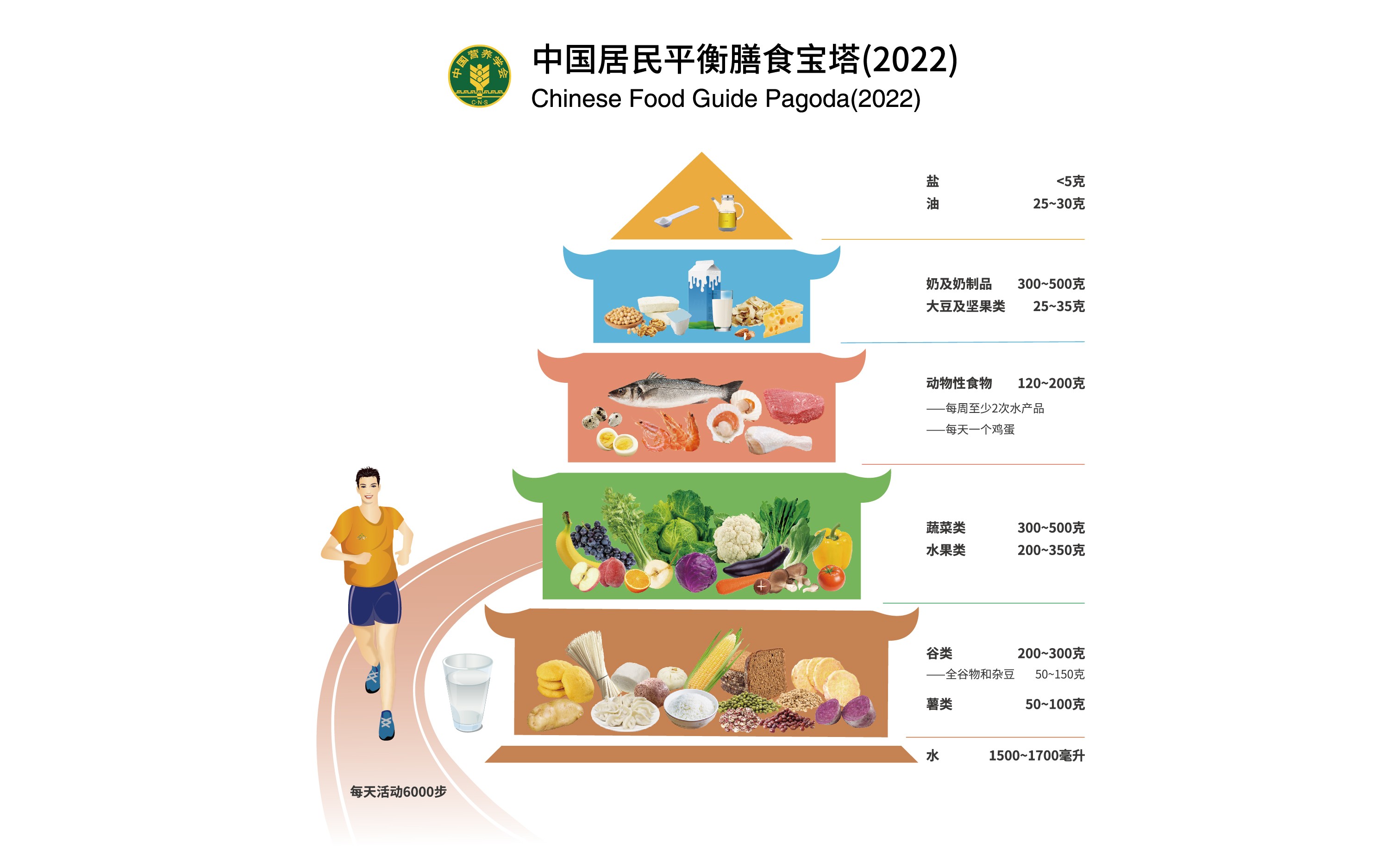
The pagoda graphic and core recommended items from the "Chinese Dietary Guidelines" can be used.
6.2 Recommended Serving Sizes
Appendix E introduces the “Recommended Reference Values for Prepackaged Food Servings” for the following 18 food categories. The reference values for servings refers to the recommended weight or volume (based on the edible portion) of each serving when the nutrition facts are displayed on a per-serving basis.
No. | Food category | Reference values for servings |
1 | Soy sauce, sauces, pickled sauces, base condiments | 10 g or ml |
2 | Cooked meat and dried meat products (e.g., meat floss, dried meat, meat jerky) | 10 g |
3 | Dried fruit products | 10 g |
4 | Nuts and seed foods | 20 g |
5 | Western-style decorative cakes (pies, cakes) | 30 g |
6 | Processed meat products (e.g., sausage-type products, Western-style ham, fermented ham, cured meat products) | 30 g |
7 | Milk powder (full-fat, skim, partially-skimmed, and modified milk powders) | 30 g |
8 | Ready-to-eat cereal powders, meal replacement powders | 30 g |
9 | Biscuits, cereal bars | 30 g |
10 | Puffed snacks (e.g., potato chips, rice crackers, baked chips) | 30 g |
11 | Bread and fermented wheat products (e.g., steamed buns, steamed mandarin rolls) | 50 g |
12 | Eggs (e.g., chicken eggs, preserved eggs, salted eggs, marinated eggs, fermented eggs) | 50 g |
13 | Ice cream | 50 g or ml |
14 | Instant noodles (noodle cakes) | 100 g |
15 | Fermented milk | 120 g or ml |
16 | Liquid milk (pasteurized, modified, or sterilized) | 200 ml or g |
17 | Liquid beverages or reconstituted solid beverages | 200 ml |
18 | Soy milk | 200 ml |
When using the reference values for servings provided above, the following cases are provided for reference:
If the minimum unit weight (or volume) of the food is within 50% to 150% of the serving reference value for that food category, the minimum unit weight (or volume) may be directly used as one serving.
When the minimum unit weight (or volume) of the food is less than 50% of the corresponding serving reference value, several minimum units can be combined to approximate the reference value for one serving. For example, if the serving reference value for biscuits is 30 g and each biscuit weighs 7 g, then four biscuits can constitute one serving, labeled as “28 g per serving / 4 pieces”; alternatively, three pieces (21 g), five pieces (35 g), or six pieces (42 g) may be used as one serving.
When the minimum unit weight (or volume) of the food exceeds 150% of the corresponding serving reference value, the serving reference value may be used directly as one serving; or the food may be divided into equal portions (such as slices, blocks, scoops, or packages) to yield an appropriate portion weight (or volume) that falls within the serving reference range. For example, if a tub of potato chips weighs 102 g, it may be divided into 3 packages and labeled as “34 g per serving” or “34 g/serving × 3 servings”; alternatively, a suitable value between 15 g and 45 g may be chosen as one serving.
7. Optimized Labeling Requirements
7.1 Clarified Definitions and Calculation Methods
This 2025 edition clarifies the definition and/or calculation method for energy, carbohydrate and sugar.
Items | Current 2011 version | 2025 Version |
Conversion factors for calculating energy | / | The energy conversion factors for components are (kJ/g): protein 17, fat 37, and carbohydrates 17. When dietary fiber content is labeled, its energy is calculated using a conversion factor of 8 kJ/g. |
Definition and calculation method of carbohydrate | / | Carbohydrates is the collective term for sugars, oligosaccharides, and polysaccharides.
The carbohydrate content per 100 g or 100 mL of food may be calculated by subtraction.
When protein and fat contents reach the “0” threshold and the carbohydrate sources are sugars and/or starch, an addition method may be used.
|
Definition of sugar | / | For nutritional labeling, “sugars” specifically refers to the sum of fructose, glucose, sucrose, maltose, and lactose contained in the food. |
7.2 Two More Formats for Nutrition Facts Label
The 2025 version adds two more allowed formats for Nutrition Facts label based on the current 6 formats. Please note that the warning “Children and adolescents should avoid excessive intake of salt, oil, and sugar" may be displayed below the nutrition facts table, aligned to the left, center, or right, and may be enclosed in a box or not.
New format 1 for labeling by both per 100 g (or 100ml) and per serving
Item | Per 100g or 100ml | NRV% | Per serving (xx g or xx ml per serving) | NRV% |
Energy | kJ | kJ | ||
Protein | g | g | ||
Fat | g | g | ||
- Saturated fat | g | g | ||
Carbohydrate | g | g | ||
- Sugar | g | g | ||
Sodium | mg | mg | ||
Children and teenagers should avoid intaking excessive salt, oil and sugar. | ||||
New format 2 for prepackaged food contains multiple foods inside
Item | Name of Food Product A | Name of Food Product B | Name of Food Product C | |||
Per 100g or 100ml or per serving | NRV% | Per 100g or 100ml or per serving | NRV% | Per 100g or 100ml or per serving | NRV% | |
Energy | kJ | kJ | kJ | |||
Protein | g | g | g | |||
Fat | g | g | g | |||
- Saturated fat | g | g | g | |||
Carbohydrate | g | g | g | |||
- Sugar | g | g | g | |||
Sodium | mg | mg | mg | |||
Children and teenagers should avoid intaking excessive salt, oil and sugar. | ||||||
8. Other New Requirements
It is newly stipulated that GB 28050-2025 can be applicable to prepackaged food that is not for direct consumer sales. The requirement will only become mandatory when corresponding nutrition labeling is marked on such prepackaged food and the storage & transportation package.
The nutrition facts label shall be clear, conspicuous and durable.
It is emphasized that the nutrition labeling of imported prepackaged foods shall comply with this Standard.
When the content of energy and nutritional components are provided per serving, the weight or volume of each serving must be indicated on the same label page.
When labeling nutritional components other than the “compulsory nutrients”, measures such as increasing the font size, changing the font style (e.g., italic, bold, heavy), or adjusting the color (of the text or background) shall be taken to make the mandatory information from Section 4.1 more prominent.
For further translation, training, consulting, food label review service, please email [email protected].
 We provide full-scale global food market entry services (including product registration, ingredient review, regulatory consultation, customized training, market research, branding strategy). Please contact us to discuss how we can help you by