

 Request a Demo
According to reports from China Nutrition and Health Food Association’s, sale of health foods has been banned in pharmacies in 20 Chinese cities. The ban comes as part of a coordinated action taken by local medical insurance departments[1] in collaboration with local authorities. The rationale for the ban is simple and based on the principle that medicare pharmacies should only contain reimbursable products covered by insurance companies. A public notice was released by authorities stating that “The sale of health foods and health related foods in Medicare pharmacies is illegal. Drugstores shall not sell products that are not covered by medical insurance programs and all non-medical products shall be removed from shelves”.
The health food sector negatively impacted
Pharmacies are still an extremely important retail channels for health foods and many health food enterprises have seen sales figures drop in the wake of the ban. According to Zhang Zhongpeng, of the China Chamber of Commerce for Import & Export of Medicines & Heath Products, pharmacies account for 23% of all health food sales. The number one spot is currently occupied by direct distribution however this segment was dealt a major blow on the back of a stringent government clamp down in 2019 due to fraudulent advertising and promotion. (read news on 100-day campaign to regulate illegal health related foods).
| Direct distribution | 49% |
| Pharmacy | 23% |
| Online shopping | 24% |
| Store and supermarket | 3% |
| Other | 1% |
According to a representative of a major drugstore chain in Shandong Province “95% of our branded chain drugstores are medicare pharmacies. Since the ban was instituted, we have seen our sales drop by over 50%”. For some brands such as Besunyen (China’s most famous Detox Tea and Slimming Tea), pharmacies play a pivotal role in their market performance with their health food products sold in more than 400,000 pharmacies across the country.
What is a Medicare Pharmacy?
A medicare pharmacy is one that is qualified to sell medicines covered by social security and medical insurance and provides medicines by deducting the cost of the drugs from consumers social security checks or are reimbursable from health insurance companies. In theory Medicare pharmacies should not operate as a cash business. Data released by National Healthcare Security Administration (HHSA) and National Medical Products Administration (HMPA) showed that in 2018, there were 341,000 Medicare pharmacies , accounting for 70% of pharmacies in China.[2] Laws and regulations do not confine the business scope of pharmacies to medical products, therefore many offer an extensive range of health foods and nutritional products.
So Why are Medicare Pharmacies Banned from Selling “Non-medical Products”?
The short answer is to protect social medical insurance funds. In recent years, an increasing number of these pharmacies have scaled up their offering of health and nutrition products and have pushed the boundaries even further by offering daily consumer goods. These pharmacies then help the consumers with insurance claims and ultimately attain the goods as a reimbursable item paid by insurance companies or local authorities.[3]
This ban is just the latest in a long line of campaigns made by both local governments and the insurance sector to stamp out reimbursements on health foods and other health related products. In 2015, some local medical insurance departments released rules prohibiting the inclusion of health foods in Medicare pharmacies, however the policy was largely tokenistic and failed to make any significant impact on industry practices. In October 2018, HHSA in conjunction with HMPA, Ministry of Public Security and National Health Commission carried out a crackdown campaign to regulate Medicare pharmacies and sale of health foods. Despite all this, the central government had never banned the sale of non-medical products in pharmacies.[4]According to HHSA reports, as of January 2019, 32,000 Medicare drugstores have been found guilty of misconduct and 24,000 insured people were involved
 Is There a Legal Basis Supporting These Local Injunctions?
It is illegal for pharmacies and the insured to cheat the government and use insurance funds beyond coverage, however, a ban on the sale or inclusion of all “non-medical products” including health foods is excessive.
There is also no legal basis to impose such a ban at a national level. China currently has no law or regulation restricting the business scope of Medicare pharmacies.
Ironically the ban itself can be considered illegal. Under Article 16 of the Administrative Permission Law, local departments are forbidden from adding administrative rules which conflict with superseding national requirements.[5] The deputy secretary-general of China Nutrition and Health Food Association Li Liangqiu noted “the action of local government probably did not undergo fair competition review and likely does not comply with legal procedures.”
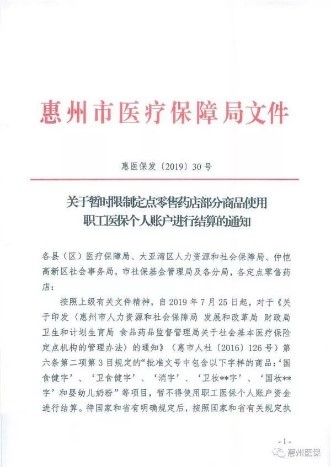
Guangdong Offers Some Clarification
Guangdong Province released a document repealing the ban on sale of “non-medical products” in Medicare drugstores. According to the document, “non-medical products” can still be sold but the premiums cannot be deducted from personal social security checks. Those products include health food, infant formula, cosmetics, sanitary disinfection supplies and the likes. The order has been in effect since July 25th.[6] Guangdong will like serve as the model for future policy reform within the sector.
 We provide full-scale global food market entry services (including product registration, ingredient review, regulatory consultation, customized training, market research, branding strategy). Please contact us to discuss how we can help you by








