Request a Demo
India's food import landscape is governed by the Food Safety and Standards Authority of India (FSSAI), ensuring that all food products entering the country meet stringent safety and quality standards. For businesses involved in importing food items, obtaining the appropriate FSSAI license is not just a regulatory requirement but a critical step in ensuring compliance and smooth operations. This article introduces the general FSSAI licence requirements under India food regulations, along with a brief look at recent updates in FSSAI orders.
Overview of FSSAI Licensing in India
Under the Food Safety and Standards (Licensing and Registration of Food Businesses) Regulations, 2011 (the Regulations), all food business operators (FBOs) in India need to be registered or licensed. There are three types of such: FSSAI registration, State FSSAI license and central FSSAI license. Registration comes with significantly lighter compliance obligations compared to licensing. It does not require regular product analysis or submission of test results, annual returns, qualified technical personnel, or third-party audits, and demands only minimal hygiene standards.
All importers importing food items including food ingredients and additives for commercial use to India are under the purview of Central Licensing Authority appointed by the FSSAI. This mandate applies to all importers, regardless of the scale of operations, ensuring that imported food products adhere to India's safety standards. Additionally, the FSSAI requires that the packaging of imported food items clearly displays the name and complete address of the importer in India, along with the valid FSSAI license number.
Introduction of the FoSCoS Online Platform
To enhance efficiency and transparency in the licensing process, the FSSAI introduced the Food Safety Compliance System (FoSCoS) in 2020. This cloud-based platform serves as a one-stop portal for all regulatory compliance transactions, including licensing, registration, inspections, and the submission of annual returns.
FoSCoS has significantly simplified the application process, allowing businesses to apply for licenses and registrations online, track application statuses, and receive timely updates, thereby reducing administrative burdens and expediting compliance procedures.
Instant (Tatkal) Issuance of Licenses
In a bid to further facilitate ease of doing business, the FSSAI launched the Instant (Tatkal) Licensing scheme on July 1, 2024. According to the Regulations, licenses are typically be granted within 60 days and registrations within 7 days. However, this scheme allows for the immediate issuance of licenses and registrations for certain categories of food businesses, including importers, through the FoSCoS.
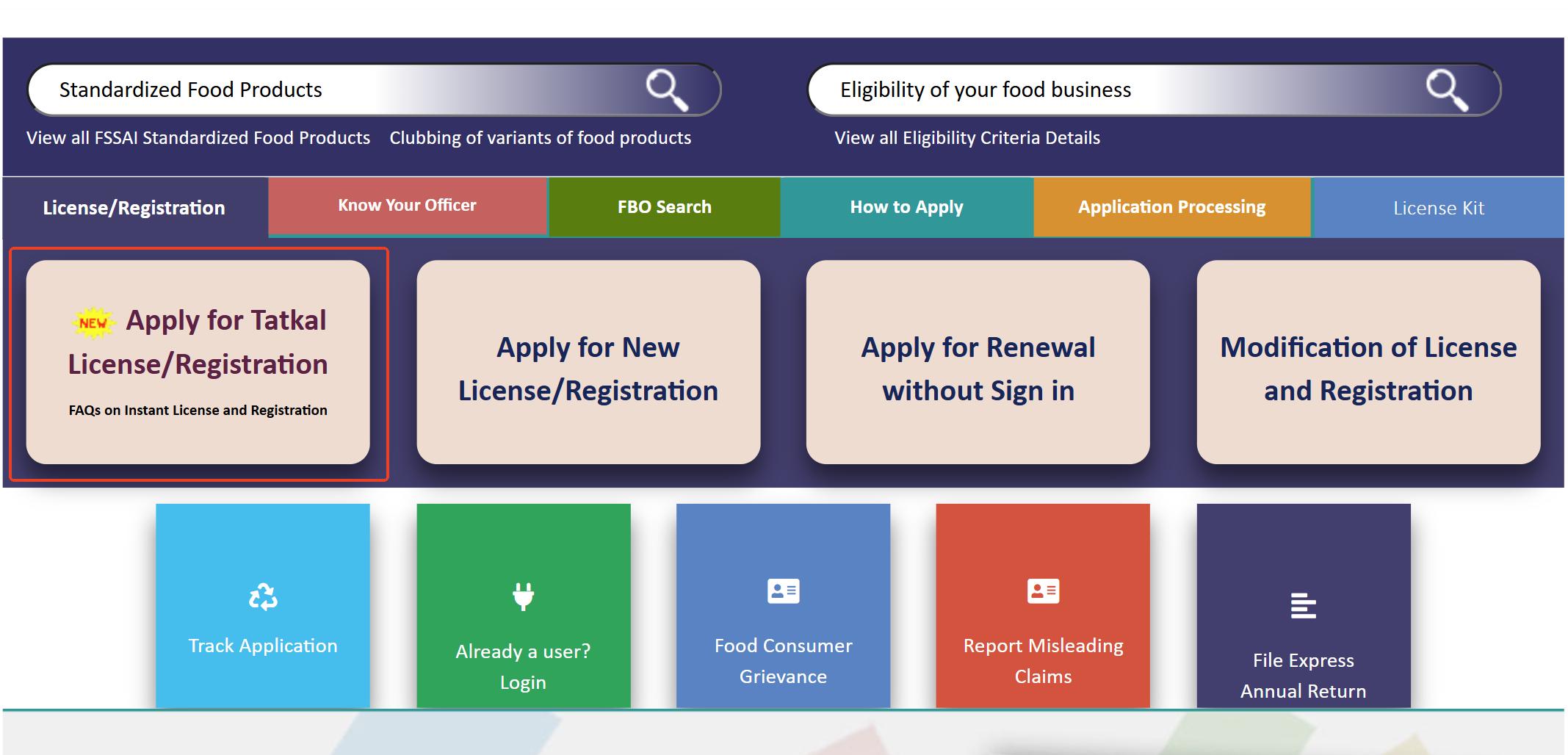 Apply for Tatkal License on FoSCoS
Unlike the conventional process which involves scrutiny and verification by food authorities, Instant issuance leverages digital verification of information like Permanent Account Number (PAN), Goods and Services Tax (GST), AADHAAR, Corporate Identification Number (CIN), etc.
Applicants must declare that they do not hold a valid license or registration for the same premises, and that no such license has been suspended or cancelled in the past three months. Additionally, they must upload clear photographs of the food business unit, including the front view or entrance, to facilitate identification under the instant issuance process.
Applicants are required to pay the full annual fee at the time of application. The fee structure remains the same as per the existing provision. For instance, the Central License fee is Rs. 7,500 plus applicable GST. Instant Licenses are granted for one year, after which businesses may renew their License/Registration for a period ranging from 1 to 5 years, in accordance with the Regulations.
Application Procedures for Importer FSSAI License in India
The process for obtaining an FSSAI license involves several steps according to the Regulations.
1. Submission of Application
You begin by submitting the complete application online through the FoSCoS portal, along with the required documents and fees. The Licensing Authority will review your application to determine if it's complete. For detailed guidance on how importers can apply for a license through the FoSCoS portal, refer to the official instructions provided here. For documents required to be submitted along with the application for FSSAI license, please refer to the official order provided here.
2. Initial Scrutiny Within 15 Days
Within 15 days of receiving your application, the Licensing Authority checks if any details or documents are missing. If anything is incomplete or additional information is needed, they’ll send a written notice asking you to provide the missing info. You must respond and complete your application within 30 days of receiving this notice. If you don’t respond in time, your application will be rejected automatically.
3. Issue of Application ID
Once your application is complete (including any extra info if asked), the Licensing Authority will issue you an Application ID number. This ID will be used in all future communication related to your license.
4. Premises Inspection
After issuing the Application ID, the Licensing Authority may instruct a Food Safety Officer or another authorized person to inspect your food import premises. If the officer finds any issues, you’ll get a notice with instructions on what needs to be fixed (usually related to hygiene or structure, based on Schedule 4). You must complete all the suggested changes within 30 days, or within any extended time the Authority gives, and notify them once the improvements are done.
5. Decision on Grant of License (Within 30 Days After Inspection)
Once the inspection is complete and your changes (if any) are verified, the Licensing Authority will decide whether to approve or reject your license within 30 days. If they plan to reject your application, they must first give you a chance to be heard, and record the reasons for rejection in writing.
6. Issuance of License
If approved, you’ll receive your FSSAI License in Format C (as per Schedule 2 of the Regulations). A true copy of this license must be displayed clearly at your business location at all times.
7. Commencement of Business
If 60 days have passed since your completed application submission and you haven’t received the license, and haven’t been told about missing documents or problems from inspection, you are legally allowed to start your import business.
Validity and Renewal of License for Food Importers
Once granted, a food license under the Regulations remains valid for a duration of 1 to 5 years, as selected by the importer at the time of application. The validity period begins from the date of issue and is subject to payment of the applicable fee and continued compliance with the conditions specified in the license.
Renewal Timeline and Application
Importers must apply for license renewal no later than 30 days before the license expiry date as indicated on the issued license. The renewal application must be submitted in Form B of Schedule 2, along with the required documents and fees, via the FoSCoS portal.
If the renewal application is submitted less than 30 days before expiry but before the actual expiry date, a late fee of ₹100 per day is applicable for each day of delay. (The earlier ₹100/day late renewal fee was removed in an FSSAI order facilitating ease of business)
License Continuity and Expiry
Once a renewal application is submitted on time, the existing license remains valid until the Licensing Authority passes an order on the renewal, which must be done within 30 days after the license expiry date.
If the renewal application is not submitted before the license expires, the license will automatically expire, and the importer must immediately cease all business activities related to food imports at the licensed premises. To resume operations, the importer must apply afresh for a new license.
Inspection for Renewal
For importers holding a valid certificate from an accredited food safety auditor or from an agency accredited or notified by the Food Authority, the license typically does not require re-inspection for renewal. However, if the Designated Officer deems it necessary, an inspection may still be ordered before renewal. The reasons for such an inspection must be recorded in writing.
Suspension or Cancellation of License for Food Importers
Importers operating under an FSSAI license must comply with all applicable conditions and improvement notices issued by the Licensing Authority. Failure to do so may lead to suspension or cancellation of the license.
Grounds for Suspension
If the Licensing Authority has reason to believe that the importer has failed to comply with the conditions specified in an Improvement Notice, the Authority may suspend the license for some or all import-related activities.
A brief statement of reasons for the suspension will be recorded in writing.
The importer will be given a reasonable opportunity to be heard before suspension.
A copy of the suspension order will be provided to the importer.
Inspection During Suspension
Once a license is suspended, the Licensing Authority will order an inspection of the importer's premises within a minimum of 14 days from the date of the suspension order. This inspection helps assess whether the importer has corrected the violations stated in the improvement notice.
Cancellation After Continued Non-compliance
If, after the inspection, the Authority concludes that the importer has not rectified the issues, it may proceed to cancel the license. The importer will first be given a chance to show cause before the cancellation is finalized.
Immediate Suspension or Cancellation in Public Interest
In serious cases affecting public health, the Licensing Authority has the power to suspend or cancel a license immediately, without prior notice, but must record the reasons in writing.
No Compensation or Fee Refund
An importer whose license is suspended or cancelled is not entitled to any compensation or refund of license fees, whether for the original grant or for renewal.
Reapplying After Cancellation
After a license is cancelled, the importer must wait at least 3 months from the cancellation date before submitting a fresh application. The new application will only be considered if all issues listed in the previous improvement notice have been fully addressed.
Modifications, Expansion, or Changes in Premises After Grant of License
Once a license is granted, importers must keep the Licensing Authority informed of all significant changes to their operations. These include updates related to:
Product category
Layout of premises
Expansion of operations
Closure of operations
Any other information that was part of the original license application
Obligation to Inform Before Changes
Food importers are required to notify the Licensing Authority before implementing any such changes. The license must always reflect accurate and current business information.
Prior Approval for Major Changes
If the proposed change alters any detail listed on the license certificate, the importer must obtain prior approval or endorsement from the Licensing Authority before beginning operations under the new conditions.
To request changes:
Submit the original license certificate
Pay a fee equivalent to one year’s license fee
Provide supporting documents if necessary
Processing and Approval
The Licensing Authority will:
Review the proposed changes
May conduct an inspection of the premises, if needed
Assess feasibility and legal compliance
If the application is in order, the Authority will issue an amended license reflecting the changes within 30 days of receiving the complete request.
Return Requirements for Licensed Food Importers
All licensed importers of food products into India must comply with annual return filing requirements under the Regulations.
1. Annual Return Filing Obligation
If you are an importer holding an FSSAI license, you must submit an annual return detailing your import activities for each class of food product handled in the previous financial year.
Due Date: On or before May 31 every year
Format: Electronically through the FoSCoS portal, or in physical form, as specified by the concerned Food Safety Commissioner
Scope: The return must cover all food categories imported under the license for the entire preceding financial year (April–March)
2. Separate Return for Each License
If your business operates under multiple FSSAI licenses (e.g., for different import premises or product categories), you must file a separate return for each license, regardless of whether the licenses are under the same company or business name.
3. Penalty for Late Filing
Failure to file the return by the May 31 deadline will attract a penalty of ₹100 per day of delay. This applies until the return is submitted.
The regulatory requirements for food licenses in India are continuously being updated. For the latest updates and changes, please follow the news section on ChemLinked.
 We provide full-scale global food market entry services (including product registration, ingredient review, regulatory consultation, customized training, market research, branding strategy). Please contact us to discuss how we can help you by