Request a Demo
To help stakeholders in food sector navigate the constantly evolving regulatory landscape, ChemLinked offers Global Food Regulation Highlights, a concise monthly report that focuses on key regulatory developments worldwide. Find out what's new on food regulation worldwide in June 2025 below.
For thorough and comprehensive monitoring of developments in specific business sector and markets, we highly recommend our customized risk alert and monitoring report service. This service empowers you to effectively stay informed about all the regulatory dynamics that can impact your business. With the added advantage of expert interpretation and analysis, our service offers you a comprehensive understanding of the significance and consequences of these regulatory changes. For more detailed information, we invite you to click on the provided sample of regulatory monitoring report. |
|

China
On June 28, 2025, the State Administration for Market Regulation (SAMR) and the National Health Commission (NHC) of China jointly issued an official notice updating the List of Non-Edible Substances That May Be Illegally Added to Food. The update adds sildenafil analogues and tadalafil analogues, which are commonly used in erectile dysfunction medications, aiming to strengthen oversight on unauthorized ingredients in food products. (Read more)
More highlights in Chinese Mainland:
China Announces Updates to Approved Feed and Feed Additive Varieties
China Grants MARA Import Registration Certificates for 187 Feed and Feed Additive Products
China Cracks Down on Illegal Addition of Bisacodyl and Its Derivatives in Food
China SAMR Further Strengthens the Supervision of Online Sales of Consumer Goods Recall
China Customs Rejected 428 Batches of Imported Food in May of 2025
China Conditionally Lifts Ban on Seafood Imports from Parts of Japan
Highlights in other areas of China:
Taiwan Updates Regulations Governing the Names and Labeling of Dairy Products
Taiwan Revises Regulations on Good Hygiene Practice for Food
Hong Kong Gazettes the Food Adulteration (Metallic Contamination) (Amendment) Regulation 2025
South Korea
On June 18, 2025, the South Korea Ministry of Food and Drug Safety consulted on draft amendments to the Standards for Recognition of Temporary Standards and Specifications for Foods. These proposed changes aim to ease requirements for the temporary recognition of new food additives, thereby reducing the regulatory burden on businesses. (Read More)
More regulation highlights in South Korea:
South Korea Proposes Amendments to Food Labeling Standard to Expand Use of E-Labels
South Korea to Revise Health Functional Food Labeling Standard to Support the Use of E-Labels
South Korea Releases Guidelines for OEM Imported Food Hygiene Evaluation
South Korea Reveals 2024 Food Import Statistics with 5.4% YoY Growth in Volume and 2.7% in Value
Japan
On June 30, 2025, Japan's Consumer Affairs Agency (CAA) released an announcement, establishing standards for Per- and Polyfluoroalkyl substances (PFAS) in mineral water. The announcement introduces a new regulation regarding the permissible levels of PFOS and PFOA in "mineral water products that are sterilized or disinfected." These substances must not exceed a combined limit of 0.00005 mg per liter. (Read More)
More regulation highlights in Japan:
Japan CAA Proposes to Revise Labeling Requirement For Food with Function Claims
[Updated] Japan's Revised MRLs for Pesticides and Veterinary Drugs in 2025

Southeast Asia
On June 20, 2025, the Ministry of Health Malaysia (MOH) launched Online Public Consultation No. 2/2025 to seek public feedback on proposed amendments to several regulations under the Food Act 1983, especially the Food Regulations 1985. To be specific, the draft is to add two new permitted probiotic cultures. In addition, it proposes to revise and add the product regulations for quite a number of sweeteners (e.g., lactose, glucose, fructose, etc.) and cocoa and chocolate products. Read more. (Read More)
More regulation highlights in Southeast Asia:
Vietnam Issues Decision 1834/QD-BYT Promulgating the Plan to Develop the Revised Law on Food Safety
Vietnam Proposes Significant Changes to Decree 15/2018 on the Implementation of the Food Safety Law
Thailand to Amend Conditions of Using Methyl Alcohol or Methanol as Processing Aid
Thailand Sets Contamination Limits of Ethylene Glycol and Diethylene Glycol in 12 Food Additives
Thailand to Update the Maximum Residue Levels of Toxic Substances in Food
Indonesia Unveils Regulation on Supervision of Processed Food Through Public Participation
India
On June 24, 2025, the Food Safety and Standards Authority of India (FSSAI) released the Food Safety and Standards (Alcoholic Beverages) first Amendment Regulations, 2025. Major updates involve honey wine, craft Beer and more. The Amendment will come into force on January 1, 2026. (Read More)
European Union (EU)
On June 12, 2025, the EU issued Commission Regulation (EU) 2025/1150 amending Annex III to Regulation (EC) No 1333/2008 as regards the use of sodium ascorbate (E 301) in vitamin A preparations intended for infant formula and follow-on formula. (Read more)
More regulation highlights in the European Union:
EU Amends Regulation (EC) No 1334/2008, Adding Two Substances to the Union List of Flavourings
EU to Expand the List of High-Risk Organic Products by Including Suspected Non-Compliance Items
EU Amends Regulation (EC) No 396/2005 Regarding Maximum Residue Levels for Pesticides in Foods (Commission Regulation (EU) 2025/1163 and Commission Regulation (EU) 2025/1164)
United States (US)
On June 10, 2025, USDA Secretary Brooke Rollins, oined by HHS Secretary Robert F. Kennedy Jr., approved Supplemental Nutrition Assistance Programs (SNAP) waivers for Arkansas, Idaho, and Utah under the "Make America Healthy Again (MAHA)" initiative. These waivers redefine which foods are eligible for purchase using SNAP benefits, explicitly excluding sugary drinks, candy, and other unhealthy items starting in 2026. (Read More)
More regulation highlights in the United States:
FDA Seeks Input on a New Method for Ranking Chemicals in Food for Post-market Assessments
FDA Updates General Food Labeling Requirements Compliance Program
Canada
On June 30, 2025, Health Canada announced an updated proposal to allow exceptional importation of certain Foods for Special Dietary Purpose (FSDP) to address ongoing or imminent shortages – primarily affecting infant formula, human milk fortifiers, and formulated liquid diets. Compared to the previous proposal, updates were made to streamline its requirements, to address targeted feedback from stakeholders, and to better align with the Food and Drugs Act. Health Canada is seeking public feedback on the proposal until August 14, 2025, with the goal of implementing the final order before the current interim policy expires at the end of the year. (Read More)
More regulation highlights in Canada:
Australia and New Zealand
On June 18, 2025, Food Standards Australia New Zealand (FSANZ) gazetted an amendment to the Australia New Zealand Food Standards Code to permit the use of cell-cultured quail as a food. The approved application, submitted by Vow Group Pty Ltd, allows the use of cultured quail cells combined with other ingredients to produce products such as logs, rolls, and patties. This decision marks a significant milestone in the regulation of cell-cultured foods in the region. The product is made from quail cells derived from embryonic fibroblasts of Japanese quail. There are no transitional arrangements, and the amendment takes effect immediately upon gazettal. (Read More)
More regulation highlights in Australia and New Zealand:
FSANZ Releases Amendment No. 238 to Amend Schedule 26 Regarding GM Food
Australia Incorporates Food Safety Requirements into the BICON System
FSANZ Consults on 3-fucosyllactose As a Nutritive Substance in Infant Formula Products
Australia Clarifies Import Conditions for Cooked Items that Have Microalgae
Australia Releases New BICON Case for Cell-cultured Meat Products
Upcoming Webinars in July
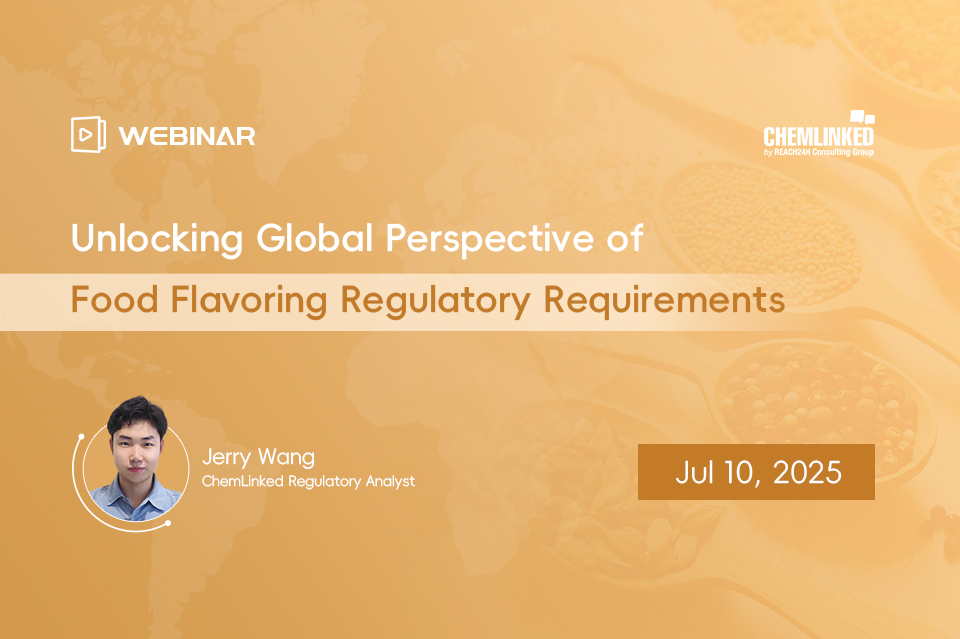
On July 10, 2025, ChemLinked will present a webinar titled Unlocking Global Perspective of Food Flavoring Regulatory Requirements, exploring how major food markets around the world regulate the use of flavorings in food, and embarking on a comparative exploration of diverse regulatory frameworks.
Recommended reading:
 We provide full-scale global food market entry services (including product registration, ingredient review, regulatory consultation, customized training, market research, branding strategy). Please contact us to discuss how we can help you by