Request a Demo
In China, regular prepackaged food shall comply with the labeling requirements stated in GB 7718-2011 General Standard for the Labeling of Prepackaged Foods and GB 28050-2011 General Rules for Nutrition Labeling of Prepackaged Foods. For prepackaged foods for special dietary uses, they shall also comply with GB 13432-2013 Labeling of Prepackaged Foods for Special Dietary Uses. For some products like beer and cheese, they should also follow additional labeling requirements specified in their GB product standards. Some notices released by the competent authority also further standardize the labeling requirement of certain foods, such as the new labeling requirement for solid beverage released this year. What’s more, after Jan 1, 2022, imported foods shall also follow the labeling requirements stipulated in Measures of the People's Republic of China for the Administration of Import and Export Food Safety (GACC Decree 249) and Regulations of the People’s Republic of China on the Registration and Administration of Overseas Manufacturers of Imported Food (GACC Decree 248).
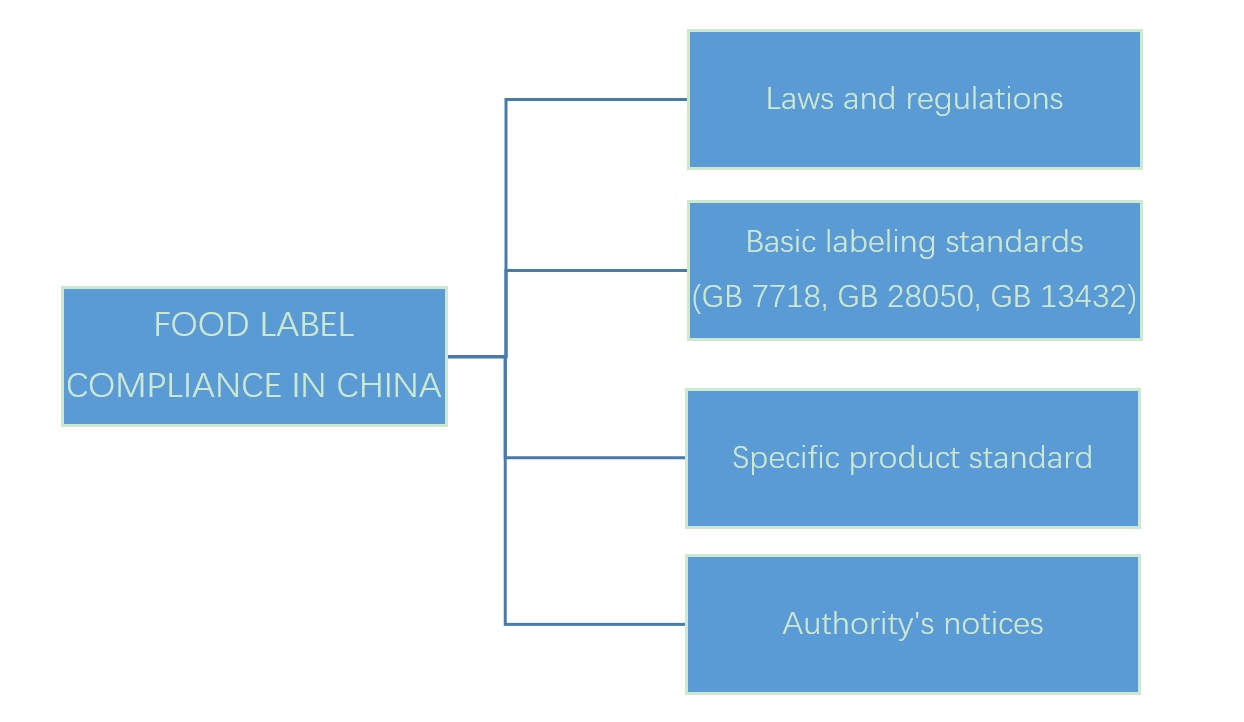 This article mainly analyses the major non-compliant items found in the labeling of prepackaged food.
1. Food Name
As per GB 7718-2011, food name shall reflect the real property of foods. However, many missed this requirement in practice. Non-compliant issues related to this point can be summarized into four situations:
the absence of food name;
when labeled with a coined name, such as “Peach Oolong”, the product was not labeled with the essential name “beverage” on the same display panel to show the real property of the product;
enterprises did not follow the specific font size requirement of certain products in corresponding product standards. For example, GB 19645-2010 National Food Safety Standard — Pasteurized Milk reveals that Chinese characters “fresh cow (goat) milk/dairy” shall be indicated close to products name on the principal display panel. The font size of these Chinese characters shall be no smaller than that of the product name, and the font height shall be no less than 1/5 of the display panel. However, in practice, enterprises did not note this requirement but followed the requirements in GB 7718, which is the font size of characters shall be no smaller than 1.8 mm. Since GB 7718 is a basic labeling standard for general prepackaged foods, if the product standard for certain foods has additional labeling requirements, such foods shall also follow the corresponding requirements as well.
The neglect of special requirements towards food name. For example, for rice dumplings that produced in accordance with SB/T 10377-2004, enterprises shall follow the requirement in this standard and label the raw material of the stuffing together with the name. In this case the name “rice dumplings (also zongzi)” is not acceptable. Enterprises shall label it as “rice dumplings with pork”, “rice dumplings with salted egg”, etc.
2. Ingredient List
Ingredients refer to any substance exists in the products used for the production and process of foods, including food additives. All ingredients shall be listed in descending order according to their weights added in the process of manufacture or preparation of the food; those accounting for less than 2% of the food can be exempted from being listed in descending order. The name of the compound ingredient shall be displayed according to GB 7718 based on different situations.
Most non-compliant items related to food labeling are related to ingredient list. Elements worth attention are illustrated below.
The ingredient list shall begin with “Ingredients” or “Ingredient List”. If the raw materials used in the preparation process are converted into other ingredients (such as wine, soy sauce, vinegar and other fermented products), then the ingredient list can begin with “Raw Materials” or “Raw Materials and Auxiliary Materials” instead of “Ingredients” or “Ingredient List”.
All ingredients shall be listed in descending order according to their weights added in the process of manufacture or preparation of the food. This is a common mistake for small enterprises and usually exists in the labeling of products like beverages, cakes and pastries. Take a beverage product, Crystal Sugar Pear Drink, as an example, some will label the ingredient list like “pear, crystal sugar, water”. But since the ingredient shall be listed in descending order based on the amount, the right order should be “water, pear, crystal sugar”.
All ingredients shall be listed. For example, the expression “etc.” is not permitted. Besides, for edible wrappers like natural casing, they shall also be labeled in the ingredient list.
In case the labeling of a food or the product information emphasizes the presence of one or more valuable ingredients or components (or comparatively-low presence/absence of one or more ingredients or components), the amount of the emphasized ingredients or components added or their amount in the final product shall be indicated. For example, if a product emphasizes the addition of chia seed, then the amount of chia seed shall be mentioned in the ingredient list.
The name of food ingredients shall be standardized. For example, it shall be “wheat flour” instead of “flour”, which may lead to misunderstanding.
When labeling food additives, it is not allowed to only label the specific function (such as sweetener or colorant) of corresponding food additives. Instead, the specific name or the international codes of the food additives shall be indicated together with the function name (such as sweetener). Or, enterprises can label specific names of all food additives in descending order of their weights added, without labeling the function name.
Excessive usage scope of food additive is not allowed. For example, sodium cyclamate is not allowed to be used in Chinese spirit called “Baijiu”. For food ingredient compliance issue, stakeholders can check Combox (a tool to ensure food ingredient compliance in China) for details.
When using novel food ingredients in food production, it is also required to follow additional labeling requirements specified in authority’s notices. For example, if ginseng is used in regular foods, then the product shall be labeled with the description “intake ≤ 3g/d” and also the unsuitable consumption groups, based on the No. 17 notice released by the former Ministry of Health in 2012.
3. Manufacturing Date/Shelf Life/Storage Condition
Frequently non-compliant items related to this point include:
The printed information related to manufacturing date and expiry date is blurry or missing.
When selling a product which contains small individual packages inside (e.g. a package of instant noodles with different flavors), the outer package didn’t label the manufacturing date of the individually packed food that produced the earliest.
The shelf life of products is not consistent with that in product standard. For example, the shelf life claimed on the product package is 18 months, but the shelf life stipulated in the product standard is 12 months.
The labeling of storage condition is missing.
4. Net Content and Specification
Non-compliant items mainly appear in three situations:
The height of characters did not meet the requirement. For example, when labeling the expression “Net Content: 2kg”, the height of these characters shall all reach 6mm according to Table 3 of GB 7718-2011.
Nonstandard unit labeling. The standard unit should be “kg” instead of “KG”. Moreover, when a product is over 1,000g, it shall be labeled as “kg” instead of “g”.
Products like canned fruit, which contains solid food and liquid food in the can, did not label the content of solid food. In this case, since fruit is the major edible food, the canned fruit product can bear the label like “Content of solid matter: no less than 70%”.
5. Nutrition Labeling
Disclosed by GB 28050-2011 National Food Safety Standard General Rules for Nutrition Labeling of Prepackaged Foods, nutrition labeling is part of the mandatory labeling item for most prepackaged foods. Mandatory nutrition labeling items include energy value, core nutrient content and their percentages in NRV (nutrient reference value), etc.
Elements worth attention:
Except for the foods listed below, prepackaged foods shall all be labeled with nutrition information.
—Fresh food, such as packed raw meat, raw fish, raw vegetables and fruits, eggs, etc.;
—Alcoholic beverages that contains 0.5% or more alcohol;
—Packaged food with total surface area ≤100 cm², or the largest surface area of the package ≤20 cm²;
—Non—prepacked food sold on the site where it is produced;
—Bottled drinking water;
—Prepackaged foods whose daily intake amount ≤ 10g or 10ml
—Other prepackaged foods exempted from nutrition labels according by other laws, regulations or rules;
The labeling of nutrient items shall follow a fixed order specified in GB 28050-2011. For example, it should be “energy, protein, fat, carbohydrate, sodium” instead of a random order like “protein, energy, fat, sodium, carbohydrate”.
Terms used in nutrition labeling shall be standardized as per the regulation. Typo mistake shall be avoided. For example, it should be NRV% rather than NVR%.
Rounding intervals for nutrients shall be labeled strictly according to Table 1 of GB 28050-2011. For example, the labeling of energy content “1500.1 kJ” is not acceptable, because the rounding interval for energy is 1 kJ.
The allowed error range for energy value and content of nutrients can be found in Table 2 of GB 28050-2011.
The information emphasized on the product label is not consistent with the nutrition fact. For example, a product claims “high calcium”, but the calcium content in the nutrition fact does not reach the requirement.
6. Special Requirements Raised in Specific Product Standards
Some product standards also raise special labeling requirements. For example, beer products manufactured based on GB/T 4927-2008 shall additionally label alcohol by volume, original gravity and warnings. Certain products (like rice) need to label the corresponding quality grade (e.g. Grade 1). In addition, some standards require products to label specific types, e.g. cooked products or raw products, etc.
To avoid non-compliant items related to this point, enterprises shall check corresponding product standards carefully when making product labels.
7. Others
There are also other non-compliant items. The most important one is that regular food is not allowed to bear function claims (e.g. improve immune system). In China, only health foods (need to get health food certificate from China’s competent authority) can bear such claims.
A Summary of the Amendment Progress of GB 7718 and GB 28050
Besides the elements described above, it is also important for enterprises to catch up to amendment progress of the two important fundamental labeling standards. The below is a summary of their current amendment progress:
GB 7718-2011 National Food Safety Standard General Standard for the Labeling of Prepackaged Foods (Bilingual version in ChemLinked Regulatory Database).
—The first consultation draft, released in 2018, view ChemLinked news and the full text.
—The second consultation draft, released in 2019, view ChemLinked news and the full text (with English translation).
GB 28050-2011 National Food Safety Standard General Rules for Nutrition Labeling of Prepackaged Foods (Bilingual version in ChemLinked Regulatory Database)
—The first consultation draft, released in 2018, view ChemLinked news and full text.
—The second consultation draft, released in 2020, view ChemLinked news and full text.
—The third consultation draft, released in 2021, view ChemLinked news and full text.
For further questions, consultation or customized report for food compliance requirements in your country/company, please email [email protected].
 We provide full-scale global food market entry services (including product registration, ingredient review, regulatory consultation, customized training, market research, branding strategy). Please contact us to discuss how we can help you by