

 Request a Demo
Brazil's food regulatory framework is one of the most comprehensive in Latin America, primarily managed by the National Health Surveillance Agency (ANVISA) and the Ministry of Agriculture, Livestock, and Food Supply (MAPA). Brazil's regulatory system is composed of a series of laws, resolutions, and decrees designed to ensure the safety and quality of both domestically produced and imported foods. As a prominent member of the Southern Common Market (MERCOSUR), Brazil actively participates in harmonizing regional food standards, which are then integrated into its national legislation. In recent years, Brazilian regulatory bodies, particularly ANVISA, have been focused on modernizing the regulatory framework to simplify regulations and improve efficiency while upholding food safety.
1. Competent Authority
The oversight of food and beverage products in Brazil is primarily handled by two federal agencies, with several other ministries playing supporting roles in specific areas:
Competent Authority | Main Obligations |
|---|---|
Under the Ministry of Health, ANVISA is the principal body responsible for the regulation of most processed foods. Its scope includes establishing standards for food composition, additives, contaminants, and labeling. It also controls the registration and inspection of food manufacturing facilities and oversees food safety at ports, airports, and borders. | |
MAPA is responsible for regulating fresh, unprocessed plant and animal products, as well as certain processed goods like dairy, meat, honey, and alcoholic beverages. It oversees agricultural production, animal health, and plant sanitation, and manages the inspection and certification of establishments producing products of animal origin (SIF stamp). | |
Ministry of Development, Industry, Trade and Services (MDIC) | MDIC manages all import and export operations registration and licensing through its Secretariat of Foreign Trade (SECEX). Its subordinate agency, the National Institute of Metrology, Quality, and Technology (INMETRO), is responsible for regulating net quantity statements on packaging and product safety. |
MMA assesses the potential environmental impact of agricultural chemicals through its Brazilian Institute of Environment and Renewable Natural Resources (IBAMA). | |
MOJPS enforces the Brazilian Consumer Code through its Department of Consumer Protection (DPDC), handling complaints related to food adulteration, misleading labels, and fraud. | |
State and municipal governments | State and municipal governments have the authority to regulate and enforce state and municipal legislations. Federal regulations must prevail when there are conflicts between federal, state, and municipal legislation. |
2. Main Regulations
Brazil's regulatory framework is underpinned by a series of laws, decrees, and resolutions. Key regulations include:
Legislations | Main Contents |
|---|---|
Defines the National Health Surveillance System and creates ANVISA, establishing its mandate to protect public health by controlling the production and consumption of products and services, including food. | |
Establishes the basic standards for food products, covering registration, labeling, and general quality parameters. While many of its articles have been updated by modern ANVISA resolutions, it remains the foundational legal framework for food in Brazil. | |
Provides rules for the labeling of packaged foods. | |
Establishes the official positive lists of food additives (e.g., colorings, preservatives, sweeteners) and processing aids authorized for use in foods, along with their respective functions and use limits. | |
Sets the maximum tolerated limits (MTC) for contaminants in food, such as heavy metals, mycotoxins, and other substances resulting from production processes or environmental contamination. | |
Establishes the regulatory framework for novel foods and new ingredients, aiming to provide greater clarity and objectivity to the legal concept of these products. | |
These complementary regulations establish the current framework for nutritional labeling on packaged foods. They mandate the inclusion of front-of-pack (FOP) warning labels for high levels of added sugar, saturated fat, and sodium, and updated the requirements for the nutrition facts table. | |
These complementary regulations establish the new risk-based framework for pre-market control of food, classifying products into three categories for regularization. | |
The primary regulation for the industrial and sanitary inspection of products of animal origin, covering all aspects from facility registration to processing and labeling. | |
Provides the foundational legal framework for the standardization, classification, registration, inspection, and production of beverages. | |
Sets forth the product requirements for food supplements, covering ingredients, usage limits, claims and labeling. |
3. Market Access Approval
Businesses seeking to import goods into Brazil must obtain a RADAR license to access the Brazilian Integrated Foreign Trade System (SISCOMEX). For each shipment, the importer must secure an Import License. Notably, depending on the product category (e.g., foods, beverages, agricultural products), additional permits must be obtained in adherence to the procedures of either ANVISA or MAPA.
3.1 Importer Registration
Before a company can import any product into Brazil, it must be authorized to operate on the Integrated Foreign Trade System (SISCOMEX), which is an electronic integrated trade documentation system designed by the Brazilian Government to control and monitor the Brazilian Foreign Trade. Gaining access to SISCOMEX requires obtaining a specific license known as RADAR.
To apply for the "RADAR" license, a company must be legally constituted in Brazil and be in good standing with federal tax authorities. The entire process is conducted entirely online through the Federal Revenue's digital portal. Core documents for the application include:
Corporate documents, including registered Social Contract and all its amendments.
Identification documents, including General Registry and Individual Taxpayer Registry of the legal representative.
Proof of financial capacity, including bank statements and tax declarations that prove the legal origin of the funds used for the company's capital.
3.2 Market Authorization
3.2.1 Products of Animal Origin
For imported products of animal origin (e.g., meat, dairy, seafood), foreign establishments must come from countries whose health inspection system has been assessed or recognized as equivalent by the Department of Inspection of Animal Products (DIPOA). In principle, a country whose health inspection system has been recognized as equivalent to the Brazilian system for a certain area or animal species may request an extension of the recognition to other areas or animal species. The process of equivalence assessment may be divided into the following main steps:
Official reply of the foreign country's competent authority regarding their interest in exporting animal products to Brazil, stating the animal area and the products or categories of products to be exported;
The competent authority of the foreign country presents its answers to the specific technical questionnaires;
The Department of Animal Health (DSA) evaluates the request in order to check technical impediments or restrictions from the perspective of animal health and definition of applicable health requirements;
Document-based check by the DIPOA regarding the organization of the country's health inspection system from the perspective of public health; this check, if necessary, can be performed by the laboratories, residues and contaminants and livestock supplies sectors;
Organization and realization of official veterinary missions to the foreign country and further adjustments to reply to the report;
If the previous procedures conclude that there are no technical and/or health impediments, export-specific certificates templates shall be negotiated, and the country will be notified of the opening of the market and procedures for eligibility of the establishments;
Once the document-based check has been completed, the Division for International Audits (DIAI/CGCOA) will organize an official veterinary mission to perform an on-site assessment of the foreign inspection system.
Once the missions have been completed and the actions taken by the health authorities of the foreign country have been deemed satisfactory in complying with the official recommendations, the process will be submitted to the Division for Equivalence Evaluation (DEQ/CGCOA) for conclusion of the assessment of the request to open the market and, if approved, negotiations on exports health certificates to be used.
In addition to restrictions of country of origin, foreign establishments (manufacturing and storage) must be registered and approved by MAPA. Brazil offers two pathways for the listing of foreign establishments:
Veterinary Mission (plant by plant eligibility): Consists of mandatory individual visits to the interested establishments by means of official Brazilian veterinary mission; or
Indication by the Foreign Health Authority ("pre-listing"): When the health authority of the foreign country may refer interested establishments for subsequent ratification by the DIPOA and establishments may be exempted from advance visits.
Registered foreign establishments of Products of Animal Origin can be searched in PGA-SIGSIF system.
Importantly, products of animal origin must finish product registration with DIPOA, including the product label. For foreign establishments, a designated representative must request access via electronic registration. When applying for a new registration or an alteration, the establishment must provide the following information and documents:
Product Identification: General data and characteristics of the product.
Composition: A list of all ingredients in descending order of quantity.
Manufacturing Process: A detailed description of all production steps, from receiving raw materials to processing, packaging, storage, and transportation. This must include quality control measures.
Health Claims: If the label makes any functional or health claims, a formal opinion from the relevant health regulatory body is required.
Thermal Processing: For commercially sterilized products, thermal processing calculations must be provided.
Label Reproduction: A high-quality, full-color, and legible image of the product label, including its dimensions.
Supporting Documents: Any other documentation needed to verify specific information or attributes claimed on the label.
Lastly, the import of products of animal origin requires prior authorization from the MAPA, which will assess whether the product meets the requirements for animal and public health. The request for prior authorization should be submitted via the online portal. The applicant should complete the request including data from the importer, the applicant, the manufacturer, and the product. Then, the process will be automatically distributed to an Animal Origin Product Inspection Service (SIPOA) and assigned to an analyst, who will issue a report authorizing the importation or rejecting the request.
3.2.2 Beverages and Wines
To import beverages, wines and wine products, the establishment must be registered with MAPA as an importer of the product it intends to import. The registration should be done through the Integrated System of Agricultural Products and Establishments (SIPEAGRO). The legal representative of the establishment must first have an account on the Brazilian government's single sign-on platform. Using the login, the user accesses the SIPEAGRO portal and requests a link to the establishment. To complete the registration, the company must have all necessary legal documents prepared for upload:
Corporate documents, including social contract and CNPJ card.
Personnel documents for both legal and technical representatives.
A list of products that the company intends to import.
Furthermore, the importing establishment must register the import request through the Management Information System for the International Transit of Agricultural Products and Inputs (SIGVIG).
3.2.3 Processed Foods
Based on the risk-based classification, ANVISA categorizes processed foods into three main groups for market entry: those requiring registration with ANVISA, those requiring notification to ANVISA, and those requiring notification to local health surveillance agencies. Exemptions from market authorization include food raw materials, fresh food, food equipment, food ingredients including food additives and technology adjuvants, food products handled and prepared in food services when intended for direct sale to the consumer.
Please note that foreign companies cannot directly make administrative arrangements with ANVISA regarding the issuance of pre-market authorizations and certificates. Foreign companies should cooperate with partner companies legally established in Brazil, which will bear legal responsibility for products imported into and distributed within Brazil.
1) Products Requiring Registration (ANVISA): These are considered higher-risk and require a full technical and safety evaluation by ANVISA before marketing. The applicant must be the manufacturer's headquarters or the manufacturer's representative headquarters or the importer's headquarters. This category includes:
Infant formula and follow-up formula
Infant formula for special medical purposes
Dietary formula for inborn errors of metabolism
Enteral nutrition formulas
Novel foods and novel ingredients
Bioactive substances and probiotics with health claim allegations
The overall application process of ANVISA registration can be outlined as follows:
Step 1: The applicant must gain access to ANVISA's petitioning system ( Sistema Solicita). This is only possible if the entity holding the registration is already registered in the system. All companies, whether they are manufacturers, representatives, or importers, must be properly registered.
Step 2: After completing the first step, registered companies can then register their products by accessing the Sistema Solicita system and submitting a petition for the desired subject. The petition must be accompanied by specific documents. The required documents depend on the category and are outlined in Annexes V and VI of IN No. 281/2024.
Step 3: The process is forwarded to the technician, who begins the analysis, including assessing whether the documentation is complete. If clarification is needed, a technical requirement is issued and sent directly to the applicant's mailbox in the Solicita System, which must be checked frequently.
Step 4: If the company does not comply with the requirement, the application is rejected. If it is fulfilled within the deadline, the technical analysis continues. The final decision is published in the Official Gazette (DOU) and the opinion is sent through the mailbox.
Notably, each registration approval is valid for five years, and the validity can be maintained through registration revalidation at least twelve months in advance of the expiration of the registration. The revalidation petition must be accompanied by the documents described in Annex VII of IN No. 281/2024. In addition, if the product is already registered and it is necessary to make any changes to the original registration process, such as modification of formula, brand, labeling, expiration date, among others, the registration holder must submit to ANVISA the request for change in the product registration, according to Annex VIII of IN No. 281/2024. All registered foods can be searched in this portal.
2) Products Requiring Notification (ANVISA): The manufacturer or importer must notify ANVISA of the product's launch before starting sales. The applicant must be the manufacturer's headquarters or the manufacturer's representative or the importer's headquarters. This category includes, but is not limited to:
Foods with functional and/or health claims
Foods for weight control
Cereals for baby food
Desalinated, potable and bottled seawater
Food supplements
The overall application process of ANVISA notification can be outlined as follows:
Step 1: The applicant must gain access to ANVISA's petitioning system ( Sistema Solicita). This is only possible if the entity holding the registration is already registered in the system. All companies, whether they are manufacturers, representatives, or importers, must be properly registered.
Step 2: After completing the first step, registered companies can then notify their products by accessing the Sistema Solicita system and submitting a petition for the desired subject. The petition must be accompanied by specific documents. The required documents depend on the category and are outlined in Annexes X of IN No. 281/2024.
Step 3: The notification will take place automatically without precedence by ANVISA. However, after the product has been notified, the documentation contained in the product notification can be subject to evaluation by ANVISA at any time.
Notably, companies holding notifications must apply for maintenance every 5 years to maintain the validity of product notifications. This cycle starts counting from 2024. For all products notified before or on September 30, 2029, a maintenance application must be submitted within the first designated window period (October 1, 2029 to December 31, 2029). The request to maintain the notification will be made through an electronic form made available in the Solicita System. The company will make a maintenance request for all valid products in a single form, regardless of the date the notification was made. All notified foods can be searched in this portal.
3) Products Requiring Notification (local health surveillance agencies): Most foods fall under this category. The manufacturer or importer must notify the start of manufacturing or import to the health authority of the State, Federal District, or Municipality. This category includes, but is not limited to:
Sugars and chocolates
Chemical leaveners and sweeteners
Foods for nutrient-restricted diets
Starches and grain products
Coffee, tea and spices
Fruit and vegetable products
Ice cream and natural mineral water
For food products that fall under this category, the manufacturer or importer of the product must fill out the form contained in Annex XI of IN No. 281/2024 and file with the health surveillance agency (state or municipal) where the company is located. The local Health Surveillance can define the filing procedures. Upon receipt of the notification of the start of manufacture or importation, the competent sanitary authority may, at its discretion, carry out a sanitary inspection at the manufacturing or storage units of the food or packaging.
Notably, this notification of commencement of manufacture or import is valid indefinitely. For any changes in the initial notification, the holding company must request a change through the protocol of a new form contained in Annex XI of IN No. 281/24. This request will result in the automatic cancellation of the initial notification.
3.3 Import License
Importing food products into Brazil requires authorization for each shipment. The importer should obtain an Import License (LI) before the goods are shipped. The process of obtaining an LI is handled electronically through the SISCOMEX system, and can be outlined as follows:
Step 1: Confirm the correct NCM code for the product to determine which agency (MAPA or ANVISA) will be responsible for its approval.
Step 2: Collect all necessary details from suppliers. The key document here is the Proforma Invoice, which serves as the basis for the LI application.
Step 3: Log into the SISCOMEX portal and fill out the electronic LI form. Once submitting the form, it is automatically routed to the appropriate consenting agency.
Step 4: An official from the relevant agency (MAPA or ANVISA) will review the application, checking for compliance with all specific regulations for that commodity. They may request additional documents or information.
Step 5: Once the agency is satisfied, they will approve the LI.
Step 6: After the goods arrive in Brazil, the approved LI must be linked to the Import Declaration, which is the final document used to clear the goods through customs.
3.4 Inspection at the Border
Upon arrival in Brazil, all food and agricultural shipments are subject to inspection by the relevant authorities at the port of entry.
ANVISA Inspection: Shipments of processed foods are subject to inspection upon arrival. This includes a documentary check (verifying the commercial invoice, Bill of Lading, LI, and other required certificates), and may involve physical inspection (checking labels, packaging integrity, storage conditions) and laboratory analysis of samples to verify compliance with Brazilian standards for composition, contaminants, and microbiological safety.
MAPA Inspection: Agricultural and animal-origin products are inspected by MAPA's Agricultural Surveillance Service (VIGIAGRO) at the port of entry. This includes checking health certificates (e.g., phytosanitary or sanitary certificates) from the country of origin, documentary verification, and physical inspection. Notably, for beverages and wines, the importer must apply for an import inspection certificate in advance.
4. Product Standards
Every product entering Brazil is subject to rigorous verification to ensure it meets the specific technical regulations, including identity and quality standards and food safety regulations. These standards are primarily set and enforced by MAPA and ANVISA. Examples of these standards are shown in the table below:
Food Category | Regulation |
|---|---|
Dairy products | Technical Regulations for Identity and Quality (RTIQ) – Milk and Its Derivatives, which includes general dairy standards (e.g, Technical Regulations of Identity and Quality of Dairy Products) and standards for specific dairy products (e.g., Technical Regulation for identity and quality of Fermented Milks) |
Meat products | RTIQ - Meat and its Derivatives, which includes general meat standards (e.g, Techanical Regulation on the Identity and Quality Requirements that the Meat Product Must Meet) and standards for specific meat products (e.g., Technical Regulations of Identity and Quality of Almond, of Preserved Meat, of Salami, of Burger, of Kebab, of Cooked Ham, and of Ham) |
Beverages, wine and wine products | Wine and Beverage Legislation, which collects the current wine and beverage standards. |
Plant-origin products | Vegetal Quality Legislation, which collects the main standards on the quality and safety of plant-origin products. |
Infant formula, baby food | RDC 976/2025, which establishes the sanitary requirements for infant formulas, formulas for high-risk newborns, transitional foods, and cereal-based foods for infants and young children, enteral nutrition formulas, and dietary therapeutic formulas for inborn metabolic errors. |
Radiated food | RDC 21/2001, which serves as technical regulations for food irradiation. |
Low-sodium salt, foods for weight control, foods for diets with nutrient restrictions, and foods for diets with controlled sugar intake | RDC 715/2022, which establishes the sanitary requirements for low-sodium salt, foods for weight control, foods for diets with nutrient restrictions, and foods for diets with controlled sugar intake. |
Food supplements |
|
Starches, biscuits, whole grains, processed cereals, flours, whole flours, pasta and breads |
|
Candy, confectionery, cocoa, chocolate, gum | RDC 723/2022, which regulates the sanitary requirements for sugar, inverted liquid sugar, confectionery sugar, taffy, candy, cocoa powder, soluble cocoa, chocolate, white chocolate, chewing gum, cocoa butter, cocoa mass, honey, molasses, and rapadura. |
Frozen desserts | RDC 713/2022, which regulates the sanitary requirements for edible frozen desserts and for preparations for edible frozen desserts. |
Mushroom, fruit and vegetable products | RDC 726/2022, which regulates the sanitary requirements for edible mushrooms, fruit products, and vegetable products. |
Vegetable oils and fats |
|
Mixtures for food preparation and ready-to-eat foods | RDC 719/2022, which regulates the sanitary requirements for mixtures for food preparation and ready-to-eat foods. |
Bottled water and ice for human consumption. | RDC 717/2022, which regulates the sanitary requirements for bottled water and ice for human consumption. |
Coffee, barley, teas, yerba mate, spices, seasonings, and sauces |
|
Nutritionally modified foods | RDC 720/2022, which regulates the sanitary requirements for nutritionally modified foods. |
For food products without specific product standards, they should comply with general and basic food safety requirements, such as contaminant limits.
5. Food Ingredients
5.1 Food Additives
ANVISA defines food additives as any ingredient, without nutritional benefits, which was deliberately added to food to modify its physical, chemical, biological, or sensorial characteristics during any stage (e.g., processing, storage, handling, or transportation).
Besides, manufacturing technology adjuvants are defined as any substance or material, excluding equipment and utensils, that is not consumed as an ingredient in itself and that is intentionally used in the preparation of raw materials, ingredients or foods, to achieve a technological purpose during their treatment or preparation, which may result in the unintentional, but inevitable, presence of residues or derivatives in the final product.
The main regulations are RDC 778/2023 and IN 211/2023, which consolidate the requirements for the uses of food additives or adjuvants . ANVISA maintains "positive lists" in annexes of IN 211/2023, specifying which additives or adjuvants are permitted for each food category and their maximum usage levels. Notably, for certain types of food additives and technological adjuvants, they also need to comply with additional regulations, such as:
RDC 725/2022 for food flavorings
RDC 728/2022 for enzymes or enzymatic preparations
RDC 779/2023 for chemical yeast food additives and biological yeast technology adjuvants and yeast nutrients intended for use in bakery products and biscuits
RDC 818/2023 for tabletop sweeteners and dietary sweeteners
Additionally, food additives and technological adjuvants must fully comply with the specifications of identity, purity and composition established in international references, including JECFA, FCC, EFSA, EU, etc.
To use new food additives or adjuvants, or to change the current permitted conditions, businesses must apply for inclusion or extension of use in accordance with Guide 43/2020. ANVISA has a tool with information on approved food additives.
5.2 Novel Food
A novel food or ingredient is any substance without a history of safe consumption in Brazil before 1999. This includes newly developed synthetic ingredients, extracts from exotic plants, or substances produced using new technologies. To evaluate the nutritional purpose of the new food or new ingredient, the following aspects must be considered:
the stated purpose and intended use of the interested company;
the mechanism of action of the nutrient, bioactive substance, enzyme or probiotic in the human body;
the composition of the new food or new ingredient, including the concentration of nutrients, bioactive substances, enzymes or probiotics;
the risks that the new food or new ingredient may pose to human health; and
the history of products containing the new food or new ingredient regulated in the national and international market.
It should be noted that for some food categories, the legislation defines positive lists of authorized ingredients, such as infant formula and food supplements. In this case, the use of an ingredient not provided for in the respective regulation depends on a safety assessment.
The safety assessment request is usually filed by the company responsible for manufacturing the new food or ingredient or, in the case of foreign companies, by a representative based in Brazil. Evaluation requests are submitted electronically and their flow within ANVISA can be monitored via the portal. The administrative flow of the safety assessment is summarized in an infographic . ANVISA also provides a tool that allows users to view new ingredients and foods that have received a favorable opinion in the safety and efficacy evaluation, where applicable.
6. Labeling and Claim
6.1 Food Labeling
In 2022, ANVISA released RDC No. 727/2022, which consolidates several old food labeling legislations. As a result, RDC 727/2022 is now the primary reference for general labeling requirements, such as the product name, list of ingredients, and country of origin. It works in concert with the more specific nutritional regulations, RDC 429/2020 and IN 75/2020, which govern the nutritional information panel and front-of-pack warnings.
Every food label must provide clear, precise, and legible information covering several mandatory elements. Failure to include any of these can render a product non-compliant. The essential checklist includes:
Product Name: The common or usual name of the food, which must not be misleading.
List of Ingredients: All ingredients must be listed in descending order of predominance by weight.
Allergen Declaration: A specific warning is required for 18 major allergens.
Lactose Warning: Foods containing lactose in quantities greater than 100 mg per 100 g or ml of food as displayed for sale must contain the warning.
Net Quantity: The net weight or volume of the product must be declared.
Manufacturer/Importer Identification: The name and address of the manufacturer, packer, or distributor.
Country of Origin: A statement indicating the country where the product was manufactured.
Lot Identification: A code that allows for the traceability of the product batch.
Date Marking: The expiration date and, in some cases, the manufacturing date.
Storage Instructions: Information on required storage conditions, such as "Keep refrigerated".
Nutritional Panel: mandatory items include energy, carbohydrates, total sugars and added sugars, protein, total fats, saturated fats, trans fats, dietary fiber, and sodium.
All mandatory labeling information must be presented in Portuguese. If the original packaging is in another language, this information can be added via a supplementary label or sticker that is securely affixed to the package before it is offered for retail sale.
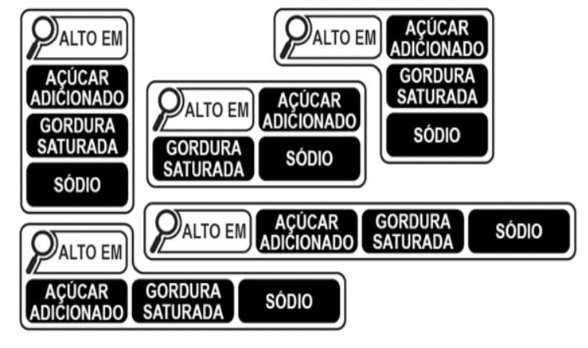
Importantly, a key feature of Brazil's current regulation is the mandatory Front-of-Pack Labeling (FOPL) system. This system uses a "magnifying glass" symbol to alert consumers when a product is high in added sugar, saturated fat, or sodium. The FOPL must be placed on the upper half of the main package panel to ensure it is easily visible to consumers.
Nutrient | Limit for Solid & Semi-Solid Foods (per 100g) | Limit for Liquid Foods (per 100ml) |
|---|---|---|
Added Sugar | ≥ 15g | ≥ 7.5g |
Saturated Fat | ≥ 6g | ≥ 3g |
Sodium | ≥ 600mg | ≥ 300mg |
Besides, there are some legislations that set forth certain additional labeling rules for food products. These legislations include:
Decree-Law No. 4680/2003, which regulates the right to information regarding food and food ingredients intended for human or animal consumption that contain or are produced from genetically modified organisms.
Law No. 10674/2003, which requires that commercialized food products inform about the presence of gluten.
Law No. 11265/2006, which regulates the marketing of food for infants and young children, as well as related childcare products.
Product standards (see Part 4)
6.2 Food Claims
Food businesses may use nutritional claims for eligible food products voluntarily. Nutritional claims refer to any statement, with the exception of the nutritional information table and front-of-pack nutritional labeling, indicating that a food has positive nutritional properties relating to its energy value or nutrient content, including claims of absolute and comparative content and of no addition. They can be further divided into:
Absolute content nutritional claims: nutritional claims that describe the level or quantity of energy and nutrients contained in the food.
Nutritional claims with comparative content: nutritional claims that compare the levels or quantity of energy value or the same nutrients contained in the reference food.
No-added nutritional claims: nutritional claims that describe that an ingredient has not been added directly or indirectly.
Conditions for bearing nutritional claims include:
Using the terms authorized for the dissemination of nutritional attributes established in Annex XIX of IN No. 75/2020;
Meeting the composition and labeling criteria for declaring nutritional claims established in Annex XX and XXI of IN No. 75/2020;
Maintaining the claimed nutritional properties until the end of the product's shelf life, considering the method of preparation of the food indicated by the manufacturer on the label.
It should be noted that nutritional claims cannot be made on alcoholic beverages and dietary therapy formulas for inborn errors of metabolism.
Besides, functional and/or health properties claims are permitted on an optional basis.
Functional property claims: claims relating to the metabolic or physiological role that the nutrient or non-nutrient has in the growth, development, maintenance and other normal functions of the human organism.
Health claims: claims that assert, suggest or imply the existence of a relationship between the food or ingredient and a disease or health-related condition.
For nutrients with functions fully recognized by the scientific community, demonstration of efficacy or analysis thereof will not be required for functional claims on the label. For new functional and/or health properties, businesses must request a petition from ANVISA prior to its use. More information can be assessed in Guidance on Evaluating Functional and Health Claims for Bioactive Substances in Foods and Food Supplements.
We are pleased to introduce our Regulatory Pathways for Novel Food Ingredients Worldwide. This guide provides a systematic overview of the regulatory frameworks for novel food ingredients in key markets, including China, the USA, the EU, Australia-New Zealand, Japan, South Korea, and Southeast Asia.
Key sections include:
Regulatory Frameworks & Authorities
Approval Processes & Documentation
Key Compliance Strategies
Download Your Free Copy Now from here.
*Global Food Compliance Service
We provide various market entry services to help stakeholders better understand exporting requirements, establish business and secure a competitive place to facilitate trade development.
Covered Countries
China, Thailand, Vietnam, Singapore, Malaysia, Philippines, Indonesia, Japan, South Korea, United States, European Union, Australia, New Zealand etc.
Our Services
Food Ingredient Review
Label Review
Product Registration
Regulatory Consultation
Monitoring, Training and customized report
Please feel free to contact us via [email protected] if you need any help.
