

 Request a Demo
For most prepackaged foods, Chile's food regulatory framework is relatively straightforward, with the Food Sanitary Regulations (Decree No. 977) serving as the most practical and comprehensive regulation. This regulation covers general labeling, additive, and hygiene requirements, as well as product requirements for over 20 food categories. Additionally, Chile is an associate member of the Southern Common Market (MERCOSUR), which receives tariff reductions when trading with permanent members. However, as an associate member, Chile does not have full voting rights or free access to members’ markets.
Part 1 Competent Authority
In Chile, the Ministry of Health (MINSAL) is the primary authority responsible for supervising the safety of most prepackaged foods, while the Ministry of Agriculture oversees agricultural products.
The following table lists the authorities and their responsibilities:
| No. | Authority | Responsibility |
| 1 | Ministry of Health (MINSAL) | Management of prepackaged products |
| 2 | Ministry of Agriculture (especially the Agriculture and Livestock Service Department, SAG) | Management of agricultural products, organic food, animal and plant quarantine; and enterprise registration and authorization for alcoholic beverages |
| 3 | National Fisheries and Aquaculture Service (Sernapesca) (subject to the Ministry of Economy, Development and Tourism) | Supervision of sanitary programs and resolutions within aquaculture |
| 4 | National Customs Service (SNA) | Customs clearance and food importation |
| 5 | Agency for Food Quality and Safety (ACHIPIA) (subject to the Ministry of the General Secretariat of the Presidency) | Risk analysis and evaluation; provides guidance for relevant authorities in the implementation of food safety and quality schemes, policies, etc. |
Part 2 Main Regulations
The Food Sanitary Regulations (Decree No. 977) is the main comprehensive regulation that aims to protect the health and nutrition of the population and ensure the supply of healthy and safe food. The regulation aims to establish the sanitary conditions of a food product regarding its production, importation, processing, packaging, storage, distribution, and sale for human consumption. Labeling requirements and advertising requirements can also be found in this Decree.
2.1 General Requirements
The table below outlines key regulations:
| Type | Regulation |
| Basic health requirements | |
| Comprehensive hygiene requirements (covering production, import, sales, etc.) | |
| Hygiene | |
| Labeling and advertising | Law 20,606 on the Nutritional Composition of Foods and Their Advertising |
| Ingredient | Resolution 393 Exempt, Setting Nutritional Guidelines on the Use of Vitamins and Minerals in Foods |
Resolution No. 3435 in 2018 regarding probiotics, which defines the sanitary control regime for products in oral dosage forms, made with Lactobacillus spp., Bifidobacterium spp., and other specific bacilli | |
| Importation | Law No. 18,164/82 of the Ministry of Finance, Introducing Amendments to Customs Legislation |
| ... | ... |
2.2 Product-specific Regulations
The table below outlines some product-specific regulations:
| Type | Regulations |
| Ingredient for dietary supplement | |
| Labeling and advertising for alcoholic beverage | |
Regulation on Consumer Information and Advertising of Alcoholic Beverages | |
| Hygiene requirements for meat | General Technical Standard on Veterinary Medical Inspection of Poultry and Their Meat |
General Technical Standard No. 62 on Medical-Veterinary Inspection of Cattle and Their Meat | |
| ... | ... |
Part 3 Market Access Approval
Importing prepackaged foods requires two procedures to be completed: the Customs Destination Certificate (CDA) and the Authorization for Use and Disposal of Imported Food. Both applications can be authorized or rejected depending on whether the products in the import consignment meet the requirements of current health regulations. Read more here.
3.1 Customs Destination Certificate (CDA)
The Customs Destination Certificate (CDA) is a resolution issued by the Regional Ministerial Secretariats of Health (SEREMI de Salud) for the customs office where the products entered the country. This resolution authorizes the removal and transportation of goods from customs premises to an authorized warehouse or storage facility. The resolution must specify the authorized warehouse's address, the route, and the conditions for transferring the goods.
Enterprises need to apply this resolution online. Read the online operation manual here. It is necessary for enterprises to have:
Invoice for the product
Copy of the health resolution from the authorized destination warehouse
The importer assumes a series of obligations and responsibilities that include the transfer of the food products to the warehouse designated in the Customs Warehouse Certificate (CDA), as well as the preservation of said products in said warehouse.
3.2 Authorization for Use and Disposal of Imported Food (UYD)
According to Article 90 of the Health Code, DFL 725/1968, businesses must request a resolution from the health authority to authorize the use, sale, consumption, transfer, and disposal of food. Before granting this authorization, the regional health authority may inspect and/or submit the products to laboratory analysis to verify compliance with current health regulations.
In practice, importers can apply for this procedure from Regional Ministerial Secretariats of Health online. Products advertised as food and that possess or claim therapeutic properties must be certified by the Applicable Control Regime, issued by the Chilean Institute of Public Health (ISP), in accordance with Article 70 of Supreme Decree 1876/95. The following documentation may be required for the authorization:
Customs Destination Certificate (CDA) (must be provided)
Health certificates if the products are derived from bovine animals
Results of analyses carried out on food in the country of origin.
Technical data sheet in Spanish issued by the food manufacturer
…
Neither products nor labeling designs or models must be reviewed or approved prior to the physical entry of the products. The importer must assume this responsibility by including all the information required by the Food Sanitary Regulations on their labels. Details can be read in this import procedure manual.
3.3 Inspection Requirements
Imported foods are subject to three technical procedures based on risk analysis, import history records, and violation behaviors:
Direct procedure without inspection: After analyzing the background information of the imported foods, the Health Authority issues the Authorization Resolution without inspecting the product.
Procedure with inspection without sampling: The product is inspected at its storage location to verify its identification, physical characteristics, labeling, and storage conditions. The Health Authority may then take samples and analyze them.
Procedure with inspection with sampling: Samples of the merchandise are taken for analysis according to the parameters established for the type of food. The samples must be taken by trained technical personnel from the Regional Health Authority and analyzed in recognized laboratories.
If noncompliance with current regulations is confirmed after these procedures, the Health Authority will issue a Rejection Resolution.
More importation details can be read in this import procedure manual.
Part 4 Product Standards
Decree No. 977 of 1996 on Food Sanitary Regulations provides not only requirements on food additives, labeling, and hygiene, but also product compliance requirements on specific food categories and subcategories. These include:
Frozen food (chapter 7)
Dairy and dairy products (chapter 8)
Ice cream and mixtures thereof (chapter 9)
Edible oil and fat (chapter 10)
Meat products (chapter 11)
Fish (chapter 12)
Shellfish (chapter 13)
Egg (chapter 14)
Farinaceous foods (chapter 15)
Baker's yeasts and leavening agents (chapter 16)
Sugar and honey (chapter 17)
Confectionery and similar products (chapter 18)
Jam and similar products (chapter 19)
Preserves (chapter 20)
Pickles (chapter 21)
Dehydrated Broths and Soups (chapter 22)
Spices, Condiments, and Sauces (chapter 23)
Stimulants (e.g., tea, coffee) or Fruiting Products (chapter 24)
Prepared Meals and Dishes (chapter 25)
Drinking Water, Mineral Water, and Ice (chapter 26)
Non-Alcoholic Beverages, Fruit and Vegetable Juices, and Packaged Water (chapter 27)
Foods for Special Diets (chapter 28)
Food Supplements and Sports Food (chapter 29)
Each chapter has further detailed product standards for specific subcategories. For instance, the product regulation for cheese is found in Chapter 8 for dairy products.
Part 5 Food Ingredients/Additives
Decree No. 977 of 1996 on Food Sanitary Regulations, provides the use requirements for ingredients and food additives. For example, the list of permitted food additives can be found in the following articles. As per Decree No. 977, all additives must comply with the identification, purity, and toxicity evaluation rules in accordance with the Codex Alimentarius.
Article 140: acid regulators
Article 141: anti-caking and anti-humidifying substances
Article 142: antifoaming and foaming substances
Article 143: antioxidant substances
Article 144: sequestering substances and synergists of antioxidants
Article 145: coloring agents
Article 146: non-nutritive sweeteners
Article 147: emulsifying substances
Article 148: emulsifying salts
Article 149: clouding additives
Article 150: thickeners or stabilizers
Article 151: moisture-stabilizing substances, filling agents, and sweeteners
Article 152: waterproofing additives or coating substances
Article 153: leavening, bleaching, and baking improving substances
Article 154: chemical preservatives
Article 155: flavorings/aromatizing agents
Article 157: flavor enhancers
Article 158: enzyme preparations and processing aids
In addition, Decree No. 977 has provided detailed product regulations, including ingredient requirements, for specific categories (View Part 4 of this Pedia). E.g., Article 236 stipulates that, for cheese production, the following may be added:
Cultures of lactic acid-producing bacteria
Cultures of fungi or bacteria specific to cheeses with special characteristics
Rennet or other enzymes appropriate for coagulation
Sodium chloride
Water
Calcium chloride
Sodium or potassium nitrate: maximum 50 mg/kg of cheese
Carotene, carotenoids, annatto, and riboflavin, alone or in combination
Authorized natural flavorings or flavoring substances
Citric and/or lactic acid
Fruits, seeds, and spices
For novel foods/ingredients, enterprises must apply for their incorporation into the permitted lists issued by the health authority. However, Chile has not published any official guidance for novel food additive/ingredient applications. As Chile heavily references the Codex Alimentarius, new additives not listed in the Codex or Chile’s lists can be authorized through the formal procedure established by the Advisory Working Group on Food Additives. Regarding the application of novel food, Chile is now consulting on “Technical Standard for the Evaluation and Incorporation into the Payroll of New Food for Human Consumption in Chile”, the consultation period of which ends on September 6, 2025).
Part 6 Labeling and Claims
6.1 Labeling
According to Decree No. 977 of 1996 on Food Sanitary Regulations, all imported foods must have the following items on their labels:
Food name
Net content
Country of origin
Number and date of the resolution and the name of the Regional Ministry of Health that authorizes the establishment that produces or packages the product
Date of manufacture or packaging
Expiration date or product shelf life
Ingredients, including mandatory allergen labeling (soy, milk, peanuts, eggs, shellfish, fish, gluten, and nuts)
Additives
Nutrition information
Storage instructions
Instructions for use
For imported foods: the name and address of the importer; The production batch code or production date must also be stamped on the packaging
GMO information, if applicable
The information on the label must be in Spanish and may occasionally be repeated in another language. Any information specified in this Regulation that was not included in the original labeling, that is not in Spanish, or that is not indicated in accordance with the provisions of this Regulation, must be placed on a label permanently affixed to the container, of an appropriate size and location. Certain nutrition labeling requirements and special labeling requirements for food categories listed in Part 4 of this pedia shall also be followed.
General labeling regulations like “Law 20,606 on the Nutritional Composition of Foods and Their Advertising” must also be followed. This law uses "high in" labeling to indicate excess critical nutrients in foods with high sugar, sodium, saturated fat, and calorie content.
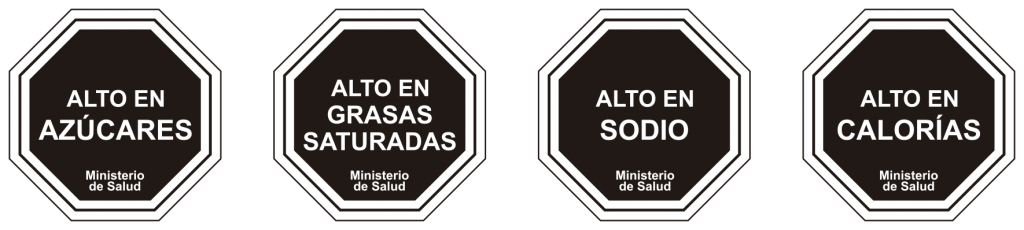
(From left to right: high in sugars, saturated fats, sodium and calories)
After satisfying the general labeling requirements, enterprises shall check the rules listed in Part 3 regarding their specific products, such as Law 21363 on the marketing and advertising of alcoholic beverages; Decree 98 for alcohol products, etc.
6.2 Claims
Claims in Chile include nutritional and health claims:
Nutritional claim: A representation that claims, suggests, or implies a food product has specific nutritional properties, such as its energy value, protein, fat, or carbohydrate content, or its content of vitamins, minerals, and other dietary factors.
A list of permitted nutritional claims can be found in Food Sanitary Regulations (Article 120), including “low sodium”, “high calcium”, “zero trans fat acid”, etc.
Health claim: A representation that claims, suggests, or implies a relationship between a food, a nutrient, or another substance in a food and a health-related condition. Health claims must be scientifically recognized or internationally agreed upon and must be framed within technical standards on nutritional guidelines approved by a resolution of the Ministry of Health.
Approved health claims and their use conditions can be found in Resolution 860 Exempt, Approving Technical Standard No. 191 on Nutritional Guidelines for Declaring the Health Properties of Foods, e.g., “Diets low in total fat may reduce the risk of some cancers. The development of cancer depends on many risk factors."
*Global Food Compliance Service
We provide various market entry services to help stakeholders better understand exporting requirements, establish business and secure a competitive place to facilitate trade development.
Covered Countries
China, Thailand, Vietnam, Singapore, Malaysia, Philippines, Indonesia, Japan, South Korea, United States, European Union, Australia, New Zealand etc.
Our Services
Food Ingredient Review
Label Review
Product Registration
Regulatory Consultation
Monitoring, Training and customized report
Please feel free to contact us via [email protected] if you need any help.


