

 Request a Demo
The United States represents one of the largest and most commercially attractive consumer food markets in the world, offering substantial growth opportunities for international food enterprises. Successfully entering this market requires a comprehensive understanding of its complex, multi-layered regulatory environment. The U.S. regulatory system operates under a hybrid model, which imposes strict pre-market authorization requirements for certain ingredients and product categories, while placing significant emphasis on post-market surveillance and manufacturer accountability.
1. Competent Authorities
The U.S. food safety regulatory system involves multiple federal agencies with distinct yet complementary roles. The table below outlines the primary federal agencies governing the U.S. food supply:
Agency | Primary Responsibility |
|---|---|
Food and Drug Administration (FDA) |
|
United States Department of Agriculture - Food Safety and Inspection Service (USDA-FSIS) |
|
Environmental Protection Agency (EPA) |
|
Customs and Border Protection (CBP) |
|
Centers for Disease Control and Prevention (CDC) | Although not a direct regulatory agency for food products, the CDC plays a critical role in food safety surveillance, outbreak investigation, and response to foodborne illness incidents. |
2. Regulatory Framework
The legal foundation of U.S. food safety is built upon several landmark statutes and implementing regulations. Effective compliance requires a working knowledge of both laws enacted by Congress and regulations codified in the Code of Federal Regulations (CFR).
Names of Laws and Regulations | Briefly Introduction |
|---|---|
The foundational statute prohibiting the introduction of adulterated or misbranded food into interstate commerce; defines key terms and establishes FDA enforcement authority. | |
Shifts U.S. food safety framework from response to prevention; introduces several foundational rules, including Preventive Controls for Human Food, Food Traceability requirements, and the Foreign Supplier Verification Program (FSVP). | |
Establishes sanitary and operational requirements for food facilities covering personnel, plant and grounds, sanitary operations, equipment, and processes. | |
Requires covered food facilities to conduct hazard analyses and implement risk-based preventive controls. | |
Requires U.S. food importers to perform risk-based verification activities to ensure imported food is produced by foreign suppliers in a manner that provides the same level of public health protection as domestically produced food. | |
Mandates registration of all domestic and foreign facilities that manufacture, process, pack, or hold food for consumption in the U.S. | |
Requires submission of prior notice to the FDA before food shipments arrive in the United States, subject to specified timelines and data requirements | |
Prescribes mandatory labeling elements and regulates food labeling claims. | |
Establishes requirements for nutrient declarations and nutrition facts panel format. | |
Standards of Identity (21 CFR Parts 130-169) | Defines compositional requirements for standardized foods. |
Food Additive Regulations (21 CFR Parts 170-180) | Lists permitted food additives and governs pre-market approval requirements for new food additives. |
GRAS Regulations (21 CFR Parts 182-186) | Lists substances generally recognized as safe and provides the regulatory framework for GRAS determinations. |
Color Additive Regulations (21 CFR Parts 70-82) | Lists color additives subject to certification and exempt from certification, and governs pre-market approval of new color additives. |
Dietary Supplement Regulations (21 CFR Part 111, 21 CFR Part 190) |
|
More rules and regulations…… | |
3. Market Access
3.1 Product Registration
Most conventional prepackaged foods do not require product-specific registration or pre-market approval from FDA. However, certain categories are subject to pre-market authorization requirements, such as infant formula and low-acid canned foods.
Example: new infant formula requires pre-market submission under 21 CFR Part 106
1) New infant formula registration
Before a new infant formula may be introduced into interstate commerce, the manufacturer shall register with the FDA. The registration shall include:
The name of the new infant formula;
The name of the manufacturer;
The street address of the manufacturer's place of business;
The name and street address of each establishment where the formula will be manufactured.
Manufacturers may register at any time prior to market introduction. The FDA recommends submitting the registration concurrently with the new infant formula submission(described below) to facilitate review.
2) New infant formula submission
At least 90 days before introducing a new infant formula into interstate commerce, the manufacturer shall submit notice to the FDA of its intent to market the product. The submission must include:
Product name and description of physical form
Explanation of why the product qualifies as a new infant formula
Quantitative formulation
Description of any reformulation or processing changes, if applicable
Assurances that the infant formula will not be marketed unless it meets the quality factors under 21 CFR 106.96 and 21 CFR 106.121, and the nutrient requirements under 21 CFR 107.100
Assurances that processing complies with section 412(b)(2) of the FD&C Act
3) Verification submission
After first production and before marketing, the manufacturer shall submit written verification to the FDA, including:
Name of the new infant formula, filing date and identification number of the new infant formula submission
Statement confirming the marketed product is the same as the product which has gone through the new infant formula submission
Summary of nutrient test results
Certification that current good manufacturing practices have been established and implemented
3.2 FDA Food Facility Registration
Under the Bioterrorism Act of 2002, as amended by the FSMA, all domestic and foreign facilities that manufacture, process, pack, or hold food for human or animal consumption in the United States must register with the FDA. Key requirements include:
A Unique Facility Identifier (UFI), typically a D-U-N-S number, prior to registration
Foreign facilities must designate a U.S. agent as the primary contact with the FDA
Registration must be submitted through FDA Industry Systems (FURLS FFRM)
Required registration information includes facility details, parent company information, U.S. agent information, food categories, types of activities for each category, and relevant statements, etc.
Biennial renewal between October 1 and December 31 of each even-numbered year
Failure to register results in refusal of imported food
Detailed registration requirements are specified in the 21 CFR Part 1 Subpart H. FDA guidance on registration process can be found in the Step-by-Step Instructions for Registration.
3.3 Foreign Supplier Verification Program (FSVP)
The FSVP places primary responsibility for imported food safety verification on the U.S. importer. The importer shall:
Conduct a hazard analysis for each imported food (biological, chemical, and physical hazards)
Evaluate food risk and supplier performance including:
The hazard analysis
The entity that will be significantly minimizing or preventing the hazards, such as the foreign supplier or the supplier's raw material or ingredient supplier
A foreign supplier's procedures, processes and practices related to the safety of food,
Applicable FDA food safety regulations, and information regarding the foreign supplier's compliance
The foreign supplier's food safety history, including the responsiveness of the foreign supplier in correcting past problems
Other factors as necessary
Determine appropriate supplier verification activities (e.g., onsite auditing, sampling/testing, records review)
Conduct verification activities as required
Conduct corrective actions when applicable
Maintain FSVP records and make them available to FDA upon request
The evaluation of the risk posed by the imported food and the supplier's performance must be reevaluated at least every three years, or when new information comes to light about a potential hazard or the foreign supplier's performance.
More verification requirements are specified in the 21 CFR Part 1 Subpart L and FDA guidance.
3.4 FDA Prior Notice
Before any food shipment arrives at a U.S. port of entry, the FDA requires advance notification, known as Prior Notice. This must be submitted electronically by any person with knowledge of the required information via the FDA's Prior Notice System Interface (PNSI) or through the CBP's Automated Broker Interface (ABI). Information required in a prior notice are specified in the 21 CFR 1.281.
Prior notice must be submitted no more than 15 days before arrival and no less than:
2 hours before arrival by road
4 hours before arrival by rail
4 hours before arrival by air
8 hours before arrival by water
More requirements are specified in the 21 CFR Part 1 Subpart I and FDA guidance
3.5 Import Restrictions and Import Certification
While most FDA-regulated foods do not require specific pre-market import permits, certain milk products (including milk and cream) shall apply for permits under the Federal Import Milk Act.
In addition, meat, poultry, and egg products must originate from USDA certified countries and establishments, and are subject to FSIS inspections upon entry.
Where systemic food safety concerns exist in a region, or where contamination risks arise from natural disasters or other incidents, the FDA may require import certification issued by FDA-designated certifying entities for affected products.
3.6 Import Process
Upon arrival, food shipments are subject to the following review process:
Entry submission to CBP and then reviewed by the FDA for FDA-regulated products (Details on entry submission can be found on FDA guidance.)
Prior notice verification by the FDA
FDA admissibility review – may result in:
May proceed – no further action required
Physical examination – sample collection and laboratory analysis
Detention – held pending demonstration of compliance
Import Alert – automatic detention without physical examination (DWPE)
4. Product Standards
4.1 Standards of Identity
Standards of Identity are detailed federal regulations that define the mandatory composition, allowable ingredients, and manufacturing processes for specific food categories. If a product is marketed under a standardized name (e.g., "sweetened condensed milk," "white chocolate"), it must strictly adhere to the recipe mandated by law. Use of a standardized name for a non-conforming product may render the product misbranded and/or adulterated under the FD&C Act. Nevertheless, manufacturers may deviate from a standard pursuant to the 21 CFR 130.10, where the deviation is associated with an authorized nutrient content claim and the substitute food demonstrates similar performance characteristics to the standardized food.
FDA has established standards of identity for approximately 300 food products, primarily codified in 21 CFR Parts 130 through 169. Key standards include:
Milk and Cream: 21 CFR Part 131
Cheese and Cheese Products: 21 CFR Part 133
Bakery Products: 21 CFR Part 136
Cereal Flours and Related Products: 21 CFR Part 137
Canned Fruits: 21 CFR Part 145
Fruit Butters, Jellies, Preserves: 21 CFR Part 150
Canned Vegetables: 21 CFR Part 156
Eggs and Egg Products : 21 CFR Part 160
Cacao Products: 21 CFR Part 163
Beverages: 21 CFR Part 165
……
For imported products, standards of identity are a common area of enforcement focus, particularly where foreign product names or formulations differ from U.S. legal definitions.
4.2 Hygiene Standards
Unlike many jurisdictions that maintain a unified maximum residue limit (MRL) framework across contaminants, the United States regulates contaminants through multiple legal mechanisms depending on the substance and risk profile. Generally, contaminant levels are established through tolerances and action levels (as defined in 21 CFR Part 109 ), as well as other types of levels (e.g. guidance levels, derived intervention levels, recommended maximum levels, and advisory levels) which are not defined in the regulation but have been used to advise industry on levels of contamination that may pose a health risk or may be avoidable through good manufacturing practices.
Tolerances for pesticide residues in foods set by EPA: 40 CFR Part 180
Action levels and other levels set by FDA
Integrated Guidance Documents for Chemical, Metals, Natural Toxins & Pesticides
Integrated Guidance Documents for Bottled Water
Action levels for undesirable microorganisms in food generally focus "zero tolerance" for pathogens like Salmonella and Listeria monocytogenes.
CPG Sec 555.300 Foods, Except Dairy Products - Adulteration with Salmonella
CPG Sec. 555.320 Listeria monocytogenes
The FDA's Chemical Contaminants Transparency Tool provides a consolidated list of contaminant levels that are used to evaluate potential health risks of contaminants in human foods.
Contaminant type included:
Persistent Pesticides (residues of cancelled pesticide chemicals that persist in the environment)
5. Ingredient Compliance
5.1 Existing Compliant Ingredients
In the United States, only ingredients authorized by the FDA as permitted food additives, or substances that are Generally Recognized as Safe (GRAS) may be lawfully used in foods.
For dietary supplements, an ingredient must generally qualify as a lawful dietary ingredient under the Dietary Supplement Health and Education Act of 1994 (DSHEA). A dietary ingredient is either an old dietary ingredient marketed before October 15, 1994, or a new dietary ingredient subject to premarket notification.
The table below summarizes ingredient categories:
Ingredient Category | Regulatory Basis | Notes |
|---|---|---|
Food Additives |
| |
GRAS Substances |
| |
Color Additives |
| Ongoing phase-out of petroleum-based synthetic dyes from the U.S. food supply |
Dietary Ingredients |
|
|
5.2 Compliance Pathways for New Ingredients
If a manufacturer intends to introduce a new ingredient, or expand the use of an existing ingredient beyond its currently authorized conditions of use, they must secure market access through one of the following legal pathways:
Pathway | Applicability | Key Requirements | FDA Compliance Result |
|---|---|---|---|
Food Additive Petition (FAP) |
| Regulation listing use in 21 CFR 172 or 173 | |
FDA GRAS Notice | Substances that can be established as GRAS through scientific procedures | "No Question" letter | |
Self-Affirmed GRAS (may be eliminated)* | Substances that can be established as GRAS through scientific procedures | Scientifically identical scope of documentation, but may not necessarily be the same in format as FDA GRAS Notice | N/A (self-affirmed) |
Color Additive Petition (CAP) |
| Regulation listing use in 21 CFR 73 or 74 | |
New Dietary Ingredient Notification (NDIN) | Dietary ingredients not marketed in U.S. before October 15, 1994 | "No Objection" letter |
Notes
In March 2025, HHS Secretary Robert F. Kennedy Jr. directed FDA to explore rulemaking to eliminate the self-affirmed GRAS pathway, requiring all GRAS determinations to be submitted as FDA GRAS Notices. In the FDA 2026 Priority Deliverables, the key actions planned for 2026 includes a proposed regulation to mandate the submission of GRAS notices to the FDA for all substances claimed to be GRAS. This signals a fundamental shift that will significantly increase the regulatory burden for new ingredient compliance.
6. Labeling
Food labeling is one of the most heavily scrutinized areas by the FDA. All mandatory labeling information must be presented in English and formatted in accordance with detailed requirements set out in 21 CFR Part 101.
Mandatory labeling items for general prepackaged foods are as follows:
Statement of identity: name specified by federal law, common or usual name, or appropriately descriptive term reflecting the true nature of the food
Net quantity of contents: must be expressed in U.S. customary units; metric units are strongly recommended in practice
Ingredient declaration: in descending order of predominance by weight
Name and address of the manufacturer, packer, or distributor: country of origin statement required for imported foods
Nutrition facts label
Allergen statement for major food allergens (milk, eggs, fish, crustacean shellfish, tree nuts, peanuts, wheat, soybeans, and sesame)
Product specific declaration if applicable
The statement of identity and net quantity of contents must appear on the Principal Display Panel (PDP). Other labeling items shall appear either on the principal display panel or on the information panel.
Nutrition facts label
Nutrition labeling is required for most prepackaged foods intended for human consumption unless a specific exemption applies.
Name and sequence of mandatory nutrients are as follows:
Calories (may be expressed in kj)
Total fat (g)
Saturated fat (g)
Trans fat (g)
Cholesterol (mg)
Sodium (mg)
Total carbohydrate (g)
Dietary fiber (g)
Total sugars (g)
Added sugars (g)
Protein (g)
Vitamin D (mcg)
Calcium (mg)
Iron (mg)
Potassium (mg)
Nutrient content shall be declared on a per serving basis in relation to the applicable serving size derived from the Reference Amount Customarily Consumed Per Eating Occasion under 21 CFR 101.12. In addition, the nutrient content shall also be declared as a percentage of the Daily Reference Value (DRV) or Reference Daily Intake (RDI) as appropriate, and expressed as a Percent of Daily Value (%DV).
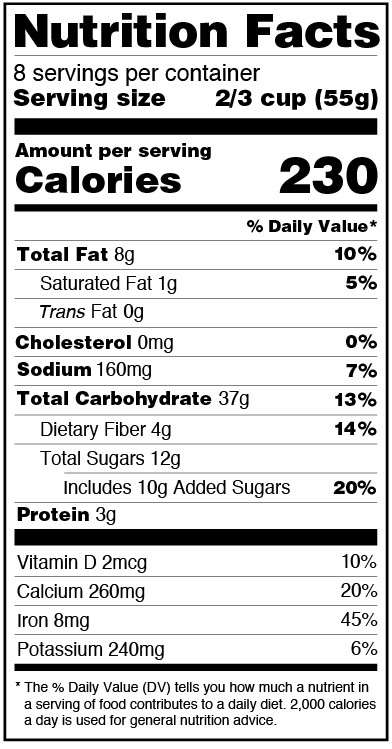 Nutrition Facts Label
* Global Food Compliance Service
We provide various market entry services to help stakeholders better understand exporting requirements, establish business and secure a competitive place to facilitate trade development.
Our Services
Food Ingredient Review
Label Review
Product Registration
Regulatory Consultation
Monitoring, Training and Customized Report
Particularly, if you're still unsure about the GRAS process or would like to explore it further, our team is here to help. We offer professional consulting and tailored support to guide food companies through GRAS-related challenges, including:
GRAS Certification Consulting & Training
Self-Affirmed GRAS
FDA Notified GRAS
Please feel free to contact us via [email protected] if you need any help.
