

 Request a Demo
The U.S. Food and Drug Administration (FDA) regulates approximately 80% of the U.S. food supply and plays a key role in food safety oversight. Under the FDA, the Center for Food Safety and Applied Nutrition (CFSAN) houses the Office of Food Additive Safety (OFAS), which reviews the safety of food ingredients and packaging.
This pedia provides an overview of Generally Recognized as Safe (GRAS), a specific regulatory classification for food ingredients, covering its historical development, GRAS classification, as well as the application process and requirements.
What Are GRAS Substances?
"Generally recognized as safe" means that the safety of a substance under its intended conditions of use is supported by scientific evidence, and generally recognized by qualified experts trained and experienced in evaluating the safety of food ingredients.
Based on their intended use, GRAS substances are typically categorized as follows:
GRAS substances directly added to human food
GRAS substances indirectly added to human food (e.g., through food contact materials)
GRAS substances used in animal food and feed
Others
In most cases, when industry stakeholders refer to "GRAS substances," they are specifically referring to those directly added to human food.
GRAS' Historical Development
The GRAS concept originated from the Food Additives Amendment to the Federal Food, Drug, and Cosmetic Act (FD&C Act), enacted in 1958. This amendment requires premarket approval for new food additives and established safety evaluation standards. In addtion, a list of hundreds of substances was created as exemption. These substances, either supported by a long history of safe use or reviewed by qualified scientific experts, were classified as "Generally Recognized as Safe" (GRAS).
In the early years, if a substance was not on the GRAS list, manufacturers shall write to the FDA for clarification, and would get an informal reply from the FDA. However, this approach lacked transparency and consistency, and it was phased out in the 1970s.
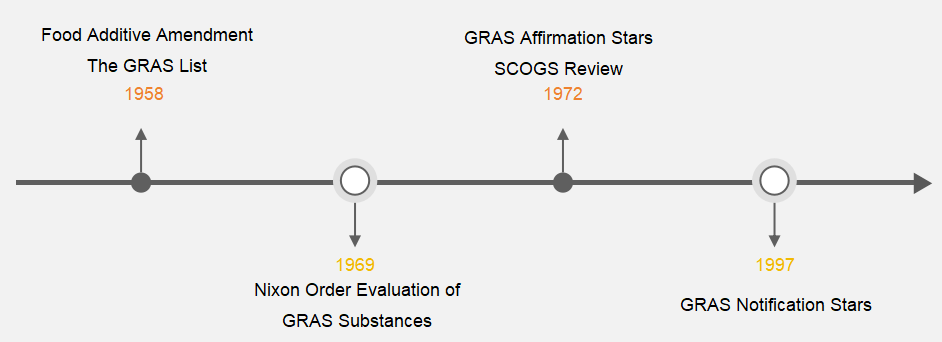
During the 1960s, concerns over the artificial sweetener cyclamate's potential link to cancer led to its removal from the GRAS list. This incident sparked widespread doubt about the adequacy of GRAS’ evidence. In response, President Nixon ordered a comprehensive re-evaluation of GRAS substances in 1969. The FDA commissioned the Life Sciences Research Office (LSRO), an independent body of scientific experts with no ties to industry or government, to conduct a rigorous review.
To formalize GRAS reviews, in 1972, the FDA introduced a process called the GRAS Affirmation Petition, allowing individuals and enterprises to petition the FDA to evaluate and affirm a substance as GRAS. Throughout the 1970s and 1980s, the FDA conducted extensive reviews based on reports from the Select Committee on GRAS Substances (SCOGS). The process was thorough but extremely resource-intensive. By 1982, only around 400 substances had been re-evaluated. The long approval timeline (usually five to six years, even more) became a significant barrier to the innovation for food companies and placed a heavy workload on the FDA.
To address these issues, the FDA introduced the GRAS Notification Program in 1997, shifting the responsibility of safety evaluation to the applicant. Instead of requesting FDA review, enterprises could choose to self-determine a substance's GRAS status based on scientific literature and expert opinion, then notify the FDA. The agency would review the notification and respond with a "no questions" letter if satisfied, or raise concerns if evidence was insufficient. Applicants could also voluntarily withdraw their notification.
Since then, the GRAS notification process has become the dominant method. It reduced FDA's workload and significantly shortened the review timeline, on average, to less than six months.
However, HHS is now proposing to end the self-affirmed GRAS pathway to enhance transparency and FDA oversight. (Read more)
GRAS Classification
Currently, there are two ways to obtain GRAS status:
Self-Affirmed GRAS, where enterprises determine on their own that a substance is safe without notifying the FDA, and
FDA-Notified GRAS, where enterprises submit a GRAS notice to the FDA for review and public record.
Self-Affirmed GRAS | FDA-Notified GRAS | |
Advantage | Allows applicants to protect proprietary data and formulation details. | Provides official FDA review and a “no questions” letter, enhancing credibility and regulatory confidence. |
Disadvantage | Lacks FDA confirmation, which may reduce authority and credibility. | Requires full public disclosure of supporting data, which may compromise proprietary or competitive information. |
GRAS Process Overview
Although both Self-Affirmed and FDA-Notified GRAS determinations involve similar scientific evaluation processes, the latter includes a formal notification to the FDA for review and response.
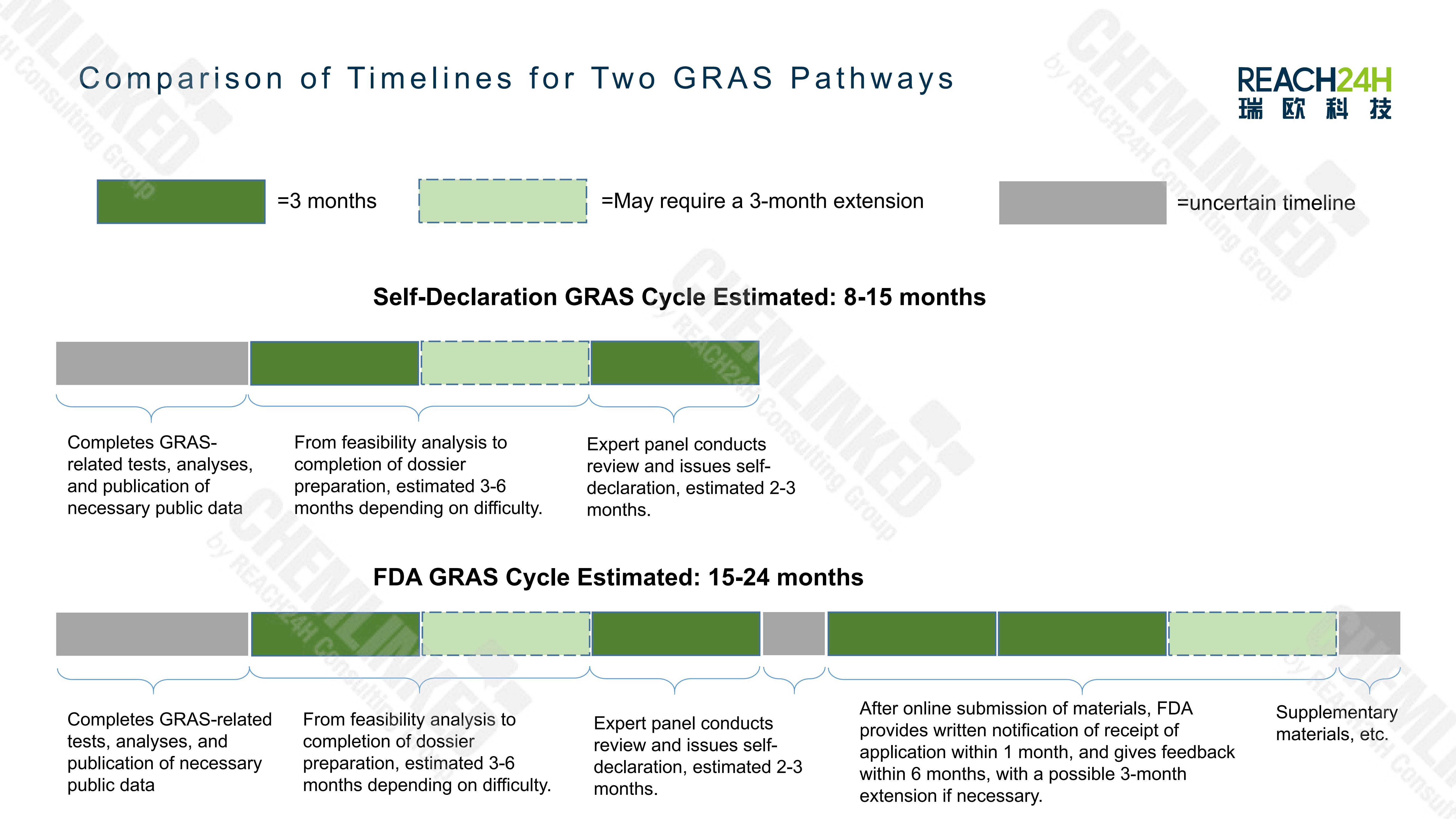
Whether applying a Self-Affirmed GRAS or an FDA-Notified GRAS, regulatory authorities do not charge administrative fee. However, associated costs vary depending on the specific substance and the availability of existing data, thus cannot be uniformly estimated. Typical expenses may include testing costs, dossier preparation services, and expert consultation fees. REACH24H Consulting Group, the parent company of ChemLinked, offers professional GRAS services. For more details, please visit this link. Should you require any assistance, feel free to reach out to us at [email protected], where we can provide a complimentary pre-assessment service for your substances.
GRAS Application Materials
To support a GRAS conclusion, applicants must prepare a comprehensive dossier in English. The key components generally include the following:
1. Signed Statements and Declarations
This section provides basic information about the notifier (and agent, if any) and the substance being evaluated.
2. Substance Information
Detailed substance information is the most essential part of a GRAS submission, which includes identification, manufacturing process, specifications, and physical/technical effect. FDA has raised objections in over half of cases due to insufficient detail in this section.
Identification:
The method of identification must reliably characterize the substance, particularly important for botanically derived materials.
Manufacturing Process:
A step-by-step description of the manufacturing process, including processing parameters and compliance with U.S. current Good Manufacturing Practices (cGMP), is required. If the process involves genetic modification or chemical synthesis, details must be provided, including the use of solvents and potential presence of heavy metals.
Specifications:
Specifications should be based on the substance's characteristic, manufacturing process, and raw materials. These may include solvents, heavy metals, microbial content, and mycotoxins. If standards from international or national bodies exist, they should be referenced. Analytical data from at least three non-consecutive production batches must be submitted.
3. Dietary Exposure Assessment
Dietary exposure assessment is a quantitative evaluation of the estimated intake of the substance from all sources, including the current dietary consumption patterns, other relevant exposure routes, and the proposed conditions of use. The FDA considers this estimated intake alongside toxicological data when determining the safety of the substance.
4. Self-Limiting Levels of Use
If applicable, manufacturers should provide an explanation of any self-limiting characteristics of the substance. These may include factors such as taste or odor that discourage consumption when present at certain levels, or technical limitations that make use above a certain level impractical.
5. History of Consumption
Evidence that the substance has been consumed in food prior to 1958 by a significant number of people may support GRAS status. If such data are unavailable, documented safe use in food over the past several decades (including outside the U.S.) may be referenced.
6. Safety Evaluation
The safety evaluation focuses on demonstrating the safety of the substance based on available data. In general, a combination of toxicological research and relevant consumption history (not necessarily limited to pre-1958 use) may be used to support the safety conclusion.
Toxicological Data:
Includes acute, subchronic (e.g., 90-day), and genotoxicity studies. Additional data such as clinical studies or ADME (Absorption, Distribution, Metabolism, and Excretion) are also valuable.
Published Literature:
To meet GRAS requirements, the safety of the substance must be generally recognized by qualified experts, based on scientific procedures and peer-reviewed evidence. Therefore, a key part of the safety evaluation involves compiling and analyzing publicly available information, which includes scientific publications authored by both the applicant and independent parties, as well as safety assessments by international authorities and other credible sources.
Applicants are expected to conduct a comprehensive review of the available literature and provide a balanced discussion of the evidence, including not only studies that support the safety of the substance, but also those that present contrary or negative findings.
Allergen:
If the substance or raw materials contain proteins or potential allergens, allergenicity studies and assessments must be included.
Significantly, applying a GRAS determination (especially for FDA-notified GRAS) means a high level of transparency. Supporting data such as proprietary studies, manufacturing process, and technical specifications may be subject to public disclosure.
Even if applicants attempt to conceal sensitive information, the FDA often issues follow-up questions requesting additional clarification. At that point, companies must choose between disclosing further details or withdrawing the GRAS notification. Therefore, we recommend applicants assess the risks and benefits in advance, and develop contingency plans before initiating the process.
Our Compliance Services
If you're still unsure about the GRAS process or would like to explore it further, our team is here to help. REACH24H offer professional consulting and tailored support to guide food companies through GRAS-related challenges, including:
GRAS Certification Consulting & Training
Self-Affirmed GRAS
FDA Notified GRAS

We are pleased to introduce our Regulatory Pathways for Novel Food Ingredients Worldwide. This guide provides a systematic overview of the regulatory frameworks for novel food ingredients in key markets, including China, the USA, the EU, Australia-New Zealand, Japan, South Korea, and Southeast Asia.
Key sections include:
Regulatory Frameworks & Authorities
Approval Processes & Documentation
Key Compliance Strategies
Download Your Free Copy Now from here
If you need assistance, please contact us at [email protected], and we can provide a free pre-assessment service for substances.


