

 Request a Demo
Since the departure from the European Union (EU), the United Kingdom (UK)'s food regulatory framework remains anchored by retained EU legislation, overseen primarily by the Food Standards Agency (FSA) and the Department for Environment, Food & Rural Affairs (DEFRA), with local authorities enforcing day‑to‑day controls. The UK now has a mechanism to selectively update or remove these inherited rules, allowing it to customize its food safety system. This ensures the UK can maintain strong consumer protections and trade standards.
Foods exported to Great Britain (England, Scotland, and Wales) must adhere to UK regulations. However, food products destined for the Northern Ireland market remain subject to EU food law. This Pedia focuses specifically on regulations applicable to Great Britain.
1. Competent Authority
The UK's food regulatory system is managed by a network of government bodies, each with distinct responsibilities:
Competent Authority | Main Obligations |
Food Standards Agency (FSA) | The primary body for England, Wales, and Northern Ireland, responsible for food safety, hygiene, labeling, and composition standards. The FSA conducts risk assessments, enforces regulations, and oversees local authority inspections. |
Food Standards Scotland (FSS) | Scotland's equivalent authority, with similar responsibilities tailored to Scotland's devolved governance, including nutrition policy and dietary health. |
Department for Environment, Food and Rural Affairs (DEFRA) | It oversees broader food policy, including trade, import controls, and environmental standards impacting food production. |
Local Authorities | They enforce food safety and hygiene regulations through inspections of food businesses, coordinated by the FSA and FSS. |
2. Main Regulations
The UK's food regulatory framework is underpinned by several key pieces of legislation, many of which were retained or adapted from EU law post-Brexit:
Legislations | Main Contents |
The cornerstone of UK food law, establishing requirements for food safety, consumer protection, and enforcement powers for authorities. | |
It establishes the overarching principles, requirements, and procedures for food and feed safety across all stages of production and distribution, serving as the fundamental framework for decision-making in matters of food safety. | |
It sets rules on food additives, including their use, labelling, and authorization. It aims to ensure a high level of consumer protection and fair practices in food trade. | |
It implements the common authorization procedure for food additives, food enzymes, and food flavorings. | |
It outlines general requirements for the safe use of flavorings and food ingredients with flavoring properties. | |
Retained EU Regulation (EC) No 2065/2003 on Smoke Flavorings | It sets rules for the use of smoke flavorings in foods, including safety assessments, authorization, and a system for ensuring effective functioning. |
It outlines requirements for the EU list of approved food enzymes, conditions of use, and labeling, ensuring enzymes are safe, necessary, and don't mislead consumers. | |
Retained Regulation (EC) No. 1169/2011 on Food Information to Consumers | It specifies the rules for providing food information to consumers in the UK, covering various aspects of food labeling, including mandatory information and allergen declarations. |
Retained EU Regulation (EC) No 1924/2006 on Nutrition and Health Claims Made on Food Labels | It regulates nutrition and health claims made on food labels, presentation, and advertising in the UK. |
It defines novel foods, clarifies the scope of the regulation, and streamlines the evaluation and approval process for novel foods. | |
It implements EU legislation regarding maximum permitted levels of contaminants in food in England (similar regulations apply in Wales, Scotland, and Northern Ireland). |
3. Market Access Approval
In Great Britain (GB), most food products do not require a specific market access approval before being placed on the market, with the exception of regulated products and foods for special groups.
3.1 Market Authorization (Regulated Products)
Certain food and feed products, called regulated products, must go through a risk analysis process, and require market authorization before they can be sold in GB market. These products include flavorings, smoke flavorings, food additives, food enzymes, GMOs, novel foods, etc. Once authorized, most regulated product types are listed in online registers which also specify their permitted uses.
Applications for such authorizations are submitted through a online regulated products application portal. Notably, there is no fee for submitting an application. A comprehensive dossier is required for submission, typically comprising two main parts:
1. Administrative information, which shall include information related to the applicant, the person responsible for the product or process, and the contacts.
2. Technical and safety information, which shall include information about the product or process and how it is intended to be used.
For novel foods, for example, the full set of information listed below must be submitted:
Item | Information |
1 | Administrative data, such as information relating to the applicant |
2 | Identity of the novel food |
3 | Production process |
4 | Compositional data |
5 | Specifications |
6 | History of use of the novel food and/or of its source |
7 | Proposed uses and use levels and anticipated intake |
8 | Absorption, distribution, metabolism and excretion |
9 | Nutritional information |
10 | Toxicological information and allergenicity |
11 | Glossary or abbreviations of terms quoted throughout the dossier |
12 | Certificates (on the accreditation of laboratories, certificates of analyses) |
13 | Full copies / reprints of all pertinent scientific data (published and unpublished) |
14 | Full study reports |
15 | Scientific opinions of national/international regulatory bodies |
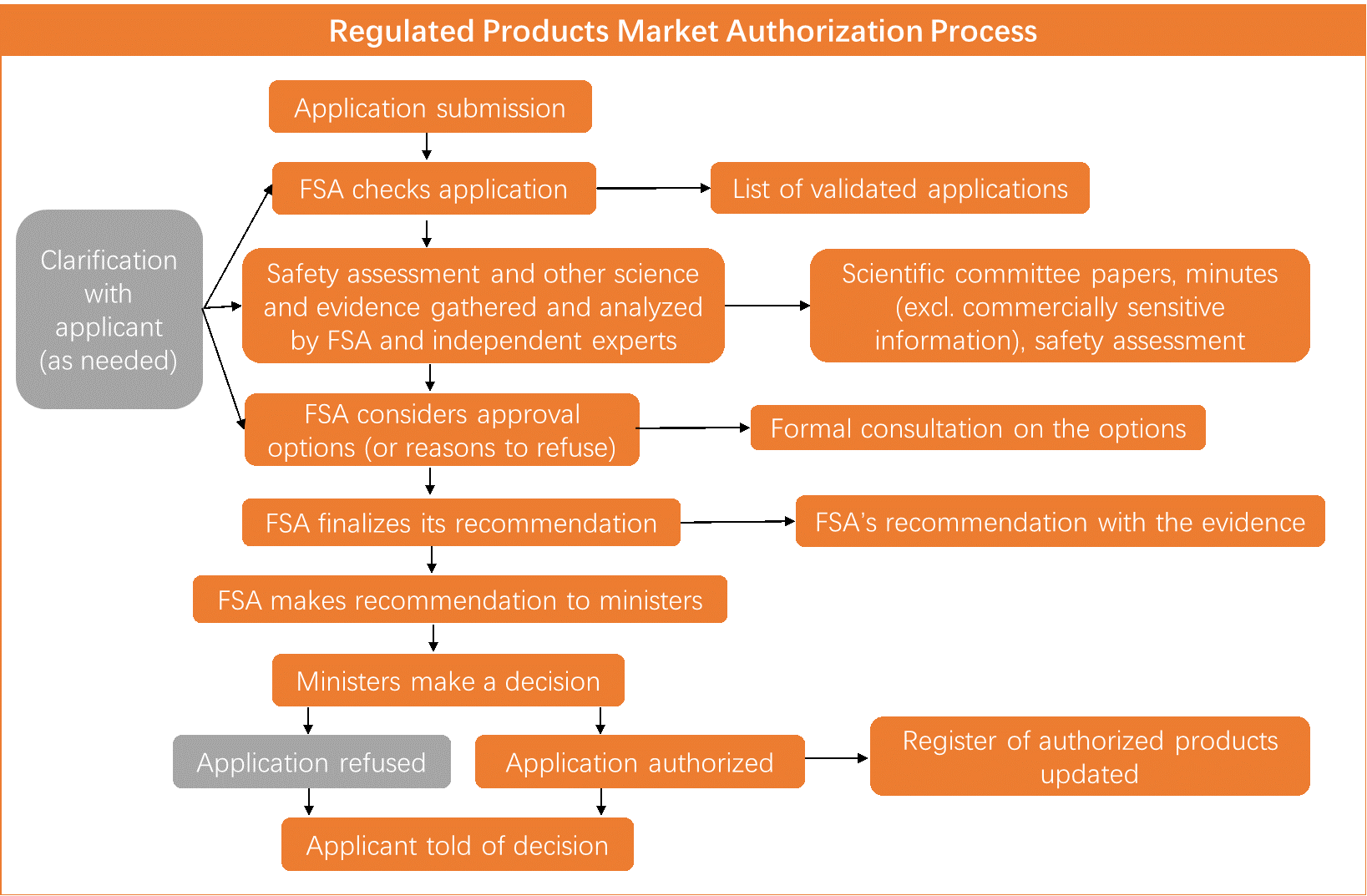
After submitting the application, the FSA will collaborate with FSS and other government departments for the assessment. The entire procedure for market authorization applications is outlined below:
3.2 Product Notification (Foods for Specific Groups)
For foods intended for specific groups, such as infant formula, follow-on formula, and foods for special medical purposes, a notification process is required. Food business operators (manufacturers or importers) must notify the competent UK authority when:
New products are placed on the GB market for the first time.
Changes are made to the formulation of products already on the GB market.
New ingredients are added to products already on the GB market.
Notification forms are to be sent via email to the Department of Health and Social Care (DHSC). The information generally required in the form includes three main parts:
1) Product details such as product name, product category and descriptions;
2) Local authority details;
3) Manufacturer or importer details such as contact information.
It is important to note that a separate form, accompanied by a copy of the product label, must be completed for each product. After reviewing the notification form and product label, the DHSC may, if necessary, request further information from the importer or manufacturer regarding the product's compliance with legislation.
4. Food Import Requirements
The UK implements varying import requirements based on food categories. This Pedia focuses on major food categories subject to specific import requirements.
4.1 High Risk Foods
In GB, food products are classified as high-risk if they contain contaminants (e.g., mycotoxins and aflatoxins), pesticides, or microorganisms that pose a risk to public health (e.g., Salmonella and Listeria). Examples include:
Groundnuts such as peanuts in shell from Bolivia or Madagascar
Dried figs from Turkey
Herbs such as mint and basil from Israel
The latest catalogue of high risk foods can be found at here.
Before importing high risk foods, importers must pre-notify GB authorities via the Import of Products, Animals, Food and Feed System (IPAFFS) at least one working day before the goods are expected to arrive at the point of entry. It is crucial to note that high-risk food products can only be imported through designated Border Control Posts (BCPs). At BCPs, documentary checks are mandatory, and physical checks may be required prior to release. Furthermore, if high-risk ingredients constitute more than 20% of the final product, the food will also be subject to import checks.
4.2 Products of Animal Origin (POAO)
For Products of Animal Origin (POAO) such as meat, eggs, dairy, honey, and gelatin, imports into GB are restricted to products originating from a list of approved countries. Only competent authorities in the exporting countries can apply for approval to export animals and animal products to GB. To apply for or amend such approval, these authorities must email the UK Office for Sanitary and Phytosanitary (SPS) Trade Assurance.
In addition to country-level restrictions, animal products must also originate from a list of approved establishments to enter GB. To apply for or amend establishment approval, food establishments should contact their local competent authorities, who will then email the UK Office for Sanitary and Phytosanitary (SPS) Trade Assurance with a completed request form.
Significantly, the UK government has introduced the Border Target Operating Model (BTOM) as a new system of import controls for live animals, germinal products, POAO, animal by-products, plants, and plant products. Under the BTOM, all products are categorized as high, medium, or low risk, depending on the specific commodity and its country of origin. Notably, all POAO are classified as either low or medium risk. Stakeholders are required to check the risk category of each commodity, as different risk levels dictate varying documentation requirements and inspection rates.
Risk Level | Product Examples | Required Documents | Pre-notification Requirements | Inspection Rates |
Medium Risk |
| Export Health Certificates (click to view the samples) | Must notify the Animal and Plant Health Agency (APHA) via IPAFFS at least one working day before the consignment is due to arrive. |
|
Low Risk |
|
| Must notify the Animal and Plant Health Agency (APHA) via IPAFFS at least one working day before the consignment is due to arrive. |
|
4.3 Composite products
A composite product is defined as a foodstuff intended for human consumption that contains both processed products of animal origin and products of plant origin.
Composite products must originate from countries approved for the POAO they contain and must have an approved veterinary residue plan as required by Decision 2011/163/EU. The meat, milk, egg, and fishery product content within the composite product must also originate from an approved country and, where appropriate, from an approved establishment. These products must be accompanied by the relevant official certificate, as specified in Regulation 2019/628, if they contain processed meat, milk, egg, or fishery products. Composite products containing any other animal product require the relevant certificate for that animal content or, in other cases, a commercial document.
Composite products are generally subject to veterinary checks at BCPs. However, a composite product that contains no processed meat product and less than half its substance from other processed POAO is exempt from veterinary checks at BCPs. Other exemptions include:
Confectionery (including sweets) and chocolate containing less than 50% of processed dairy and egg products.
Pasta and noodles not mixed or filled with processed meat product, and containing less than 50% of processed dairy and egg products.
Bread, cakes, biscuits, waffles and wafers, rusks, toasted bread, and similar toasted products that contain less than 20% of processed dairy and egg products.
Olives stuffed with fish.
Soup stocks and flavorings packaged for the final consumer that contain less than 50% of fish oils, fish powders, or fish extracts.
Food supplements packaged for the final consumer which contain small amounts (in total less than 20%) of processed animal products other than meat products.
5. Product Standards
The UK enforces mandatory compositional standards for various food categories to ensure quality, consistency, and consumer protection. These standards are detailed in specific regulations, primarily focusing on product composition and labeling rules, especially for foods at risk of substitution with lower-quality alternatives.
Below is a table summarizing key food categories and their standards in England; however, similar rules apply across the entire UK.
Food Category | Regulation |
Bottled Water | The Natural Mineral Water, Spring Water and Bottled Drinking Water (England) Regulations 2007 |
Bread and Flour | |
Cocoa and Chocolate | |
Fruit Juices and Nectars | |
Honey | |
Jams and Marmalade | |
Milk Products | |
Products Containing Meat | The Products Containing Meat etc. (England) Regulations 2014 |
Soluble Coffee | The Coffee Extracts and Chicory Extracts (England) Regulations 2000 |
Sugars | |
Food Supplements | |
Infant Formula and Follow-on Formula |
All the other food products should comply with General Food Law provisions.
6. Food Ingredients
The core legislative foundation includes the Food Safety Act 1990 and a body of retained EU regulations, which collectively mandate that all food placed on the market must be safe, wholesome, and accurately represented to consumers. The UK employs a "positive list" approach for food additives and certain flavorings, meaning only substances explicitly approved following rigorous scientific assessment can be used, often under specified conditions and maximum permitted levels. Additionally, the introduction of any new food ingredient, including novel foods, necessitates a comprehensive pre-market authorization process, involving detailed scientific evaluation and subsequent ministerial approval.
6.1 Food Additive
The UK defines food additives as ingredients that are added to carry out particular functions. Within the UK, food additives are regulated under retained EU Regulations (EC) Nos. 1333/2008 on Food Additives, which provides a comprehensive list of authorized food additives and their conditions of use in Annex II. Food additives are grouped into 27 functional classes, such as sweeteners, colors, and preservatives, depending on their functional class.
For unauthorized food additives or proposed modifications to existing authorizations, businesses must obtain market authorization, as specified in Section 4.1 of this Pedia. An application for food additive authorization should consist of:
An accompanying letter outlining the application (identifying the substance, its proposed use, and the relevant food categories to which the application relates).
A technical dossier.
A summary of the dossier.
A public summary of the dossier.
Contact information for the applicant(s) and technical experts.
Detailed information about all the general and specific data and information required for the application is provided in the assimilated Regulation (EU) 234/2011. Typically, such applications take at least a year to complete.
6.2 Food Flavoring
Food flavorings are substances used to impart a new taste or odor to a food, or to enhance the existing taste or odor. All flavorings and their individual constituents must be safe under general food law. Food flavorings (including flavoring substances, flavoring preparations, thermal process flavorings, flavor precursors, and other flavorings) are regulated by assimilated EU Regulation No. 1334/2008, while smoke flavorings are regulated by assimilated EU Regulation No. 2065/2003.
The FSA maintained a database for authorized flavorings and smoke flavorings in GB. Applications for new authorizations of flavorings and smoke flavorings follow requirements similar to those for food additive applications.
6.3 Food Enzymes
Enzymes are present in microorganisms, plants and animals and act as catalysts in various chemical reactions. Food enzymes are primarily utilized in the baking industry, winemaking and brewing, cheese manufacturing, and the production of fruit juices.
An official list of authorized food enzymes has not yet been established in the UK. Until this list is in place, enzymes may continue to be used in food if they meet the requirements of general food law and retained Regulation (EC) No. 1332/2008 on Food Enzymes. Once the list is established, new food enzymes will require authorization to be placed on the market in GB.
6.4 Novel Food
Novel foods are defined as any food not used for human consumption to a significant degree within the UK or the EU before 15 May 1997. This broad category encompasses newly developed foods, those produced using innovative technologies or processes, and traditional foods originating from third countries.
Novel foods require explicit authorization before they can be placed on the market in Great Britain, as specified in Section 4.1 of this Pedia. There are two primary authorization routes:
Traditional Food Notification: This is a simplified route with reduced data requirements, applicable to products that have been consumed outside the UK/EU for at least 25 continuous years. If the FSA raises no reasoned safety objections within a four-month review period, the product may be authorized and added to the approved list.
Full Application: This route is required for all other novel foods, including those for which safety objections were raised during a Traditional Food Notification. This pathway demands a comprehensive set of information detailed in the legislation. The dossier requirements for a full novel food application are extensive, mirroring the general regulated products application process, and include detailed information on the identity, production process, compositional data, specifications, history of use, proposed uses and intake, absorption, distribution, metabolism, and excretion (ADME), nutritional data, and toxicological information. The Advisory Committee on Novel Foods and Processes (ACNFP) plays a crucial role as an independent body of scientific experts advising the FSA on matters related to novel foods and processes, particularly in safety assessments.
Novel foods authorized in the EU prior to EU exit remain authorized in GB. The FSA maintains a public register of authorized novel foods, which reflects their authorization status and provides references to their terms of authorization.
7. Labeling and Claim
7.1 Food Labeling
In GB, the labeling of prepackaged foods shall comply with retained Regulation (EC) No. 1169/2011 on Food Information to Consumers. All prepacked food requires a food label that displays certain mandatory information. All food is subject to general food labeling requirements, and any labeling provided must be accurate and not misleading. The following information must appear by law on food labels and packaging:
Mandatory Labeling Items | Explanations and Notes |
Name of the food |
|
List of ingredients |
|
Allergen information |
|
Quantitative declaration of ingredients (QUID) |
|
Net quantity |
|
Storage conditions and date labelling | Include a "best before" or "use by" date, and storage instructions if needed. |
Name and address of manufacturer | Provide the name and physical address of the food business or importer. No email or phone number is allowed. |
Country of origin or place of provenance |
|
Preparation instructions | If preparation is needed, include clear instructions (e.g., oven temperature, cooking time). |
Nutritional declaration |
|
Additional message | If the product contains certain ingredients (e.g., sweeteners, caffeine, colorings), a warning or note must be included, additional messages must be indicated. |
Apart from these, for products with specific product standards, such as bread and flour, milk products, infant formula, etc., their labeling is controlled by the corresponding product-specific regulations (as specified in Section 6 of this Pedia).
7.2 Food Claims
In GB, voluntary nutrition or health claims must comply with the requirements of retained Regulation (EC) No 1924/2006 on nutrition and health claims made on foods.
A nutrition claim suggests or implies a food's beneficial nutritional properties (e.g., "low fat", "high in fiber").
A health claim suggests or implies health benefits from consuming a food (e.g., "maintenance of bones").
GB maintains a register of authorized and rejected nutrition and health claims. It's important to note that nutrition claims not explicitly on the register may still be used if consumers would understand them to have the same meaning as a listed claim. For instance, "rich in protein" is permissible if the food meets the "high in protein" criteria.
Crucially, claims must also adhere to general food labeling legislation, which prohibits any claim implying that a food can prevent, treat, or cure a human disease, or any reference to such a property.
For new nutrition and health claims, businesses may submit such applications via the DHSC mailbox.
* Global Food Compliance Service
We provide various market entry services to help stakeholders better understand exporting requirements, establish business and secure a competitive place to facilitate trade development.
Covered Countries
China, Thailand, Vietnam, Singapore, Malaysia, Philippines, Indonesia, Japan, South Korea, United States, European Union, Australia, New Zealand etc.
Our Services
Food Ingredient Review
Label Review
Product Registration
Regulatory Consultation
Monitoring, Training and Customized Report
Please feel free to contact us via [email protected] if you need any help.


